
Textile Decoded
What Is a Fiber? Natural, Man-Made and Synthetic
A beginner's guide to textile fibers: the natural, regenerated cellulose and synthetic families, staple versus filament, and why fiber choice decides how uniform fabric behaves.
Jump to section
Quick answer
A fiber is the smallest hair-like unit of a textile, far longer than it is thick and flexible enough to be twisted into yarn. Fibers come in two big families: natural fibers grown by plants or animals (cotton, linen, wool, silk), and man-made fibers formed in a factory. Man-made fibers split again into two kinds. Regenerated cellulose fibers, such as viscose, are made by dissolving plant cellulose and re-forming it. Synthetic fibers, such as polyester and nylon, are built from petrochemicals. Fibers are also either staple (short lengths that must be spun) or filament (one continuous strand). Almost every property you feel in a finished uniform starts here.
What a fiber actually is
Pull a single thread out of the hem of a shirt and untwist it between your fingers. It falls apart into fine hairs. Those hairs are fibers: the raw material of every textile. A fiber is very long compared with its thickness, and it is flexible. It is strong enough to be twisted together with other fibers into a continuous thread called yarn.
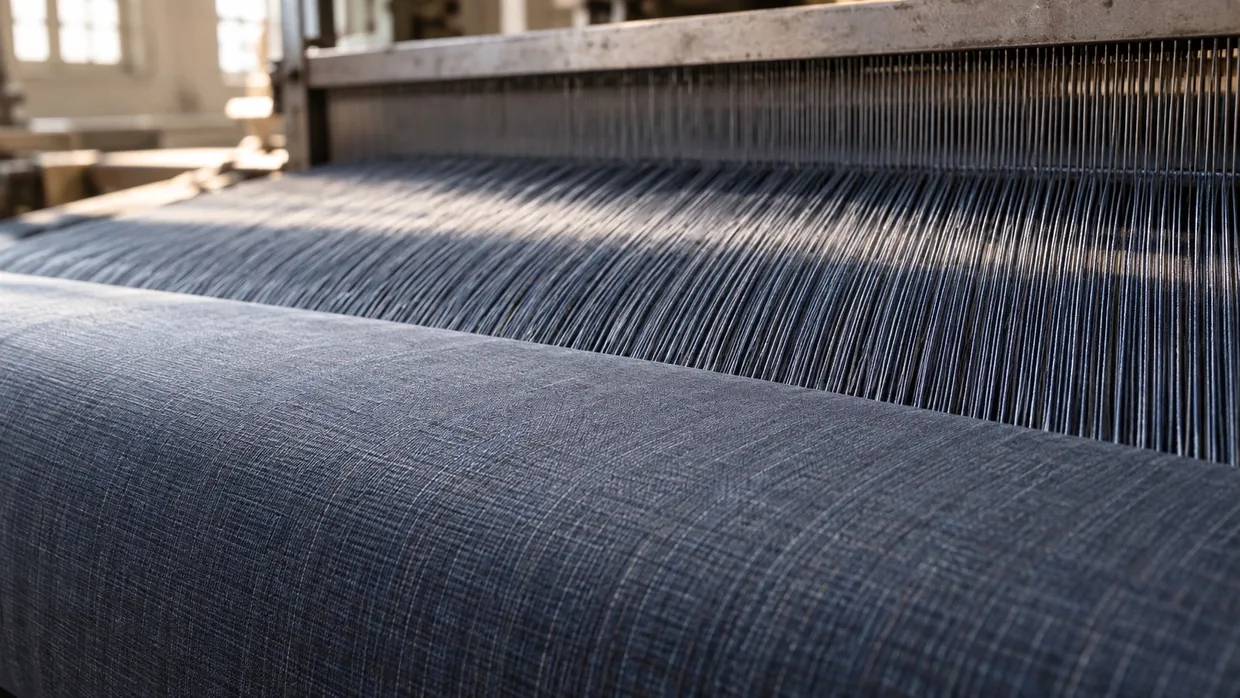
The chain from raw material to garment always runs in the same order: fiber is spun into yarn, yarn is woven or knitted into fabric, and fabric is cut and sewn into a garment. Weaving, the step we do in-house at Village Atoon in Bhilwara, is explained in how a loom works. This module starts one step earlier, because the fiber decides most of what the cloth can do. It decides how the cloth breathes, how it creases, how it takes colour and how it survives washing.
The family tree: natural, regenerated and synthetic
Every textile fiber sits on one branch of this tree. The first split is simple: was the fiber grown, or was it formed in a factory? Grown fibers are called natural. Factory-formed fibers are called man-made, often shortened in the trade to MMF (man-made fiber).
The man-made branch then splits in two, and this is where beginners get confused. Some man-made fibers start from a natural raw material, usually wood pulp. The pulp is chemically dissolved and pushed back out as a new fiber. These are regenerated cellulose fibers. Others are built up from small petrochemical molecules into long chains called polymers. These are synthetic fibers. Viscose and polyester are both man-made, but only polyester is synthetic.
Natural fibers: grown, then cleaned
Natural fibers come in two kinds. Plant fibers are made mostly of cellulose, the same material that gives plants their structure. Cotton grows as fluffy hairs attached to the seed of the cotton plant; linen comes from the stem of the flax plant. Animal fibers are made of protein. Wool is sheep fleece; silk is spun by the silkworm as it builds its cocoon.
Because they are grown, natural fibers vary with weather, soil and season. Two crops of cotton can differ in length, fineness and colour, which is one reason cotton shades and prices move from year to year. Cotton is the most important natural fiber for uniforms, and it gets its own lesson next.
Regenerated cellulose: natural raw material, factory fiber
Viscose, modal and lyocell all begin as cellulose from wood pulp. The pulp is dissolved into a thick liquid. The liquid is forced through a spinneret (a metal plate with many tiny holes, a little like a shower head), and the streams are set into solid fiber again. The chemistry is the same family as cotton, so these fibers absorb moisture, feel cool and soft, and take dye readily.
Modal and lyocell are cousins of viscose made by different routes, with differences in wet strength and softness. In uniform cloth, viscose is the one you meet most, blended with polyester as poly-viscose (also called TR in the trade). How much viscose goes into that blend, and why, is the subject of poly-viscose ratios explained.
Synthetic fibers: built from petrochemicals
Synthetic fibers are made by joining small molecules derived from crude oil and natural gas into long polymer chains, melting or dissolving the polymer, and pushing it through a spinneret. Polyester is by far the largest synthetic fiber in apparel. Nylon, acrylic and elastane complete the main group.
Synthetics are strong, consistent from lot to lot and quick to dry, but most absorb very little water, so on their own they can feel warm and clammy. That is why uniform fabric so often blends polyester with viscose or cotton: polyester brings strength, shape and easy care; the cellulose fiber brings comfort. The full journey from crude oil to polyester fiber is the third lesson in this module, and how it behaves in cloth is covered in polyester suiting for uniforms.
Staple versus filament
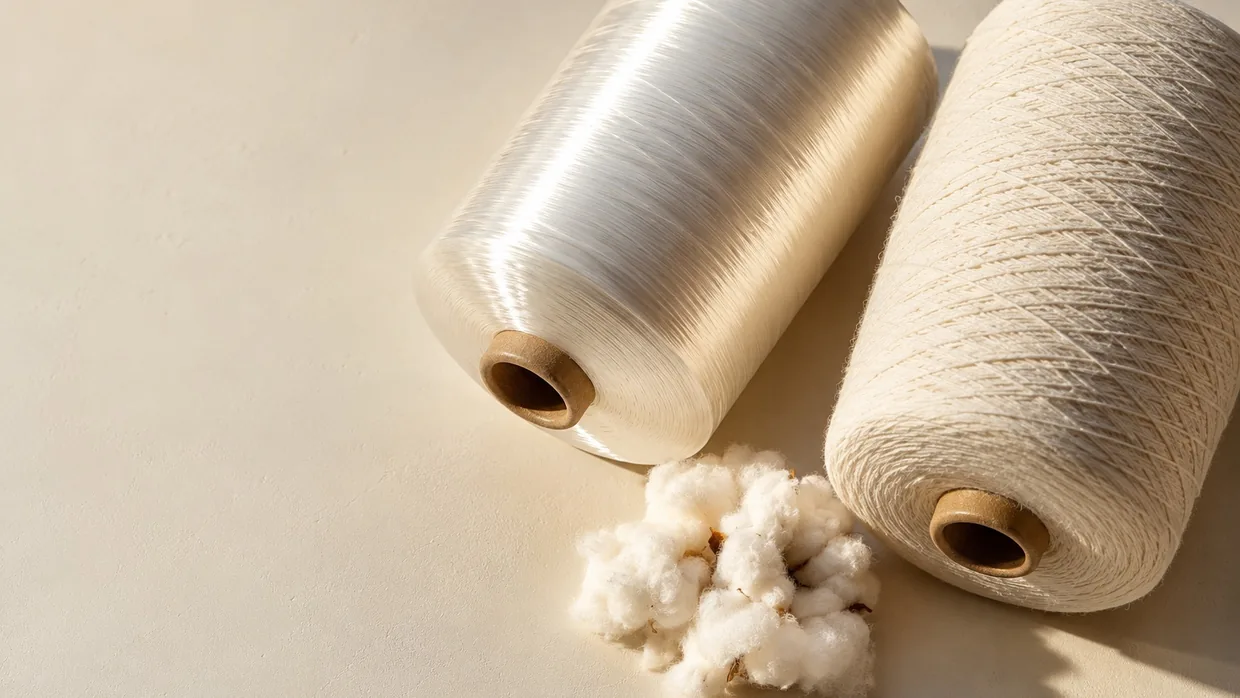
The second way to sort fibers is by length. Staple fibers are short pieces, measured in millimetres or a few centimetres. On their own they would fall apart, so they must be twisted together, a process called spinning, to make a yarn. Cotton, wool and linen are naturally staple. Staple yarns have tiny fiber ends sticking out, which gives a softer, more matte, more natural feel.
Filament is one continuous strand that can run for kilometres. Silk is the only natural filament. Man-made fibers come out of the spinneret as filament and can be used that way, giving smooth, lustrous yarn, or cut into staple so they can be spun and blended with cotton or viscose. Polyester staple fiber (PSF) and polyester filament are the same polymer in two different forms. If a spec sheet says spun polyester, it means staple; filament and texturised filament are covered in texturised yarn in suiting.
Why this matters when you buy uniform fabric
- Comfort: cellulose fibers (cotton, viscose, linen) absorb moisture; most synthetics do not. The blend ratio decides how a shirt feels after eight hours.
- Durability and easy care: synthetics resist creasing, shrinking and abrasion better, which matters under institutional laundry.
- Colour: different fibers need different dye classes, so a blend is dyed in more than one step. See why uniform fabrics fade.
- Feel and look: staple yarns read soft and matte; filament yarns read smooth and bright.
- Price movement: each fiber follows its own raw material, crop weather for cotton, crude oil for polyester, wood pulp for viscose. A later lesson in this module explains what moves fiber prices.
The composition line on a fabric spec, such as 65/35 polyester viscose, tells you which branches of the tree the cloth came from. Every term used here is also in the glossary. Next lesson: cotton, from field to bale.
FAQ
Frequently asked questions
- Is viscose a natural or a synthetic fiber?
- Neither, strictly. Viscose is a man-made regenerated cellulose fiber: its raw material is natural wood pulp, but the fiber itself is formed in a factory. It behaves much like cotton (absorbent, soft, easy to dye) rather than like polyester.
- What is the difference between man-made and synthetic?
- Man-made is the wider group: any fiber formed in a factory. Synthetic is the part of that group built from petrochemicals, such as polyester and nylon. All synthetics are man-made, but regenerated fibers like viscose are man-made without being synthetic.
- Which fiber is best for uniforms?
- There is rarely one best fiber. Most uniform fabric is a blend, typically polyester with viscose or cotton, because polyester gives strength and easy care while the cellulose fiber gives comfort. The right ratio depends on climate, wash routine and the role.
- How can I tell what fiber a fabric is made of?
- Start with the composition on the spec sheet or selvedge label. A burn test at home gives a rough idea: natural cellulose burns like paper, while polyester melts and forms a bead. But only a lab fiber analysis gives a reliable blend percentage.
- Does Benny Cotts make its own fiber or yarn?
- No. We buy yarn and weave it into fabric in-house at Village Atoon, Bhilwara, with dyeing, processing, finishing and testing done at partnered Bhilwara process houses. These fiber lessons are general industry explainers so you can read a spec with confidence.
Cite this guide
Quoting this page? Paste the line below so the credit links back.
<a href="https://www.bennycotts.com/guides/what-is-a-fiber-natural-man-made-synthetic">What Is a Fiber? Natural, Man-Made and Synthetic</a>, Benny Cotts, 2026Next in Fibers
Cotton: From Field to Bale
More in Fibers
- What Is a Fiber? Natural, Man-Made and Synthetic
- Cotton: From Field to Bale
- Polyester: From Crude Oil to Fiber
- Viscose: Fiber From Wood Pulp
- Wool, Linen, Nylon and Elastane: The Rest of the Fiber Family
- What Moves Fiber Prices: Cotton, Polyester and Viscose
- Blends Compared: Poly-Viscose, Poly-Cotton, Cotton and Polyester
- Poly-Viscose vs Cotton for Uniforms: 7 Differences
- Poly-Viscose and Poly-Cotton Ratios Explained: The Manufacturing Reasons Behind Each Blend
- Why 65/35 Is a Common Ratio for Uniform Shirting
- 100% Polyester Suiting for Uniforms: Where It Wins and Where It Loses
- Stretch and Lycra Uniform Fabric, Explained
Updated 12 October 2026 · Benny Cotts, Bhilwara
Fabrics
Fabrics mentioned in this guide
Spec, price and MOQ on every fabric page.

Power Gold
Premium Poly-Viscose blend · 230-250 GSM
Our premium-line suiting with a refined hand and superior drape.

Benzer Special
Poly-Viscose blend · 200-220 GSM
Versatile PV blend optimized for uniform programs at scale.

Spun Shirting
Micro 1/40s spun polyester · 67 GSM
Lightweight micro shirting, spun 1/40s count, in 74 shades.

Cambery
Poly-cotton blend · 150-180 GSM
Chambray-style fabric with a soft, breathable finish.
Industries this applies to
Uniform programs these fabrics are used for
- Fabric for Business Attire
- Fabric for Corporate Shirts
- Fabric for Blazers & Waistcoats
- Fabric for School Uniforms
- Fabric for College & University Uniforms
- Fabric for Sports & PT Uniforms
- Fabric for Pre-School & Kindergarten Uniforms
- Fabric for Nurse Scrubs
- Fabric for OT & Surgical Wear
- Fabric for Patient Gowns
- Fabric for Hotel Uniforms
- Fabric for Chef Coats
- Fabric for Waiter Uniforms
- Fabric for Salon & Spa Uniforms
- Fabric for Cabin Crew Uniforms
- Fabric for Business Suits
- Fabric for Black-Tie Attire
- Fabric for Formal Event Wear
Fabric types covered here
Keep reading
Related guides



Ready to place an enquiry?