
Textile Decoded
Viscose: Fiber From Wood Pulp
How viscose is made from wood: dissolving pulp, the xanthate route, spinning into an acid bath, why it is natural-based but man-made, and how modal and lyocell differ.
Jump to section
Quick answer
Viscose is made from the cellulose in wood. Trees are pulped into a purified sheet called dissolving pulp, which is treated with caustic soda and carbon disulphide until it dissolves into a thick, honey-like liquid. That liquid is pushed through a spinneret into an acid bath, where the cellulose turns solid again as fine filaments. These are washed and usually cut into staple fiber. The raw material is natural, but the fiber is formed in a factory, which is why viscose is called a regenerated or man-made cellulosic fiber. Modal and lyocell are close cousins made from the same kind of pulp by different routes.
Natural-based, but man-made
Fibers sort into three families. Natural fibers, like cotton and wool, are grown as fibers. Synthetic fibers, like polyester and nylon, are made from petrochemicals. Viscose sits in between: it is a regenerated cellulose fiber. Cellulose is the material plant cell walls are built from, and cotton is almost pure cellulose. Wood is also mostly cellulose, but its cellulose is locked in short, stiff cells that cannot be spun. Viscose making dissolves that cellulose and then regenerates it. This means it turns the cellulose back into solid form, shaped as a long, fine fiber.
So chemically, viscose is cellulose, like cotton. That is why the two share many traits: they absorb moisture, breathe well, take dye readily and burn like paper rather than melting. But the fiber itself is shaped by a machine, so it counts as man-made. In some markets it is also called rayon. Fabrics sold as bamboo are, in nearly every case, viscose made from bamboo pulp, not a fiber grown in the plant.
Step one: dissolving pulp
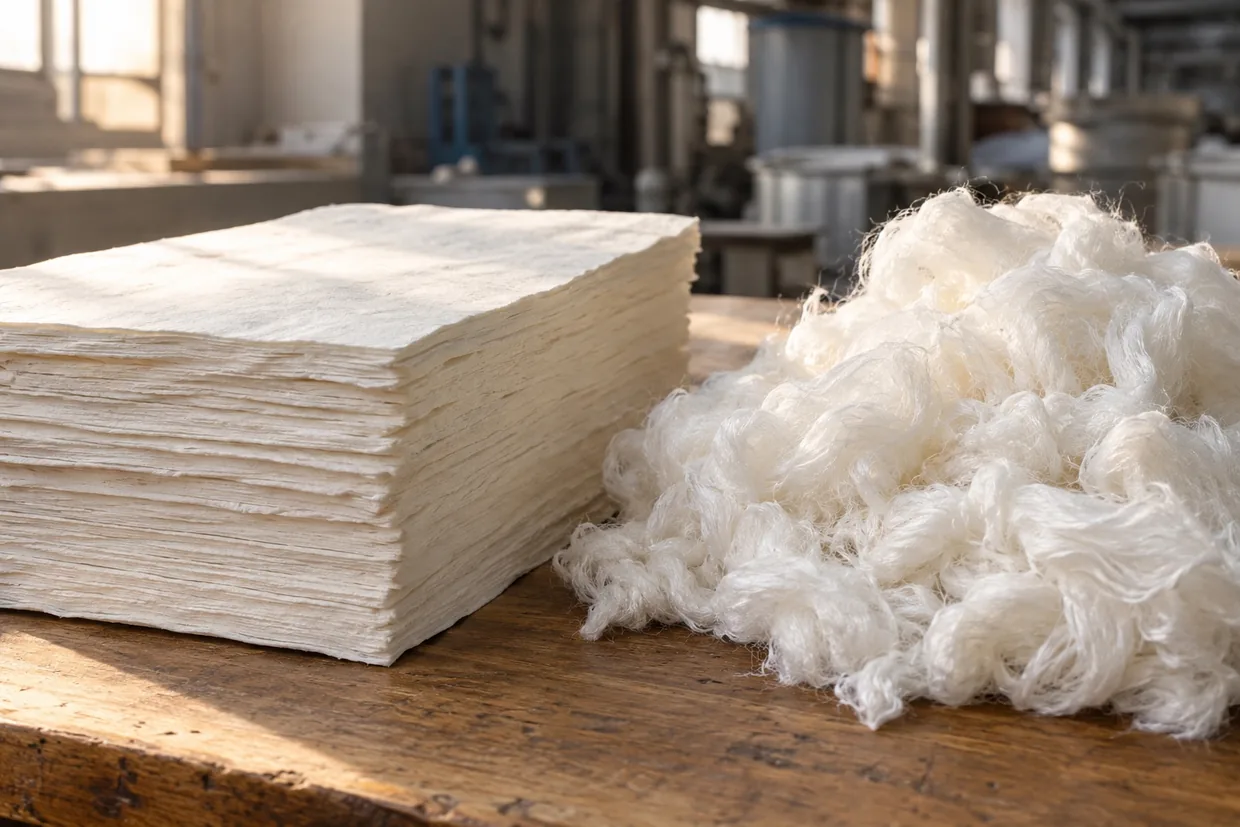
The starting point is dissolving pulp, a very pure grade of wood pulp, made from fast-growing trees such as eucalyptus, beech and pine, or from bamboo. Wood chips are cooked with chemicals to strip out lignin (the natural glue that holds wood fibers together) and other non-cellulose material. What remains is bleached and pressed into thick white sheets, similar in look to blotting paper. The glossary entry for dissolving pulp notes the other source: refined cotton linter, the short fuzz left on cotton seed after ginning.
Dissolving pulp is a different product from the pulp used for paper. It must be much purer, because anything that is not cellulose causes problems later in spinning. Only a limited number of pulp mills make it. This is one reason viscose prices follow pulp supply closely.
How viscose is made, step by step
The classic viscose process has changed little in principle since it was developed over a century ago. It takes the cellulose apart just enough to dissolve it, then puts it back together:
- Steeping: the pulp sheets are soaked in caustic soda (sodium hydroxide), which swells the cellulose and makes alkali cellulose. Excess liquid is pressed out and the sheets are shredded into crumbs.
- Ageing: the crumbs rest under controlled conditions so the cellulose chains shorten slightly, which sets how thick the final solution will be.
- Xanthation: the crumbs are reacted with carbon disulphide (a chemical that evaporates easily), turning them into an orange compound called cellulose xanthate.
- Dissolving: the xanthate dissolves in dilute caustic soda to give a thick golden solution. This viscous liquid is what gave viscose its name.
- Ripening and filtering: the solution is rested, filtered and freed of air bubbles so it spins cleanly.
- Wet spinning: the solution is pumped through a spinneret, a plate with many fine holes, into a bath of dilute sulphuric acid. The acid breaks down the xanthate and the cellulose regenerates as solid filaments. Because the fiber forms in a liquid bath, this is called wet spinning.
- Stretching, washing and cutting: the filaments are stretched to align them, washed free of chemicals, and usually cut into staple fiber, then dried and baled.
Polyester is made by melting plastic. Viscose cannot be melted, because cellulose scorches before it melts. That is why it needs a chemical route to become a liquid at all. Compare the two in our lesson on how polyester is made.
Staple and filament viscose
Like polyester, viscose comes as staple or filament. Viscose staple fiber is cut to lengths that match cotton or polyester staple so it can be blended on the same spinning machinery, and it is the form used in poly-viscose suiting and shirting. Viscose filament yarn keeps each strand continuous and is used for linings and smooth, lustrous dress fabrics.
Delustrant (an additive that reduces shine) is added here too. Plain viscose has a soft sheen, and titanium dioxide in the solution gives the duller, more wool-like look preferred in most uniform suiting. Spun-dyed or dope-dyed viscose has pigment added to the solution before spinning, so the colour is inside the fiber from the start.
What viscose brings to a fabric
Viscose is soft, drapes well and feels cool. It absorbs more moisture than cotton: its moisture regain, the water it holds from normal air, is around 11 to 13 percent, against about 0.4 percent for polyester. That is the comfort half of a poly-viscose blend. It also takes dye evenly, which helps shade consistency from lot to lot.
Its main weakness is wet strength. Viscose loses a large part of its strength when wet and can stretch or distort while wet, so all-viscose garments need gentle washing. Blending with polyester solves most of this, which is the whole logic of poly-viscose. Our guide to poly-viscose ratios explains how the split between the two fibers changes handle, strength and laundering.
Modal and lyocell: the cousins
Modal and lyocell start from the same dissolving pulp but take different routes, and the differences show in the fabric.
| Fiber | How it is made | What it is like |
|---|---|---|
| Viscose | Classic xanthate route, spun into an acid bath | Soft, absorbent, good drape; weak when wet |
| Modal | A modified viscose route, adjusted to give a more ordered fiber structure | Silkier, holds strength and shape better when wet, less shrinkage than viscose |
| Lyocell | Pulp dissolved directly in an organic solvent, no xanthate step; the solvent is recovered and reused | Strongest of the three, wet or dry; smooth; can fibrillate (develop a fine surface fuzz) if not finished for it |
Lyocell appears in our glossary, where it is noted that lyocell and viscose compete for the same pulp. In uniform fabric, plain viscose remains the usual partner for polyester; modal and lyocell appear more in premium shirting and knitwear.
The environmental picture, factually
Viscose is often marketed as natural or eco, but the honest picture has two sides. On one side, the raw material is renewable wood. The cellulose in the fiber can biodegrade in the right conditions, unlike polyester, although dyes and finishes affect this in a finished fabric.
On the other side, the process is chemically intensive. Carbon disulphide is toxic. Plants without good capture and recovery systems have been linked to air and water pollution and to worker health concerns. Pulp sourcing also matters, because wood from poorly managed or protected forests carries a deforestation risk. Producers address these through chemical recovery, closed-loop processing and certified forest sourcing. Lyocell's solvent route avoids carbon disulphide altogether.
For a buyer, the practical point is that viscose is neither automatically green nor automatically harmful. It depends on how and where the fiber was made, and the proof is in the fiber producer's documents. Our guide to sustainability certifications explains what the common schemes do and do not cover.
Brands that buy finished garments increasingly ask where the wood came from, not just what the fiber is. Canopy, a forest conservation group, rates the large viscose, modal and lyocell producers every year in what it calls the Hot Button report, and many brands use it when they choose suppliers. Its criteria for 2027, reported by Fibre2Fashion in October 2026, give an automatic red rating to any producer with known high-risk forest sourcing, whatever else it does well. A red rating does not mean the fiber is banned, and not every brand buys only from green-rated producers. The useful step is simpler: before an order, ask the mill which producer made the viscose in the yarn, and check that producer's current rating and audit status yourself.
Where Benny Cotts fits
We do not make viscose fiber or spin yarn. Viscose fiber comes from a few large producers, spinning mills blend it with polyester into yarn, and we buy that yarn and weave it in-house at Village Atoon, Bhilwara. Dyeing and finishing then happen at partnered Bhilwara process houses.
Next in this module: wool, linen, nylon and elastane, the rest of the fiber family, and where each turns up in suiting and uniforms.
FAQ
Frequently asked questions
- Is viscose a natural or a synthetic fiber?
- Neither, strictly. It is a regenerated cellulose fiber: the raw material is natural cellulose from wood, but the fiber is formed in a factory. It behaves much more like cotton than like polyester, because chemically it is cellulose.
- Are viscose and rayon the same thing?
- Yes, in everyday trade use. Rayon is the older and broader name for regenerated cellulose fibers, and viscose rayon is the most common type. In India and much of the fabric trade it is simply called viscose.
- Is bamboo fabric really made from bamboo?
- The pulp is, but in almost every case the fiber is viscose made from bamboo pulp, using the same chemical process as wood-based viscose. It behaves like viscose, not like a separate natural bamboo fiber.
- Why does viscose shrink or lose shape in the wash?
- Viscose absorbs a lot of water and becomes much weaker while wet, so agitation and heat can stretch or shrink it. Blending with polyester, as in poly-viscose, and following the care label largely solves this.
- Is modal or lyocell better than viscose for uniforms?
- They are stronger when wet and often softer, but they are less common in uniform suiting, where poly-viscose is the standard. If you want to compare real fabrics, use Request Catalog on our quote page and tell us how the garments will be worn and washed.
Cite this guide
Quoting this page? Paste the line below so the credit links back.
<a href="https://www.bennycotts.com/guides/viscose-fiber-from-wood-pulp">Viscose: Fiber From Wood Pulp</a>, Benny Cotts, 2026Next in Fibers
Wool, Linen, Nylon and Elastane: The Rest of the Fiber Family
More in Fibers
- What Is a Fiber? Natural, Man-Made and Synthetic
- Cotton: From Field to Bale
- Polyester: From Crude Oil to Fiber
- Viscose: Fiber From Wood Pulp
- Wool, Linen, Nylon and Elastane: The Rest of the Fiber Family
- What Moves Fiber Prices: Cotton, Polyester and Viscose
- Blends Compared: Poly-Viscose, Poly-Cotton, Cotton and Polyester
- Poly-Viscose vs Cotton for Uniforms: 7 Differences
- Poly-Viscose and Poly-Cotton Ratios Explained: The Manufacturing Reasons Behind Each Blend
- Why 65/35 Is a Common Ratio for Uniform Shirting
- 100% Polyester Suiting for Uniforms: Where It Wins and Where It Loses
- Stretch and Lycra Uniform Fabric, Explained
Updated 20 October 2026 · Benny Cotts, Bhilwara
Fabrics
Fabrics mentioned in this guide
Spec, price and MOQ on every fabric page.

Officer Choice
Poly-Viscose (PV) blend · 210-230 GSM
Crisp, structured suiting engineered for officer uniforms.

Benzer Special
Poly-Viscose blend · 200-220 GSM
Versatile PV blend optimized for uniform programs at scale.

Commander PV Ultima Shirting
Poly-Viscose (PV Ultima), 2/40 x 2/40 premium, 2/40 x 1/20 standard
PV Ultima spun shirting in 135 shades, 36" and 58", grey ready year-round.
Industries this applies to
Uniform programs these fabrics are used for
- Fabric for Corporate Shirts
- Fabric for Corporate Trousers
- Fabric for School Uniforms
- Fabric for College & University Uniforms
- Fabric for Sports & PT Uniforms
- Fabric for Pre-School & Kindergarten Uniforms
- Fabric for Hotel Uniforms
- Fabric for Waiter Uniforms
- Fabric for Ground Staff Uniforms
- Fabric for Army Uniforms
- Fabric for Police Uniforms
- Fabric for Security Guard Uniforms
- Fabric for Industrial Uniforms
- Fabric for Construction Workwear
Fabric types covered here
From the blog
Keep reading
Related guides


Ready to place an enquiry?