Fabric basics
Why 65/35 Is a Common Ratio for Uniform Shirting
What the polyester share and the cotton or viscose share each do in a uniform shirting blend, why 65/35 keeps turning up, and what moving the ratio either way trades off.
Jump to section
- What the numbers mean
- What the polyester share does
- What the cotton share does
- Moving the ratio either way
- Who buys 65/35 and why
- How a 65/35 shirt behaves in wear
- Care and laundering a 65/35 shirt
- Climate: Indian summer and monsoon
- Common buyer mistakes with shirting ratios
- How to specify shirting on an order
- Poly-cotton or poly-viscose for shirting
Quick answer
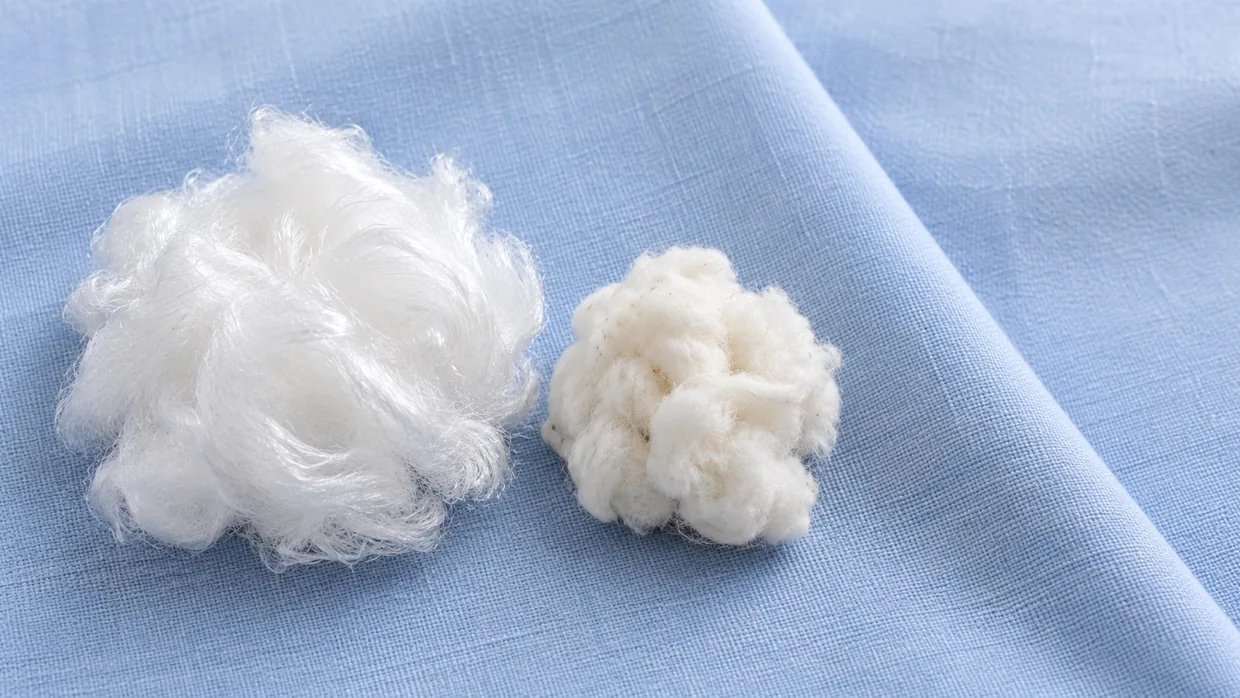
65/35 means 65 percent polyester and 35 percent cotton (or viscose) by weight. It is a common shirting ratio because polyester is in the majority. That is enough for the shirt to recover from creases, hold its size and stay strong through repeated washing. The cotton share is still large enough for absorbency and a familiar feel. It is a compromise, not a rule. More polyester means an easier-care but warmer, less absorbent shirt. More cotton means a cooler, softer shirt that creases and moves more in the wash.
What the numbers mean
A blend ratio is a proportion by weight of the fibers spun together into the yarn, polyester first. 65/35 poly-cotton is 65 percent polyester and 35 percent cotton; 65/35 PV is the same split with viscose in place of cotton. The fibers are blended before spinning, so the ratio runs through every thread rather than sitting on the surface. How blends are spun and labelled is covered in yarn counts and blends explained.
This guide stays on the shirting question. The wider case for 65/35 across suiting, and how ratio interacts with GSM and weave, is set out in poly-viscose and poly-cotton ratios explained.
What the polyester share does
- Crease recovery: polyester is thermoplastic (it softens with heat and can be set in shape). It is set by heat during processing and springs back towards that shape after creasing. On a polyester-rich blend, easy-care comes from the fiber rather than an applied finish, as explained in easy-care and wrinkle recovery in shirting.
- Dimensional stability: polyester takes up very little water. The official moisture regain (the water a fiber takes up from the air) used in textile trade calculations is 0.4 percent for polyester against 8.5 percent for cotton. So the polyester share barely swells in the wash, which helps hold the shirt's size. See fabric shrinkage explained.
- Strength and abrasion: polyester is a strong fiber, and the polyester share helps collars, cuffs and seams stand up to repeated institutional laundering.
What the cotton share does
- Absorbency: cotton takes up sweat that polyester alone would leave on the skin, which matters for a shirt worn a full shift.
- Handle: a cotton share gives a drier, more natural feel against the skin than an all-polyester shirting.
- The trade-off: cotton is the part that creases and moves in washing. The more cotton in the blend, the more a shirt relies on careful laundering or a resin finish for a crisp look.
Moving the ratio either way
| Direction | Gains | Gives up |
|---|---|---|
| More polyester (80/20, 100% polyester) | Faster drying, sharper crease recovery, size held through hot washing | Absorbency and a cotton-like feel; can feel warm and clammy on a long shift |
| Around 65/35 | Most of polyester's easy-care with a meaningful cotton share | Neither as cool as cotton-rich nor as carefree as polyester-rich |
| More cotton (50/50, CVC, 100% cotton) | Cooler, softer, more absorbent | More creasing and shrinkage risk; often needs a resin finish for easy-care |
Pilling and whiteness also shift with the blend: see fabric pilling explained and why white shirting yellows and greys.
Who buys 65/35 and why
Shirting is worn against the skin, laundered often and judged up close. That is why the ratio matters more here than in trousers. Schools use 65/35 for uniform shirts because it survives a year of weekly and sometimes daily washing and still looks tidy. Corporates like it for shirts that need to look fresh by afternoon. Hospitality and security buyers use it where garments go through bulk laundry.
It is also a safe starting point for a buyer who is unsure. It is rarely the best at any one thing, but it has no serious weakness for ordinary institutional use.
How a 65/35 shirt behaves in wear
- Comfort: more comfortable than all-polyester because the cotton or viscose share takes up some sweat. Less cool than a cotton-rich shirt.
- Creases: they fall out faster than in cotton. A quick iron or a hang-dry usually finishes the job.
- Colour: white and light shades stay fresher, and dark shades fade less than in cotton. See why uniform fabrics fade.
- Pilling: the polyester share can form pills at cuffs, collars and under bag straps if the yarn is poor. Better spinning and finishing reduce it.
- Collars and cuffs: they hold shape better, especially with good fusing and interlining.
- Opacity: a lighter shirting can show the skin or undershirt, so check GSM and opacity.
Care and laundering a 65/35 shirt
- Wash warm, with normal detergent. Boiling water is not needed and shortens colour life.
- Avoid chlorine bleach, and do not over-dry. Heat that is too high can leave the cloth stiff or shiny.
- Take shirts out of the dryer while slightly damp and hang them. This cuts creases and saves ironing.
- Iron on a medium setting. Polyester can glaze under a very hot iron.
- Wash whites separately. Polyester can pick up stray dye from darker clothes in the same load.
For a wash sheet to give a laundry or a school, see uniform fabric care and washing instructions.
Climate: Indian summer and monsoon
In peak summer, a 65/35 shirt in a light GSM and a relaxed cut is usually comfortable indoors. For outdoor staff, a cotton-richer blend (50/50 or CVC) may feel cooler, at the cost of more ironing.
In the monsoon, the polyester majority helps. The shirt dries faster than cotton and is less likely to smell musty in a bag. PV shirting with a large viscose share dries more slowly and is weaker when wet, so handle it gently. Uniform fabric for hot, humid climates covers this in more depth.
Common buyer mistakes with shirting ratios
- Treating 65/35 as a standard and not asking for the ratio in writing. Check it on every quote.
- Assuming 65/35 poly-cotton and 65/35 PV are the same. Cotton is stronger wet and takes dye differently from viscose.
- Choosing by feel alone. A soft shirting can be light in GSM and turn see-through or pill early.
- Not testing shrinkage and colour fastness on a sample before bulk.
- Going to 80/20 or more to save money and then finding the shirt hot to wear on a long shift.
- Mixing fabrics from different lots for one program without a shade check.
How to specify shirting on an order
- Blend and ratio, polyester first, such as polyester-cotton 65/35.
- GSM and width. Shirting often comes in 36 and 58 inch widths, as in shirting width 36 vs 58.
- Weave: plain, twill, dobby or chambray. See dobby and chambray explained.
- Shade, with an approved swatch and agreed tolerance.
- Expected shrinkage, colour fastness and pilling, using the spec sheet guide.
We weave in-house at Village Atoon. Dyeing, processing, finishing and testing happen with partnered process houses in Bhilwara. For the difference between shirting and suiting cloth, see suiting vs shirting fabric.
Poly-cotton or poly-viscose for shirting
The same ratio logic applies to PV shirting, with viscose in the cotton's place: softer and more fluid, but weaker when wet. Commander Shirting is PV 70/30 at 168 GSM in 36 and 58 inch widths, a little further towards polyester than 65/35. Cambery is a poly-cotton chambray at 150 to 180 GSM. For the wider fiber choice, see poly-viscose vs cotton for uniforms and all four blends compared.
Whichever blend you choose, ask for the ratio in writing on the quote alongside GSM and weave, because the same ratio can feel very different across constructions. To compare shirtings in hand, Request Catalog.
FAQ
Frequently asked questions
- Is 65/35 the industry standard for shirting?
- It is a common ratio rather than a fixed standard. Shirting is also woven at 80/20, 50/50, CVC (cotton-majority) and 100% cotton, and PV shirting at 70/30 and other splits. The right ratio depends on climate, laundering and how much easy-care the programme needs.
- Does 65/35 poly-cotton still need a wrinkle-resistant finish?
- Often less than cotton-rich cloth, because the polyester majority supplies recovery on its own. Resin durable press finishes are still applied to polyester-cotton blends when a crisper result is wanted, mainly to control the cotton share.
- Will a 65/35 shirt shrink?
- Less than all-cotton, because polyester absorbs very little water, but the cotton share can still move. Ask for a shrinkage figure on the spec sheet rather than assuming.
- Is 65/35 better than 80/20 for a school shirt?
- It depends on the child and the climate. 80/20 lasts longer and dries faster but feels warmer. 65/35 is more comfortable in the heat and still easy to care for. Most schools in warm regions pick 65/35 for shirts.
- Does 65/35 poly-cotton fade or yellow over time?
- Less than cotton in colour, but white shirting can still dull or yellow if it is washed with colours, over-bleached or stored damp. Wash whites separately and follow the care label. See the yellowing guide.
- Can I mix 65/35 and 80/20 shirts in the same uniform program?
- It is better not to. Different ratios dye and fade a little differently, so shades can drift apart after a few washes. Keep one ratio and one approved shade across a program.
- Is 65/35 cooler than polyester?
- Generally yes, because the cotton share absorbs sweat that a 100% polyester shirt would not. It will not feel as cool as a cotton-majority shirt.
Cite this guide
Quoting this page? Paste the line below so the credit links back.
<a href="https://www.bennycotts.com/guides/why-65-35-poly-cotton-shirting">Why 65/35 Is a Common Ratio for Uniform Shirting</a>, Benny Cotts, 2026Next in Fibers
100% Polyester Suiting for Uniforms: Where It Wins and Where It Loses
More in Fibers
- What Is a Fiber? Natural, Man-Made and Synthetic
- Cotton: From Field to Bale
- Polyester: From Crude Oil to Fiber
- Viscose: Fiber From Wood Pulp
- Wool, Linen, Nylon and Elastane: The Rest of the Fiber Family
- What Moves Fiber Prices: Cotton, Polyester and Viscose
- Blends Compared: Poly-Viscose, Poly-Cotton, Cotton and Polyester
- Poly-Viscose vs Cotton for Uniforms: 7 Differences
- Poly-Viscose and Poly-Cotton Ratios Explained: The Manufacturing Reasons Behind Each Blend
- Why 65/35 Is a Common Ratio for Uniform Shirting
- 100% Polyester Suiting for Uniforms: Where It Wins and Where It Loses
- Stretch and Lycra Uniform Fabric, Explained
Updated 25 October 2026 · Benny Cotts, Bhilwara
Fabrics
Fabrics mentioned in this guide
Spec, price and MOQ on every fabric page.

Commander Shirting 58"
Poly-Viscose 70/30 · 168 GSM
Fine 1/20 poly-viscose shirting in a full 58-inch width.

Commander Shirting 36"
Poly-Viscose 70/30 · 168 GSM
Fine 1/20 poly-viscose shirting in a narrow 36-inch width.

Cambery
Poly-cotton blend · 150-180 GSM
Chambray-style fabric with a soft, breathable finish.
Industries this applies to
Fabric types covered here
Keep reading
Related guides




Ready to place an enquiry?