
Fabric basics
How a Loom Works: Parts and Motions of Weaving
Warp and weft, the nine main parts of a loom, the shed-pick-beat-up cycle, and how heald frames turn the same yarn into plain, twill or dobby cloth.
Jump to section
Quick answer
A loom makes cloth by crossing two sets of yarn at right angles. The warp runs lengthwise off a beam at the back. The weft is laid across it one row, or pick, at a time. Each cycle the heald frames lift some warp ends to open a gap called the shed, the weft is carried through it, and the reed beats it into the cloth. Repeat that a few hundred times per minute and the yarn becomes fabric.
Warp and weft: the two sets of yarn
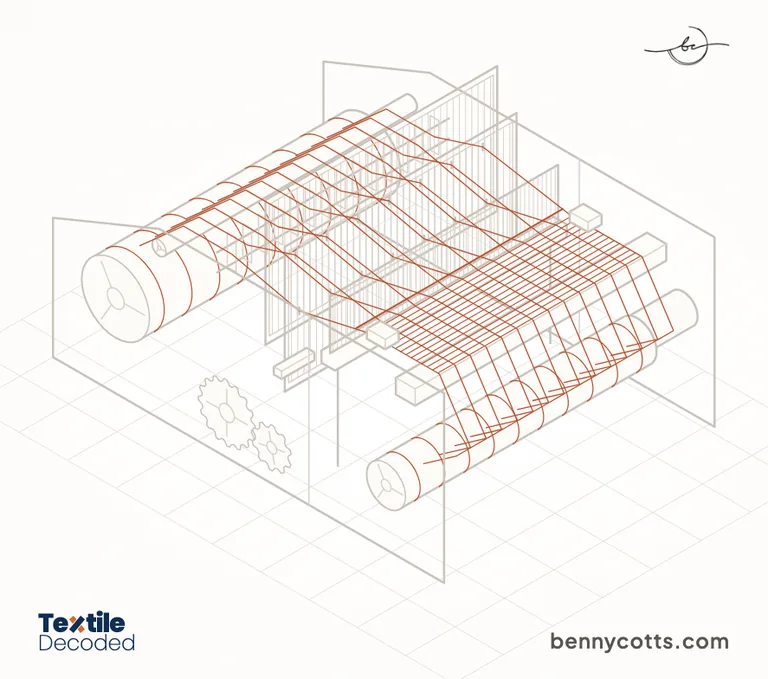
Every woven fabric is made of two sets of yarn. The warp is the lengthwise set: thousands of parallel threads, called ends, wound side by side onto a warp beam before weaving starts. The weft is the crosswise set: a single thread laid across the full width of the warp, one row at a time. Each row is called a pick.
The two sets do different jobs, so they are often different yarns. Warp is held under tension for the whole run and rubbed by the loom parts on every cycle, so it needs to be the stronger, more even yarn. It is usually sized (coated with a starch-like film) to protect it during weaving. Weft is under far less strain. This is why a fabric spec quotes warp and weft separately, for example 2/40s x 2/40s or 100 ends x 80 picks per inch. Our yarn counts guide explains how to read those numbers.
The nine parts of a loom
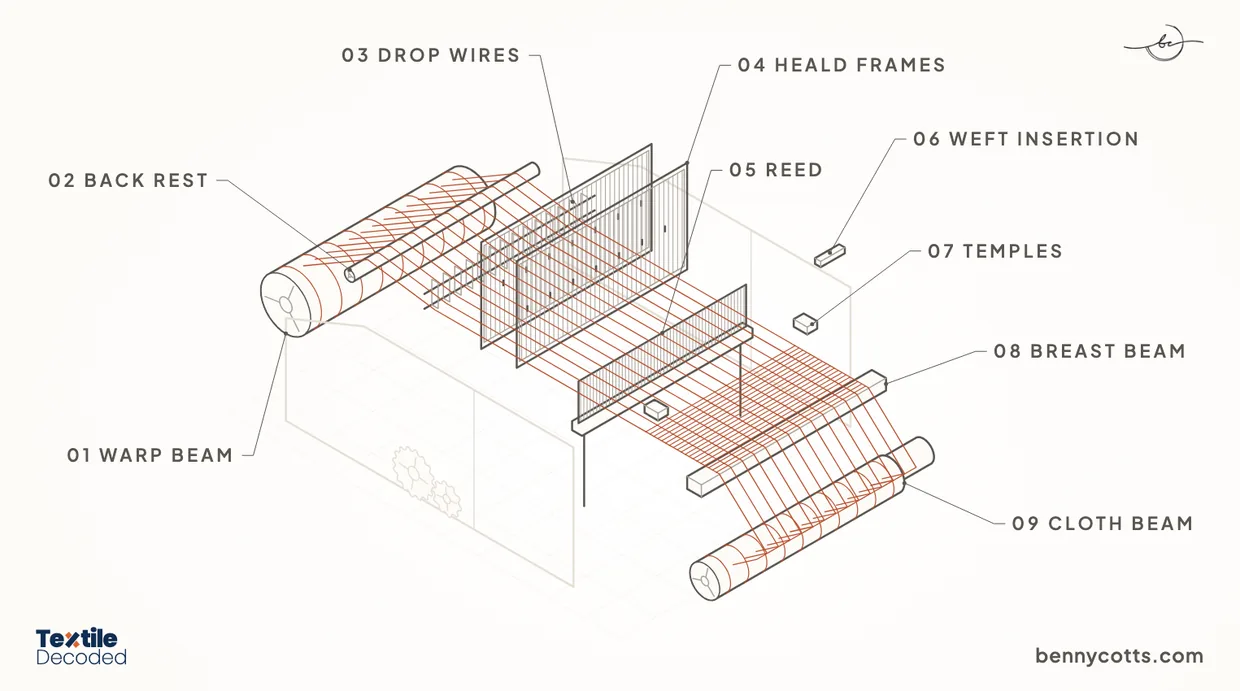
Looms differ in speed and in how they carry the weft, but the path the yarn takes is the same on all of them. Read from the back of the loom to the front:
| Part | What it does |
|---|---|
| Warp beam | Holds the warp, wound side by side, and releases it a little at a time. |
| Back rest | Guides the warp sheet into the loom and keeps tension even across the width. |
| Drop wires | A thin wire rides on every end. If an end breaks, its wire drops and the loom stops. |
| Heald frames | Each end is threaded through the eye of a heddle wire. The frames rise and fall to part the ends. |
| Reed | A fine comb. Its dents keep the ends evenly spaced and beat each new pick into the cloth. |
| Weft insertion | Carries the weft across the full width, through the opening in the warp. |
| Temples | Grip both edges of the cloth so it stays at full width while it is woven. |
| Breast beam | The front rail the newly woven cloth passes over. |
| Cloth beam | A take-up roller draws the cloth forward and the cloth beam winds up the finished fabric. |
Before any of this runs, every end has to be passed through its drop wire, its heddle eye and its reed dent in the right order. That step, called drawing-in, is done once per warp, and it fixes the weave pattern and the ends per inch for the whole run.
The weaving cycle: shed, pick, beat-up
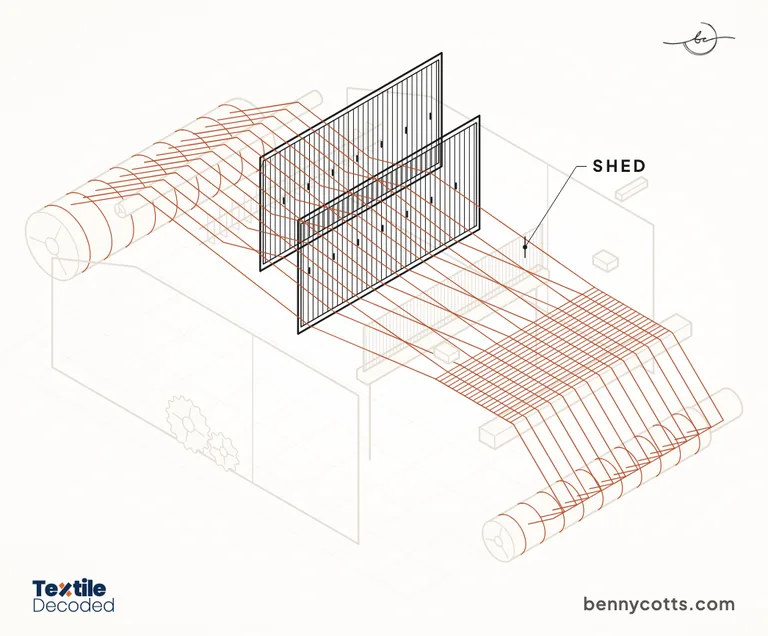
Weaving is one short cycle repeated pick after pick. Three primary motions make the cloth:
- Shedding: the heald frames lift some ends and lower the rest. The opening between the two layers is the shed.
- Picking: the weft is carried through the shed, across the full width. One crossing makes one pick.
- Beat-up: the reed swings forward and presses the new pick against the woven edge, which is called the fell of the cloth.
Then the frames change over, the ends that were up go down, and the new shed locks the last pick in place. That changeover is what makes the yarns interlace instead of lying loose.
Picking: how the weft crosses the warp
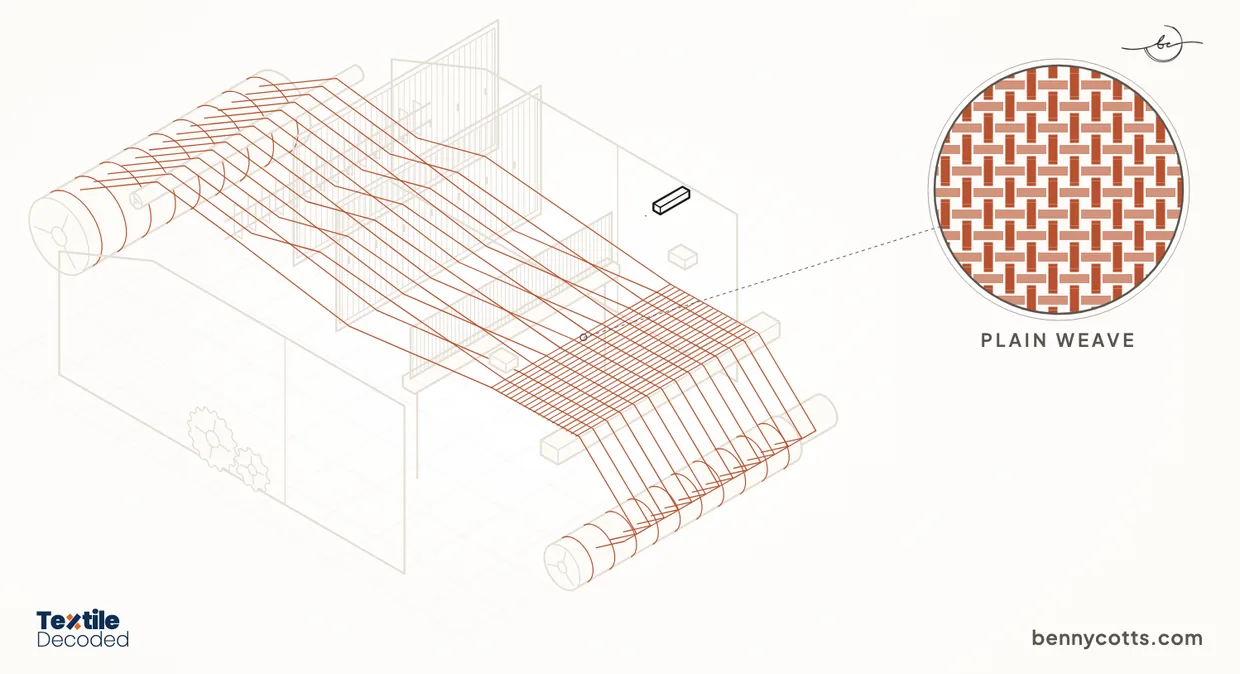
Picking is where looms differ most. Older looms throw a shuttle carrying a bobbin of weft from side to side. Shuttleless looms draw the weft from a large cone beside the loom. They carry it across with a rapier (a rigid or flexible arm), a jet of air, a small gripper projectile or a jet of water. The method changes the speed, the kinds of yarn the loom handles well, and how the edges of the cloth are finished. The principle stays the same: one pick per cycle, laid through an open shed.
On shuttleless looms the weft is cut at each edge, so the selvedge is formed by a separate tucking or leno device rather than by one continuous thread turning back. That is why selvedges look different from one mill to the next.
Beat-up, let-off and take-up
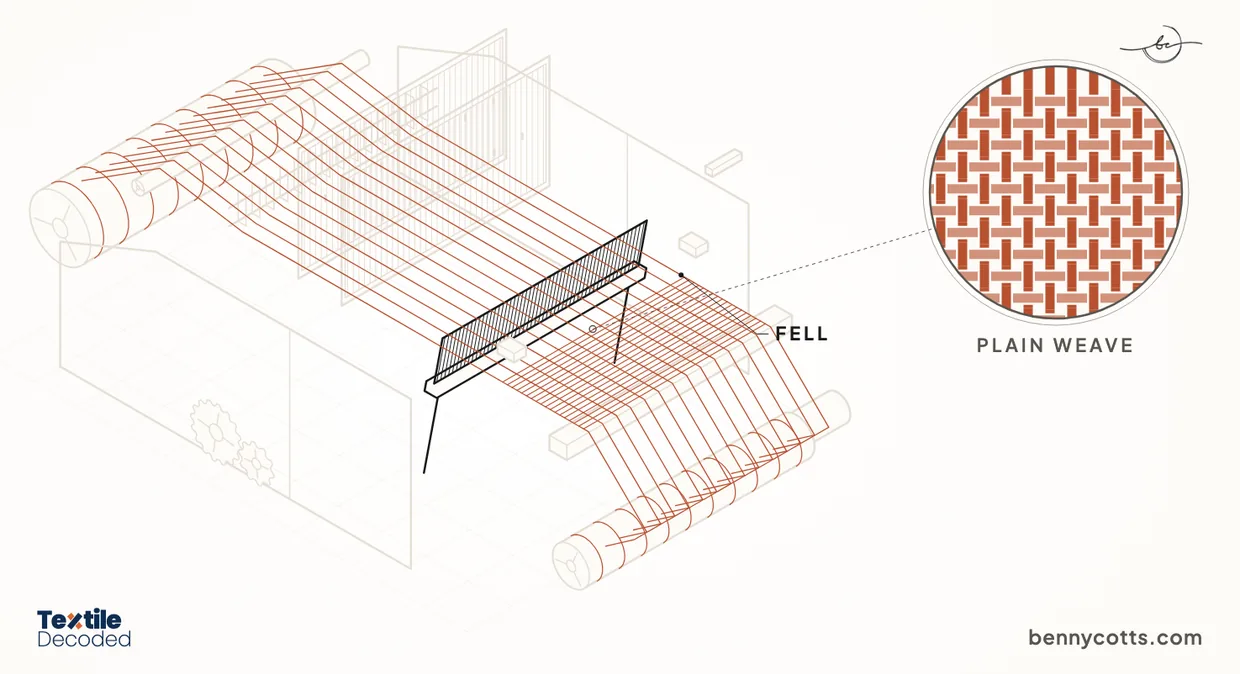
The reed does two jobs. Between beats it keeps the ends evenly spaced; the number of dents per inch and how many ends go through each dent set the fabric's ends per inch. On each beat it pushes the new pick hard against the fell, so the picks sit at an even spacing instead of wherever they landed.
Two secondary motions keep the cycle going. Let-off turns the warp beam forward a little so fresh warp is fed in at a steady tension. Take-up draws the woven cloth forward onto the cloth beam. The rate of take-up against the rate of picking sets the picks per inch: draw the cloth away slower and the picks pack closer together.
Uneven let-off or take-up shows up in the fabric as thick or thin places across the width, and a damaged reed shows as a lengthwise streak. Our guide to woven fabric defects covers what each fault looks like and who fixes it.
How the same loom makes plain, twill and dobby
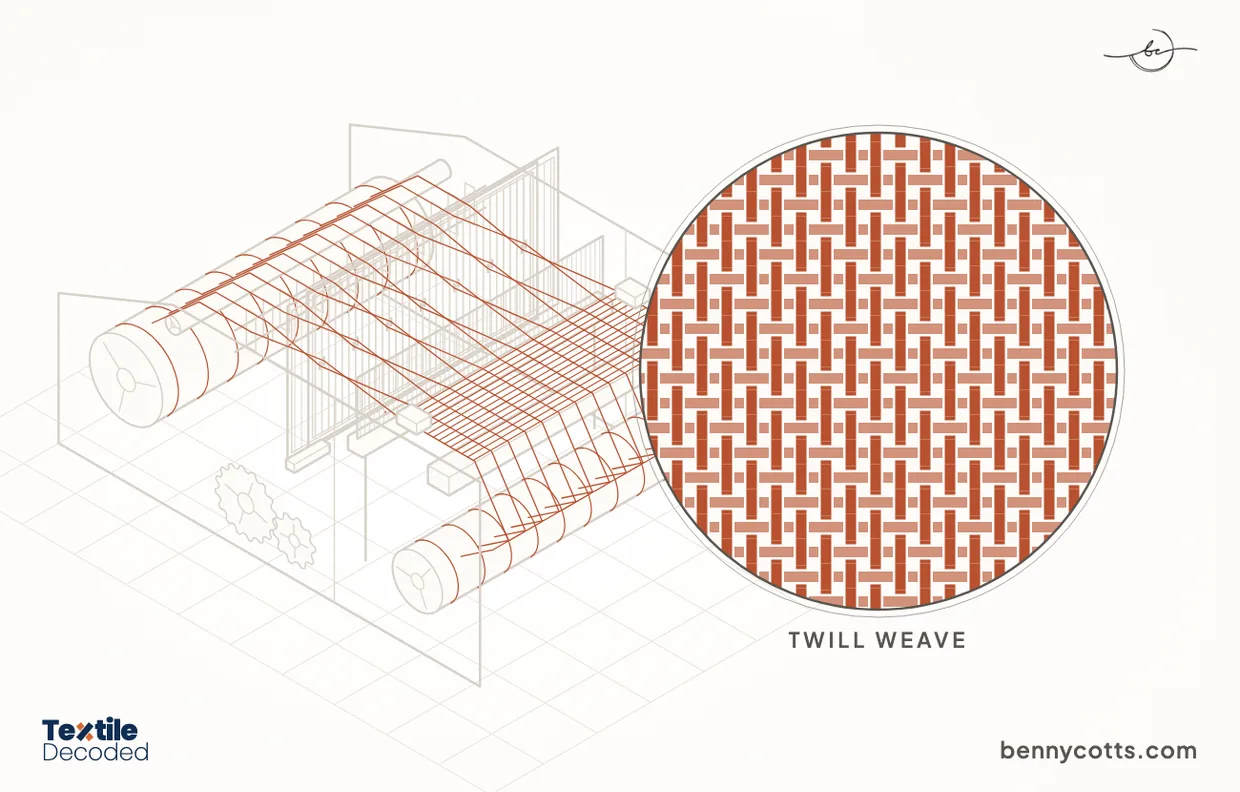
The weave depends on which ends rise on each pick, and that depends on how many heald frames there are and in what order they lift.
- Plain weave: two lifting groups. Alternate ends go up and down, so each weft passes over one end and under the next. It is the flattest, most balanced cloth.
- Twill: three or more frames, lifted in a stepping order so the floats shift by one end on each pick. That step is the diagonal line on the face.
- Dobby: a dobby head controls many frames independently, which lets the loom repeat small geometric figures in the cloth itself.
- Jacquard: each end is controlled on its own instead of by frames, for large figured designs.
The twill vs plain weave guide covers how each weave wears in a uniform, and the dobby guide shows what dobby textures look like in practice.
What this means when you buy fabric
Knowing the loom helps you read a spec and ask better questions. Ends per inch is fixed when the warp is drawn in, so changing it means a new warp. Picks per inch can be adjusted more easily on the loom. The warp beam is prepared for one construction and one length, which is a large part of why custom weaving carries a minimum order quantity. And faults like broken ends, reed marks and temple marks are weaving faults: they should be caught at greige inspection, before the fabric is dyed and finished.
Weaving is done on our own looms at our unit in Atoon, Bhilwara; dyeing and finishing happen afterwards at partner process houses in the region. If you want to see a construction before ordering, ask for a sample on WhatsApp.
FAQ
Frequently asked questions
- What is the shed in weaving?
- The shed is the opening between the raised and lowered warp ends. The heald frames create it on every cycle so the weft can be passed through. The ends then change over and close the shed, locking that pick in place.
- What does a reed do on a loom?
- The reed is a fine metal comb the warp passes through. It keeps the ends evenly spaced across the width, which sets the ends per inch, and on each cycle it beats the newest pick firmly against the edge of the woven cloth.
- What is the difference between warp and weft?
- Warp is the lengthwise set of yarn, wound on a beam and held under tension for the whole run. Weft is the crosswise yarn laid across it one pick at a time. Warp is usually the stronger yarn because it takes more strain during weaving.
- Why does a loom need temples?
- Woven cloth tends to pull narrower than the warp in the reed. Temples grip both edges near the fell and hold the cloth at full width, so the edge ends are not chafed by the reed and the fabric keeps its specified width.
- What are the primary motions of a loom?
- Shedding, picking and beat-up. Shedding opens the warp, picking lays the weft through it, and beat-up presses the weft into the cloth. Let-off and take-up are the secondary motions that feed warp in and draw cloth away.
Cite this guide
Quoting this page? Paste the line below so the credit links back.
<a href="https://www.bennycotts.com/guides/how-a-loom-works">How a Loom Works: Parts and Motions of Weaving</a>, Benny Cotts, 2026Next in Weaving
Loom Types: Shuttle, Rapier, Air-Jet, Projectile and Water-Jet
More in Weaving
- How a Loom Works: Parts and Motions of Weaving
- Loom Types: Shuttle, Rapier, Air-Jet, Projectile and Water-Jet
- Twill vs Plain Weave for Uniforms
- Dobby Weave Structure and Chambray, Explained
- Yarn-Dyed vs Piece-Dyed Fabric, Explained
- Woven Fabric Defects: Where Each One Comes From
- Woven vs Knitted Fabric: What's the Difference?
Updated 11 October 2026 · Benny Cotts, Bhilwara
Fabrics
Fabrics mentioned in this guide
Spec, price and MOQ on every fabric page.

Power Gold
Premium Poly-Viscose blend · 230-250 GSM
Our premium-line suiting with a refined hand and superior drape.

Benzer Special
Poly-Viscose blend · 200-220 GSM
Versatile PV blend optimized for uniform programs at scale.

Fine Strip Dobby
Poly-Viscose blend · 205-225 GSM
Subtle dobby texture for executive uniforms.

Premium Twill Check
Poly-Viscose blend · 300 GSM
Heavy 300 GSM poly-viscose twill check for blazers and uniforms.
Industries this applies to
Uniform programs these fabrics are used for
- Fabric for Business Attire
- Fabric for Corporate Uniforms
- Fabric for Blazers & Waistcoats
- Fabric for School Uniforms
- Fabric for College & University Uniforms
- Fabric for Sports & PT Uniforms
- Fabric for Pre-School & Kindergarten Uniforms
- Fabric for Hospital Staff Uniforms
- Fabric for Hotel Uniforms
- Fabric for Waiter Uniforms
- Fabric for Cabin Crew Uniforms
- Fabric for Business Suits
- Fabric for Black-Tie Attire
- Fabric for Formal Event Wear
Fabric types covered here
Keep reading
Related guides


Ready to place an enquiry?