Textile Decoded
Yarn Quality: What to Check Before It Becomes Fabric
A beginner's guide to yarn quality: count variation, strength (CSP, RKM, single yarn strength), unevenness (U%, CVm), imperfections, hairiness and twist, and the fabric defect each bad yarn property turns into.

Jump to section
Quick answer
Yarn quality is judged on six things. These are how consistent the count is (count CV%), how strong the yarn is (CSP for a skein, RKM and single yarn strength for individual threads), how even its mass is along its length (U% or CVm%), how many thin places, thick places and neps it has per 1,000 metres, how hairy it is, and whether the twist is right and steady. Each one has a fabric consequence. Count variation shows up as barre bands, unevenness as streaks and a cloudy look, weak spots as warp breaks and holes, neps as specks after dyeing, hairiness as pilling and fuzz. Most of these faults cannot be fixed once the yarn is woven, so they are cheapest to catch on the yarn test report.
Why yarn quality decides fabric quality
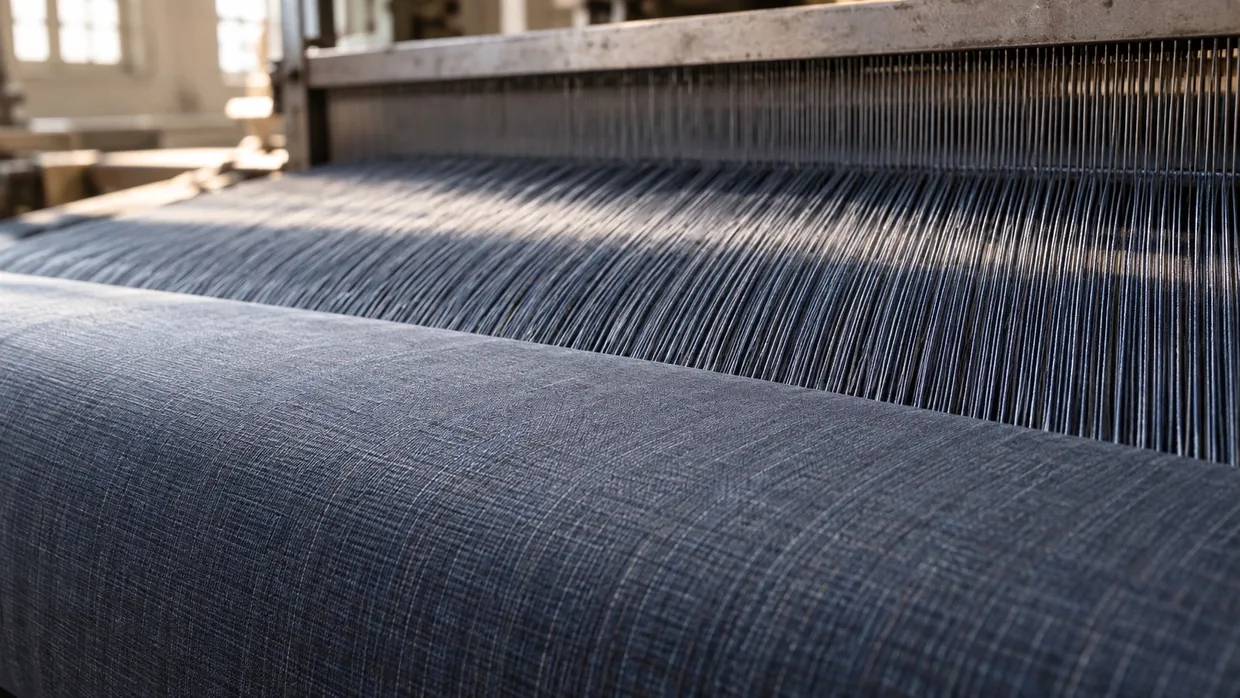
In the previous lessons, fiber became yarn. Now picture that yarn going onto a loom. A single warp thread (warp end) in a uniform fabric may run for thousands of metres. It rubs against the reed and heddles (the loom parts that space and lift it), and is pulled tight and released hundreds of times a minute. Every weak spot, thick lump or variation in thickness travels with it into the cloth.
Weavers do not usually spin; they buy yarn, which is how Benny Cotts works too. So the yarn test report is where a weaver, and through it a fabric buyer, gets a first look at how the cloth will behave. This lesson explains the numbers on that report in plain words, and links each one to the fabric defect it causes later. The defects themselves are covered in woven fabric defects, causes and who fixes them.
Count and count variation (count CV%)
Count is the yarn's fineness: how much length there is per unit of weight. The English cotton count (Ne) says how many 840-yard hanks weigh one pound, so a higher Ne is a finer yarn. Tex says how many grams 1,000 metres weigh, so a higher tex is a coarser yarn. Both are explained in yarn counts and blends explained.
A cone labelled 2/30s is never exactly 30s all the way through. The tester cuts a number of fixed lengths (skeins or leas), weighs them, and reports the average count and its coefficient of variation, count CV%. CV% is the standard deviation expressed as a percentage of the average: the bigger it is, the more the count wanders from skein to skein and cone to cone.
Why it matters: if neighbouring cones differ slightly in count, the cloth made from them differs slightly in thickness and in how much dye it takes. The eye is very good at spotting that as a band, called barre. A low, steady count CV% and yarn from a single lot are the first defences against it.
Strength: CSP, RKM and single yarn strength
Yarn strength is measured two ways. The older way breaks a whole lea, a skein of 120 yards, and multiplies the breaking load in pounds by the count in Ne. The result is the count strength product, CSP. Because it multiplies by count, CSP lets you compare the strength of yarns of different fineness on one scale.
The second way breaks one thread at a time on an automatic tester, many times over. It reports single yarn strength (the breaking force in grams-force or centinewtons), elongation (how far the yarn stretches before it breaks) and tenacity, the force divided by the yarn's fineness. Tenacity is often quoted as RKM, from the German for breaking length in kilometres: the length of yarn, in kilometres, that would snap under its own weight. Numerically, RKM is the same as tenacity in centinewtons per tex.
The average is only half the story. A loom does not stop because of the average yarn; it stops at the weakest point. That is why testers also report the CV% of strength and the lowest single breaks. A yarn with good average strength but a high strength CV% hides weak links, and weak links are what cause warp breaks during weaving and weak spots in the finished cloth.
Unevenness: U% and CVm%
Run a yarn through a capacitance evenness tester and it measures the mass of every short length as it passes, plotting a wavy line around the average. Two numbers summarise that wobble. U% is the average deviation from the mean mass. CVm% is the coefficient of variation of mass. Both say the same thing in slightly different ways: lower is more even. For a normal spread of values, CVm% comes out at about 1.25 times U%, and many reports now lead with CVm%.
The same tester draws a spectrogram, a chart of how often the mass repeats a pattern. A sharp peak at one wavelength usually points to a mechanical fault in spinning, such as a roller that is off-centre. This leaves a regular thick and thin pattern in the yarn. In fabric, a regular pattern like that can show up as moire (a wavy, watery look) or a repeating stripe.
Uneven yarn makes a cloudy or streaky fabric, because thicker stretches cover more and absorb more dye than thinner ones. Unevenness also feeds into strength: the thinnest stretches are usually the weakest.
Imperfections: thin places, thick places and neps
Unevenness describes the general wobble. Imperfections are the outliers, counted one by one and reported per 1,000 metres of yarn. For ring-spun yarn the usual counting levels are:
- Thin places (-50%): stretches where the mass drops at least 50% below the mean. They are weak, and they show as thin lines in the cloth.
- Thick places (+50%): stretches at least 50% above the mean, longer than a nep. They show as slubs and dark streaks.
- Neps (+200%): short, tight knots of tangled fiber, at least 200% above the mean. They often take dye differently from the yarn around them and appear as specks after dyeing.
The three counts are often added up as total IPI (imperfections per kilometre). More sensitive levels, such as -40% thin, +35% thick and +140% neps, are used for compact and finer yarns, so check which levels a report uses before you compare two of them. Separately, yarn clearers on the winding machine cut out rarer large faults, and a classification test sorts what remains by length and size.
Hairiness
Staple yarn is never perfectly smooth. Fiber ends stick out of the surface, and the more of them there are, the hairier the yarn. A common hairiness index, H, is the total length of protruding fiber, in centimetres, per centimetre of yarn. Some testers instead count the hairs longer than set lengths, such as 3 mm.
A little hairiness gives spun yarn its soft, matte handle. Too much causes trouble. Hairy warp ends cling to each other and to the healds, which raises breakage on the loom. In the finished fabric, protruding fibers tangle into small balls under rubbing, which is pilling (see the glossary for how pilling is graded). Polyester-rich fabrics pill more stubbornly, because strong polyester fibers hold the balls on instead of letting them break away. Uneven hairiness from cone to cone can also show as streaks, because hairy yarn scatters light differently.
Twist
Twist is what holds staple fibers together. It is quoted as turns per inch (TPI) or turns per metre (TPM), and spinners also use a twist multiplier, which scales twist to count so yarns of different fineness can be compared. Direction is given as Z or S, depending on which way the spiral leans.
Too little twist and the yarn is weak and hairy. Too much and it becomes hard, snarls into little loops, and can make a fabric twist out of shape, a defect called skew or torque. Twist that varies between lots changes how the yarn reflects light and takes dye, so it can appear as shade bands even when the count is right.
From yarn fault to fabric defect
Put the properties side by side and a pattern appears: almost every common fabric defect has a yarn property behind it. The table sums it up.
| Yarn property | What the report shows | How it appears in fabric |
|---|---|---|
| Count variation | Count CV% | Barre bands, uneven weight |
| Strength | CSP, RKM, single yarn strength and its CV% | Warp and weft breaks, weak spots, holes, poor tear strength |
| Unevenness | U%, CVm%, spectrogram | Cloudy look, streaks, moire, uneven dyeing |
| Imperfections | Thin, thick, neps per 1,000 m | Thin lines, slubs, specks after dyeing |
| Hairiness | Hairiness index H | Pilling, fuzz, loom stops, streaks |
| Twist | TPI or TPM, twist CV% | Snarls, skew, shade bands, harsh or limp feel |
Several of these defects can also come from the loom or the process house, which is why a fault in cloth needs tracing back before anyone is blamed. Our woven fabric defects guide walks through that.
How to read a yarn test report
Mills test yarn on electronic instruments for evenness, strength, hairiness and classification. The industry compares results against published world statistics, percentile tables that show where a yarn sits among similar yarns spun worldwide. A yarn at the 25% level is better than about three quarters of comparable yarns on that property. The figures only mean something against yarns of the same fiber, blend, count and spinning system.
- Compare like with like: a 2/40s poly-viscose ring yarn against the same, never against a different count or system.
- Look at variation as well as averages: count CV%, strength CV% and the weakest breaks tell you more about loom performance than the mean.
- Check the counting levels for imperfections, since -40%/+35%/+140% and -50%/+50%/+200% give very different totals.
- Ask for results by lot, and keep a fabric order to one yarn lot where possible.
- Treat a report as a sample: it describes the cones that were tested, so consistency across lots matters as much as one good result.
Next lesson: Warping: building the warp beam, the first step of Module 3 as the yarn heads for the loom. The faults this yarn can cause in cloth are in woven fabric defects, causes and who fixes them.
FAQ
Frequently asked questions
- What is a good CSP for yarn?
- There is no single good number, because CSP depends on fiber, blend, count and spinning system. Compare a yarn's CSP with yarns of the same type and count, and look at its variation as well as its average.
- What is the difference between U% and CVm%?
- Both measure how much the yarn's mass varies along its length. U% is the average deviation from the mean, CVm% is the coefficient of variation. For a normal spread CVm% is about 1.25 times U%. Lower is more even in both.
- What causes barre in fabric?
- Barre is a band of different shade or texture, usually caused by yarn that differs in count, twist, fiber mix or dye uptake from its neighbours. Mixing cones from different lots is a common cause. Loom tension faults can cause similar bands.
- Does yarn hairiness cause pilling?
- It is one of the main causes. Protruding fibers tangle into balls when the fabric is rubbed. Fiber type, twist, fabric construction and finishing such as singeing also affect how much a fabric pills.
- Can a fabric buyer ask for the yarn test report?
- You can ask, and a weaver who buys yarn will usually hold mill test reports for each lot. For the finished cloth, the fabric test report (GSM, tensile and tear strength, pilling, colourfastness) is what confirms the yarn did its job.
Cite this guide
Quoting this page? Paste the line below so the credit links back.
<a href="https://www.bennycotts.com/guides/yarn-quality-what-to-check">Yarn Quality: What to Check Before It Becomes Fabric</a>, Benny Cotts, 2026More in Yarn
- How a Spinning Mill Works
- Ring, Open-End and Air-Jet Spinning Explained
- Yarn Counts and Blends Explained
- Combed, Carded, Sanforized: Spec-Sheet Terms Explained
- Texturised Yarn in Suiting: What It Is and What It Changes
- What Moves Yarn Prices: Fiber, Count, Spinning and the Market
- Yarn Quality: What to Check Before It Becomes Fabric
Updated 15 October 2026 · Benny Cotts, Bhilwara
Fabrics
Fabrics mentioned in this guide
Spec, price and MOQ on every fabric page.

Power Gold
Premium Poly-Viscose blend · 230-250 GSM
Our premium-line suiting with a refined hand and superior drape.

Benzer Special
Poly-Viscose blend · 200-220 GSM
Versatile PV blend optimized for uniform programs at scale.

Spun Shirting
Micro 1/40s spun polyester · 67 GSM
Lightweight micro shirting, spun 1/40s count, in 74 shades.
Industries this applies to
Uniform programs these fabrics are used for
- Fabric for Business Attire
- Fabric for Corporate Shirts
- Fabric for Blazers & Waistcoats
- Fabric for School Uniforms
- Fabric for College & University Uniforms
- Fabric for Sports & PT Uniforms
- Fabric for Pre-School & Kindergarten Uniforms
- Fabric for Hotel Uniforms
- Fabric for Waiter Uniforms
- Fabric for Cabin Crew Uniforms
- Fabric for Business Suits
- Fabric for Black-Tie Attire
- Fabric for Formal Event Wear
Fabric types covered here
Keep reading
Related guides


Ready to place an enquiry?