Textile Decoded
Polyester: From Crude Oil to Fiber
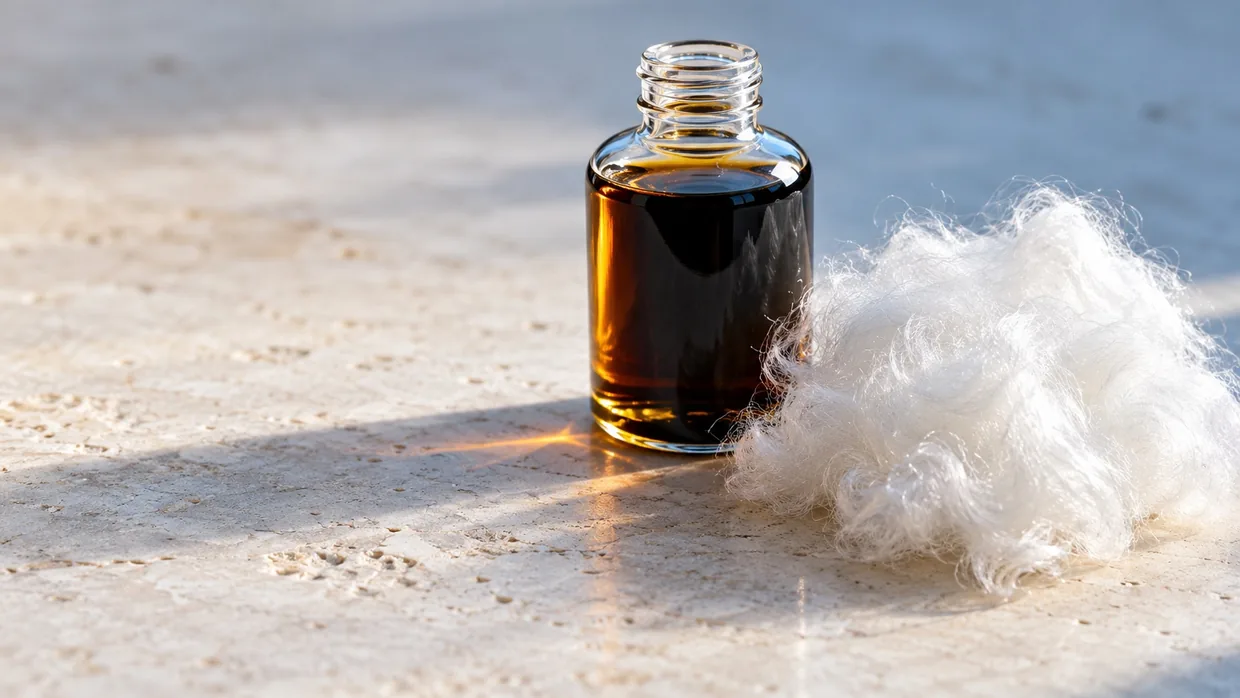
How polyester is made, step by step: crude oil to paraxylene and PTA, MEG, polymerisation into PET chip, melt spinning, and the split into staple and filament.
Jump to section
Quick answer
Polyester starts as crude oil. Refineries turn it into chemicals called paraxylene and ethylene, which become two feedstocks: PTA (purified terephthalic acid) and MEG (monoethylene glycol). Reacted together, they form a plastic called PET, which is cut into small chips. The chips are melted and pushed through tiny holes in a spinneret to make continuous filaments. Those filaments are either kept long, as filament yarn, or crimped and cut short as polyester staple fiber, the kind blended with viscose or cotton in most uniform fabric.
What polyester actually is
Polyester is a synthetic fiber: it is made entirely from chemicals, with no plant or animal source, unlike cotton or even viscose. The word describes a family of plastics, but in textiles it almost always means one of them, polyethylene terephthalate, or PET. It is the same polymer used for clear drinks bottles. A polymer is simply a very long molecule built by linking thousands of small repeating units, called monomers, into a chain.
The bottle connection is worth remembering, because it explains a lot about how polyester behaves in cloth. PET is strong and melts rather than burns. It barely absorbs water (its moisture regain, the water it takes up from the air, is about 0.4 percent against around 8 percent for cotton). It also holds a shape it was set in with heat. Those are the reasons polyester gives a uniform its crease resistance and quick drying, and also why a pure polyester shirt can feel warm and clammy on a long shift. Our polyester suiting guide covers what that means in a finished garment; this lesson is about how the fiber gets made.
The full route at a glance
The chain has two feedstock legs that meet in the middle. One leg goes from crude oil to paraxylene to PTA. The other goes from natural gas or naphtha to ethylene to MEG. The two meet at polymerisation, where PET is made. From there everything is one line again until spinning, where it splits into staple and filament.
Almost none of this happens at a weaving mill, or even at a spinning mill. The petrochemical steps run at refineries and large chemical plants, and the fiber is made by a few large producers who sell it on. Benny Cotts sits several steps further down: we do not make fiber or spin yarn. We buy finished yarn and weave it in-house at Village Atoon, Bhilwara, then send the cloth to partnered Bhilwara process houses for dyeing and finishing.
From crude oil to PTA and MEG
Crude oil is first separated at a refinery into fractions by boiling point. One of those fractions is naphtha, a light liquid that is the starting point for a large share of the chemical industry. Naphtha is processed to concentrate aromatics, a group of ring-shaped molecules, and from that mix paraxylene (PX) is separated out.
Paraxylene is then oxidised, meaning reacted with oxygen from air, and purified into PTA, a white powder. PTA supplies the terephthalate part of the polymer and makes up most of PET's weight.
The second feedstock is MEG. Ethylene, a simple gas made by cracking (breaking down with heat) naphtha or natural gas, is oxidised to ethylene oxide and then reacted with water to give MEG, a clear liquid. It supplies the ethylene glycol part of the polymer.
Because PTA and MEG are both traded petrochemicals, their prices follow oil and refinery margins more than anything in textiles. The glossary has short entries for PTA, MEG and paraxylene, and the lesson on what moves fiber prices later in this module picks up that thread.
Polymerisation: making PET chip
Polymerisation is the reaction that links small molecules into a long chain. For PET, PTA and MEG are mixed into a paste and heated. They first combine into short units. Then, under heat and vacuum, those units join end to end into long chains, while water and excess glycol are drawn off. The longer the chains, the stronger the eventual fiber.
The molten polymer is pushed out as strands, cooled in water and chopped into small pellets called PET chip. Chip is the form in which polymer is stored, traded and moved between plants. Some large plants skip the chip stage and pipe molten polymer straight to the spinning line. This is called direct spinning, but the chemistry is the same.
Small additives go in at this stage too. The most common is titanium dioxide, a white pigment that dulls the natural glassy shine of PET. That is where the trade terms bright, semi-dull and full-dull come from. They describe how much delustrant (the additive that dulls the shine) the polymer carries, and they affect the look of the finished cloth.
Melt spinning: chip becomes fiber
Melt spinning is the step where plastic becomes fiber. The chips are dried thoroughly, because moisture weakens molten PET, then melted in an extruder (a heated barrel with a screw that pushes the melt forward). PET melts at roughly 250 to 260 degrees Celsius.
The melt is forced through a spinneret, a metal plate drilled with many fine holes, like a shower head. Each hole produces one continuous filament. The filaments are cooled by a stream of air as they leave, so they set solid within moments.
Fresh filaments are weak because their long molecules lie tangled. They are then drawn, meaning stretched to several times their length, which lines the molecules up along the fiber and gives polyester its strength. How much drawing happens, and when, decides which product comes off the line.
Staple or filament: PSF, POY and FDY
From here the line splits. For staple fiber, filaments from many spinnerets are gathered into a thick rope called tow. The tow is drawn, given a crimp (a zigzag wave so the fibers grip each other), heat set and cut into short lengths. That is polyester staple fiber, or PSF. It is cut to match the fiber it will be blended with, commonly 38 mm for cotton-system spinning and 51 mm for longer blends. This is the fiber that goes into poly-viscose and poly-cotton yarn. Staple yarn is spun, so it has a slightly hairy, matte surface. Our guide to yarn counts and blends explains how it is described.
For filament, the long strands are never cut. Filament yarn as a group is often called PFY (polyester filament yarn). Two forms matter most:
- POY, partially oriented yarn: drawn only part way at high speed. It is an intermediate, not a finished yarn. Texturisers draw it the rest of the way and add bulk, producing DTY, the textured yarn behind many suitings. Our texturised yarn guide covers that step.
- FDY, fully drawn yarn: drawn completely on the spinning line, giving a smooth, flat and often lustrous filament ready to weave or knit as it is.
So a fabric labelled 100 percent polyester can be spun staple, textured filament or flat filament, and the three feel nothing alike. Always ask which one you are being offered.
Recycled polyester: same polymer, different starting point
Recycled polyester, often written rPET, is PET that has already been used once, mostly as drinks bottles. In mechanical recycling, bottles are collected, sorted, washed and shredded into flakes, which are melted and spun just like virgin chip. Chemical recycling breaks the polymer back down towards its building blocks and rebuilds it. It can handle dirtier waste, but it is a larger and costlier process. Textile-to-textile recycling exists but is still a small share of supply.
Once spun, recycled polyester is the same polymer as virgin and behaves the same way in cloth. So the claim lives in the paperwork, not the fabric. Two things are worth knowing as a buyer. First, food-grade recycling for new bottles competes for the same clean bottles, so textile-grade flake is not always easy to get. This is the main reason recycled uniform fabric usually costs more. Second, recycled content cannot be confirmed by simply looking at or testing the cloth. It rests on chain-of-custody documents (records of who handled the material at each stage) from fiber to fabric. Our guide to sustainability certifications explains how those schemes work.
Why this matters when you buy fabric
You do not need to know reaction chemistry to buy uniform fabric, but the route explains three things buyers ask about. Polyester prices move with oil and petrochemicals, not with the weaving mill. Staple and filament polyester give very different fabrics under the same label. And recycled polyester is a sourcing and documentation question, not a different material.
Next in this module: Viscose: fiber from wood pulp, the other half of every poly-viscose blend, and a fiber made from a plant but still made in a factory.
FAQ
Frequently asked questions
- Is polyester just plastic?
- Yes, in the sense that it is the same polymer, PET, used for clear drinks bottles, melted and spun into fine fibers. Spinning and drawing line its molecules up, which is why a polyester fiber is strong and flexible rather than brittle like a bottle wall.
- What is the difference between PSF and polyester filament yarn?
- PSF, polyester staple fiber, is cut into short lengths and spun into yarn, often blended with viscose or cotton, giving a matte and slightly fuzzy yarn. Filament yarn keeps each fiber continuous for the whole length of the yarn, giving a smoother, shinier result. Most poly-viscose uniform fabric uses PSF.
- Why does polyester melt instead of burning like cotton?
- PET is a thermoplastic: it softens and melts with heat rather than charring. That is why polyester shrinks back from a flame and leaves a hard bead, why a hot iron can glaze it. It is also why heat setting can fix a crease or a dimension permanently.
- Is recycled polyester weaker than virgin polyester?
- Not in any way that shows in normal uniform use. Once spun, rPET is the same polymer and the fabric behaves the same. Mechanical recycling can shorten the polymer chains slightly, which producers manage in processing. The practical difference is price and paperwork, not performance.
- Does Benny Cotts make its own polyester fiber or yarn?
- No. Fiber is made by large producers and yarn by spinning mills. We buy yarn, weave in-house at Village Atoon, Bhilwara, and use partnered Bhilwara process houses for dyeing and finishing. If you want to see what that yarn becomes, use Request Catalog on our quote page.
Cite this guide
Quoting this page? Paste the line below so the credit links back.
<a href="https://www.bennycotts.com/guides/polyester-from-crude-oil-to-fiber">Polyester: From Crude Oil to Fiber</a>, Benny Cotts, 2026Next in Fibers
Viscose: Fiber From Wood Pulp
More in Fibers
- What Is a Fiber? Natural, Man-Made and Synthetic
- Cotton: From Field to Bale
- Polyester: From Crude Oil to Fiber
- Viscose: Fiber From Wood Pulp
- Wool, Linen, Nylon and Elastane: The Rest of the Fiber Family
- What Moves Fiber Prices: Cotton, Polyester and Viscose
- Blends Compared: Poly-Viscose, Poly-Cotton, Cotton and Polyester
- Poly-Viscose vs Cotton for Uniforms: 7 Differences
- Poly-Viscose and Poly-Cotton Ratios Explained: The Manufacturing Reasons Behind Each Blend
- Why 65/35 Is a Common Ratio for Uniform Shirting
- 100% Polyester Suiting for Uniforms: Where It Wins and Where It Loses
- Stretch and Lycra Uniform Fabric, Explained
Updated 12 October 2026 · Benny Cotts, Bhilwara
Fabrics
Fabrics mentioned in this guide
Spec, price and MOQ on every fabric page.

Officer Choice
Poly-Viscose (PV) blend · 210-230 GSM
Crisp, structured suiting engineered for officer uniforms.

Power Gold
Premium Poly-Viscose blend · 230-250 GSM
Our premium-line suiting with a refined hand and superior drape.

Serze Italian Premium
Poly-Viscose blend, fiber dyed · 405 g/m
Heavy fiber-dyed serge suiting, 405 g per metre at 58 inch.
Industries this applies to
Uniform programs these fabrics are used for
- Fabric for Business Attire
- Fabric for Corporate Trousers
- Fabric for Blazers & Waistcoats
- Fabric for Cabin Crew Uniforms
- Fabric for Ground Staff Uniforms
- Fabric for Army Uniforms
- Fabric for Police Uniforms
- Fabric for Security Guard Uniforms
- Fabric for Industrial Uniforms
- Fabric for Construction Workwear
- Fabric for Business Suits
- Fabric for Black-Tie Attire
- Fabric for Formal Event Wear
Fabric types covered here
Keep reading
Related guides



Ready to place an enquiry?