
Textile Decoded
Woven vs Knitted Fabric: What's the Difference?
Woven cloth crosses two sets of yarn at right angles; knitted cloth is built from rows of loops. Here is how that changes stretch, stability and shape, and why uniform trousers and shirts are woven while T-shirts and PT wear are knit.
Jump to section
Quick answer
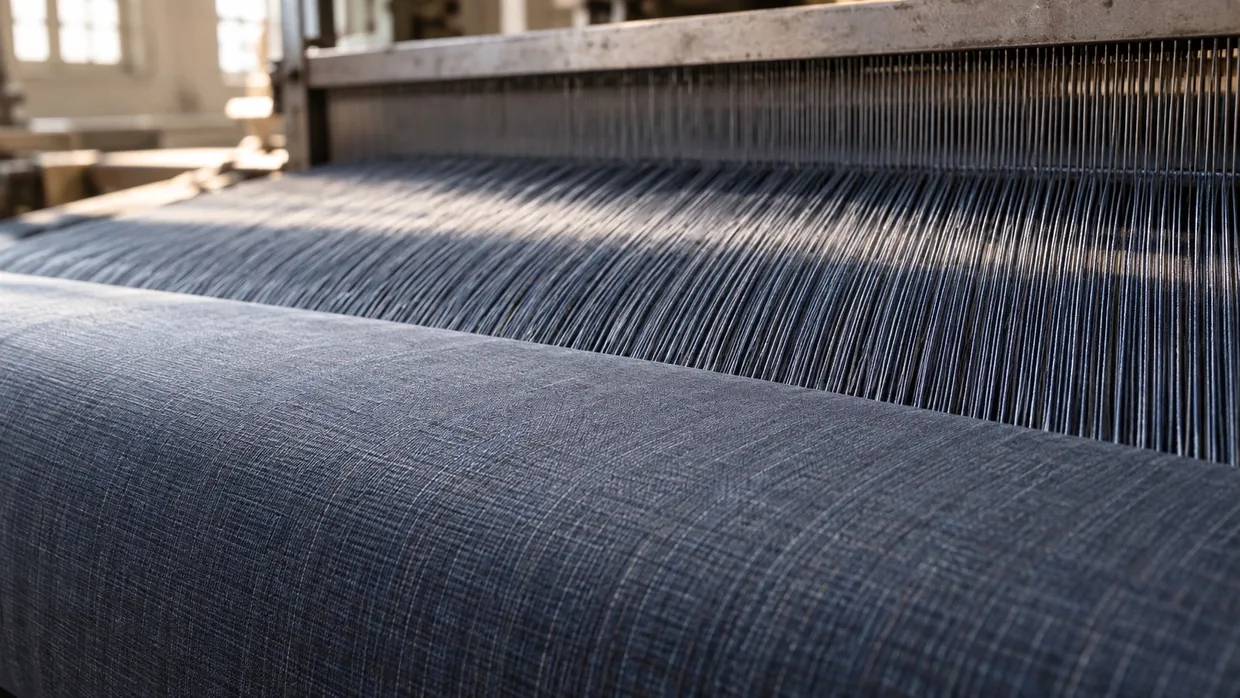
Woven fabric is made by interlacing: two sets of yarn, the lengthwise warp and the crosswise weft, cross over and under each other at right angles on a loom. Knitted fabric is made by interlooping: a yarn is pulled through loops of itself, row after row, like hand knitting. Because loops can open and close, knits stretch easily and spring back. This suits T-shirts, polos and PT wear. Woven cloth barely stretches unless elastane is added, so it holds a sharp, stable shape. That is why uniform trousers, shirts, blazers and suiting are woven.
Two ways to turn yarn into cloth
Almost every everyday fabric is either woven or knitted. Both start from yarn, but they hold it together in completely different ways. That one difference explains most of how the cloth behaves when you wear it.
A third family, nonwovens, skips yarn altogether and bonds fibers directly, as in wipes or interlinings. This lesson sticks to the two that make clothing.
Woven: yarns that cross
In weaving, one set of yarns, the warp, is stretched lengthwise on the loom. A second yarn, the weft, is passed across the warp, going over some ends and under others. This crossing is called interlacing. The how a loom works lesson shows the machine that does it.
The pattern of over and under is the weave. The simplest is plain weave, one over and one under. Twill steps the crossing along by one each row and makes a diagonal line. Our twill vs plain weave guide compares the two.
Because the yarns lie straight and lock each other in place, woven cloth hardly stretches along the warp or the weft. It gives a little only on the bias, the diagonal direction.
Knitted: yarns that loop
In knitting, yarn is formed into loops, and each new loop is pulled through the one before it. This is called interlooping. The loops can change shape when pulled, which is where knit stretch comes from.
There are two main kinds:
- Weft knit: one yarn runs across the fabric, forming a row of loops, and the next row loops into it. Most T-shirt jersey, rib and polo pique are weft knits. They stretch well, especially across the width, and can run (unravel along a line) if a loop breaks.
- Warp knit: many yarns run lengthwise, each looping into its neighbours in a zigzag. Warp knits such as tricot are firmer, run less, and are common in sportswear linings, mesh and lingerie.
Stretch, stability and shape
| Woven | Knitted | |
|---|---|---|
| How yarn is held | Interlaced at right angles | Interlooped in rows of loops |
| Stretch without elastane | Very little, some on the bias | Natural stretch, often in both directions |
| Stability | Holds its size and lines | Can grow or relax with wear and washing |
| Shape it gives | Crisp creases, sharp edges, tailored fit | Soft drape that follows the body |
| Cut edge | Frays if not finished | Usually does not fray, but can curl or run |
Woven cloth can be given stretch by adding elastane (spandex) to the weft. That gives comfort while keeping the woven look, as our stretch and Lycra uniform fabric guide explains.
Why uniforms are mostly woven
A uniform is meant to look the same on every wearer, every day. Trousers need a crease that stays, shirts need a collar and cuffs that stand up, and blazers and suits need structured shoulders and lapels. Woven cloth does all of this because it does not grow or sag under its own weight.
Woven fabric also takes pressing, buttonholes and pocket stitching cleanly, and holds dimension well through repeated institutional washing. That is why school trousers, office shirting, security and police uniforms, chef coats and suiting are woven.
Where knits win
When the wearer moves a lot and a relaxed fit is fine, knits make more sense. T-shirts, polo shirts, track pants, PT and sports kits, and innerwear are almost always knitted, because the stretch lets them pull on over the head and move with the body without buttons or a tailored cut.
Many uniform programs use both: woven trousers and shirts for daily wear, and a knitted polo or PT set for sports days. Our sports and PT uniform fabric guide covers that side.
What this means for a fabric buyer
If the garment needs a crease, a collar, structure or a fixed size, ask for woven fabric. If it needs to pull on and stretch freely, ask for a knit. When you want some give in a woven garment, ask about elastane blends rather than switching to a knit. For corporate programs, the same choice shows up as woven shirt or knit polo.
Benny Cotts is a weaver: we weave shirting, suiting and uniform fabric at our unit in Village Atoon, Bhilwara, and partnered Bhilwara process houses handle dyeing and finishing. We do not make knitted fabric.
Browse the full course on the Textile Decoded hub.
FAQ
Frequently asked questions
- What is the main difference between woven and knitted fabric?
- Woven fabric interlaces two sets of yarn at right angles. Knitted fabric interloops yarn into rows of loops. The loops give knits natural stretch, while woven cloth stays stable and holds a sharp shape.
- How can I tell if a fabric is woven or knitted?
- Look closely at the surface: woven cloth shows yarns crossing in a grid or diagonal, while knits show tiny V shapes or loops. Pull it gently: a knit stretches easily, a woven barely moves except on the diagonal.
- Can woven fabric stretch?
- Only a little on its own, mostly on the bias. Adding elastane to the yarn gives woven fabric comfort stretch while it keeps its crisp woven look.
- Does Benny Cotts make knitted fabric?
- No. We weave shirting, suiting and uniform fabric at our weaving unit in Village Atoon, Bhilwara. You can Request Catalog at /quote to see the woven fabrics we make.
Cite this guide
Quoting this page? Paste the line below so the credit links back.
<a href="https://www.bennycotts.com/guides/woven-vs-knitted-fabric">Woven vs Knitted Fabric: What's the Difference?</a>, Benny Cotts, 2026More in Weaving
- How a Loom Works: Parts and Motions of Weaving
- Loom Types: Shuttle, Rapier, Air-Jet, Projectile and Water-Jet
- Twill vs Plain Weave for Uniforms
- Dobby Weave Structure and Chambray, Explained
- Yarn-Dyed vs Piece-Dyed Fabric, Explained
- Woven Fabric Defects: Where Each One Comes From
- Woven vs Knitted Fabric: What's the Difference?
Updated 18 October 2026 · Benny Cotts, Bhilwara
Fabrics
Fabrics mentioned in this guide
Spec, price and MOQ on every fabric page.

Spun Shirting
Micro 1/40s spun polyester · 67 GSM
Lightweight micro shirting, spun 1/40s count, in 74 shades.

Power Gold
Premium Poly-Viscose blend · 230-250 GSM
Our premium-line suiting with a refined hand and superior drape.

Sonata
Poly-Viscose blend · 190-210 GSM
Cost-efficient uniform fabric without compromising weave quality.
Industries this applies to
Uniform programs these fabrics are used for
- Fabric for Business Attire
- Fabric for Corporate Shirts
- Fabric for Blazers & Waistcoats
- Fabric for School Uniforms
- Fabric for Sports & PT Uniforms
- Fabric for Pre-School & Kindergarten Uniforms
- Fabric for Doctor Coats
- Fabric for Nurse Scrubs
- Fabric for Lab Coats
- Fabric for OT & Surgical Wear
- Fabric for Patient Gowns
- Fabric for Chef Coats
- Fabric for Salon & Spa Uniforms
- Fabric for Cabin Crew Uniforms
- Fabric for Housekeeping Uniforms
- Fabric for Business Suits
- Fabric for Black-Tie Attire
- Fabric for Formal Event Wear
Fabric types covered here
Keep reading
Related guides



Ready to place an enquiry?