Fabric basics
Texturised Yarn in Suiting: What It Is and What It Changes
Filament polyester starts smooth, shiny and flat. Texturising, by false-twist or air-jet, adds crimp or loops that give bulk, stretch, cover and a more matte hand. How it differs from spun yarn, and the pilling and snagging trade-offs to weigh.
Jump to section
- Filament and spun: the starting point
- What texturising does
- False-twist and air-jet: two routes
- How it differs from spun yarn
- Pilling and snagging: the trade-off
- What it changes in the finished uniform
- Where texturising fits with stretch
- Checking a swatch yourself
- How to specify it
- Common buyer mistakes
- What to ask your mill
Quick answer
Texturised yarn is continuous filament yarn, usually polyester, that has been processed to put crimps, coils or loops along its length. Untreated filament is smooth and packs flat, so it can look glassy and feel slick. Texturising gives it bulk, some stretch, better cover and a hand (feel) closer to a natural-fiber yarn. False-twist texturing twists, heat-sets and untwists the filaments so they keep a coiled crimp. Air-jet texturing uses a turbulent air stream to blow loops into the filaments. Compared with spun yarn it has few free fiber ends, which helps against pilling. But its surface loops and crimp can be pulled out by sharp edges, so snagging is the trade-off to check.
Filament and spun: the starting point
Polyester reaches a weaver in two broad forms. Spun yarn is made from short staple fibers twisted together, the route behind the poly-viscose blends covered in yarn counts and blends explained. Filament yarn is made from continuous strands that run the full length of the yarn.
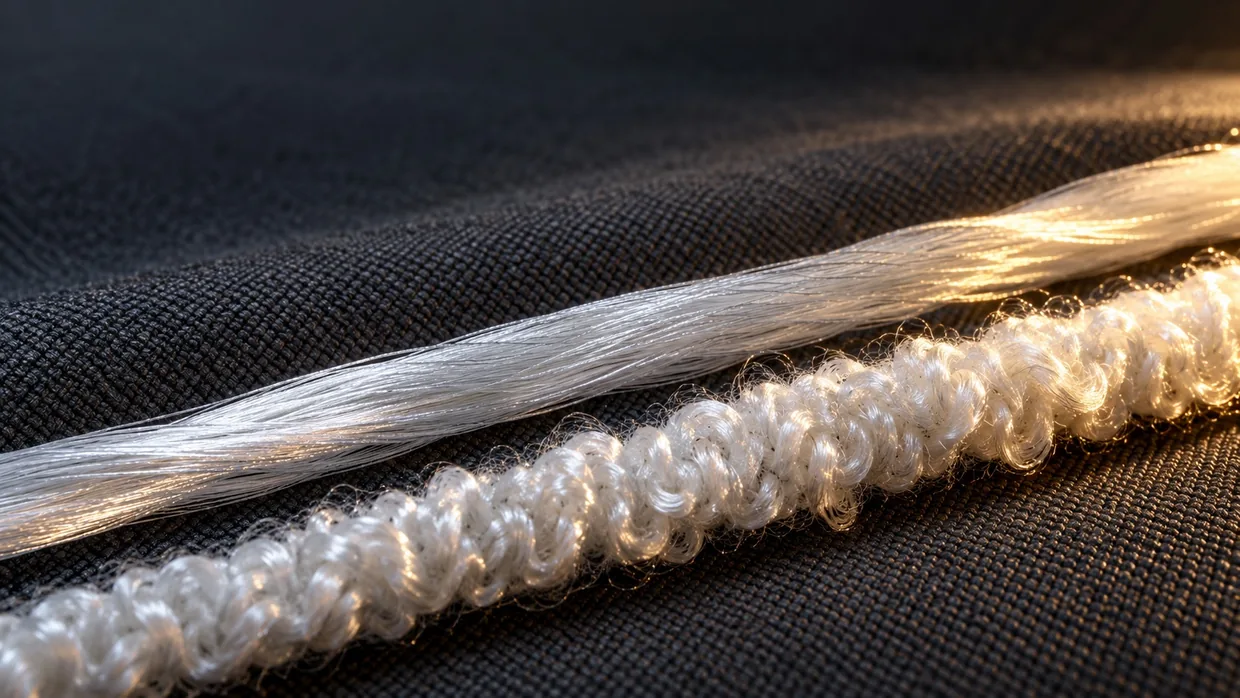
Untreated filament has a smooth, parallel structure. That makes it strong and even, but in cloth it tends to lie flat and close, with a shine and a slick feel that look and feel synthetic. Texturising is the step that changes this.
What texturising does
The Textile Institute describes a textured yarn as a continuous filament yarn processed to add crimps, coils, loops and other fine distortions along its length. These distortions give synthetic filament its useful properties in apparel.
- Bulk: the crimped filaments no longer pack tightly, so the yarn occupies more volume for the same weight.
- Stretch: coiled crimp can extend under load and pull back, giving a degree of mechanical stretch without elastane.
- Cover: a bulkier yarn fills the gaps between threads, so the cloth looks more closed and less see-through.
- Matte hand: the broken-up surface scatters light and feels drier than smooth filament, closer to a natural-fiber yarn.
- Thermal insulation: the extra air held in a bulked yarn adds some warmth.
False-twist and air-jet: two routes
False-twist texturing is a common route for polyester. The filaments are twisted, heat-set while twisted, then untwisted. Because the heat has fixed the twisted shape, the filaments relax into coils rather than lying straight. This mainly produces bulk and stretch.
Air-jet texturing works without twist. The filament is overfed into a nozzle where a turbulent air stream blows the filaments into small loops and entangles them. Research at Loughborough University and elsewhere has studied how those loops form. The loopy surface makes an air-jet textured yarn look and feel like a spun yarn, with similar surface friction.
Put simply: false-twist gives more stretch and bulk, and air-jet gives a spun-like look with little stretch. Either can be specified, and the mill's yarn supplier sets the exact parameters.
| False-twist textured | Air-jet textured | |
|---|---|---|
| How it is made | Twist, heat-set, untwist | Air jet blows filaments into loops |
| Main effect | Bulk and stretch | Spun-like look and surface |
| Surface | Crimped, coiled filaments | Small loops on the surface |
How it differs from spun yarn
A spun yarn is a bundle of short fibers held by twist, so its surface carries many protruding fiber ends, the hairiness you see against the light. A textured filament yarn is still made of continuous strands; texturising changes their shape, not their length.
That difference drives the two main trade-offs below. It is also why a texturised polyester and a poly-viscose spun yarn can look similar but behave differently in wear. Blend, weave and GSM shape the result as much as yarn type does. See polyester suiting for uniforms for how an all-polyester range compares with blends.
Pilling and snagging: the trade-off
Pills form when loose fiber ends on a yarn surface work free and tangle into small balls. Research on yarn hairiness has linked more surface fiber ends with more pilling. Continuous filament has few free ends to start with, so a texturised filament cloth has less raw material for pills than a spun yarn of the same fiber. The full mechanism, and how pilling is graded, is in fabric pilling explained.
Snagging works the other way. Crimp and surface loops can catch on a sharp or rough edge, such as a badge pin, a velcro strip or a rough chair. They are then pulled out as a visible loop or a pulled line. Because the filament is continuous, a snag can pull a run of yarn rather than one short fiber. ASTM D3939, the mace test, measures snagging resistance. It covers fabrics made from textured or untextured filament and spun yarns, and grades results on a 1 to 5 scale.
Construction matters too: snag resistance is a property of the finished cloth, not the yarn alone. For roles with badges, tools or hook-and-loop fastenings, it is worth asking for a snag result alongside the pilling grade.
What it changes in the finished uniform
In a finished garment, texturised yarn shows up in four ways. The cloth looks more closed, so a light shade is less likely to show the lining or skin through it. The surface is drier and less glassy than flat filament, which is why it reads as suiting rather than lining. A little give appears in the crimp, which helps a trouser sit comfortably through a long day. And the cloth drapes softly, because the bulked yarn is more flexible than a tight, flat one.
None of this makes it a hot-weather fiber. The yarn is still polyester, so it absorbs little moisture, and comfort in heat still depends on the weave, the GSM and how open the cloth is. Texturising improves the hand of polyester. It does not turn it into cotton.
Where texturising fits with stretch
False-twist crimp gives mechanical stretch, but it is different from the elastane stretch described in stretch and Lycra uniform fabric. Elastane adds a high-recovery fiber to the yarn; texturising reshapes the polyester itself. If a programme needs reliable recovery (the fabric springing back) at knees and elbows, specify the stretch you want and how recovery will be tested. Do not assume a textured yarn will supply it.
Checking a swatch yourself
- Look at the cloth under a magnifier. Spun yarn shows many short fiber ends, texturised yarn shows continuous crimped or looped strands.
- Hold it to the light to judge cover. Bulked yarn should fill the gaps between threads.
- Draw a fingernail or the tip of a pin lightly across the surface and look for pulled loops. This is only a quick check and does not replace a graded snag test.
- Rub two pieces of the cloth together and see how quickly the surface changes, then compare after a few washes.
How to specify it
Name the yarn in the spec, not just the fiber. A line that says only 100 percent polyester leaves open whether the cloth is spun, flat filament or texturised, and these behave differently in the wash and in wear. Say which yarn is used in the warp and which in the weft, because many cloths mix them. Filament yarn size is given in denier rather than a cotton-style count, so expect that unit on the spec.
If texturising is part of the reason you are buying the cloth, write down the result you need as a test: a pilling grade, a snagging grade, and a recovery figure if stretch is expected. A named process is a description. A tested result is something you can hold the supplier to.
Common buyer mistakes
- Reading texturised as stretch. Only false-twist gives some give, air-jet gives little, and neither replaces elastane.
- Assuming filament cloth is always shiny or cheap looking. Texturising is exactly the step that fixes that.
- Judging pilling alone. A cloth with few pills can still snag badly around badges, tools and fasteners.
- Comparing a texturised cloth and a spun cloth on handle in the hand only. Wear them through a few washes first.
- Leaving the yarn type off the purchase order, so a later lot arrives in a different construction.
What to ask your mill
- Is the warp, weft or both texturised filament, spun yarn, or a combination?
- If texturised, is it false-twist or air-jet?
- What pilling grade and what ASTM D3939 snagging grade does the cloth reach?
- Is any stretch from yarn crimp, from elastane, or both, and how is recovery tested?
For how these details sit on a spec sheet, see how to read a fabric spec sheet. To see suiting qualities in hand, Request Catalog.
FAQ
Frequently asked questions
- How can I tell texturised yarn from spun polyester in a cloth?
- Under a magnifier, spun yarn shows many short fiber ends and a hairy edge, while texturised yarn shows continuous strands that are crimped or looped. Surface alone can mislead, since air-jet yarn is made to look spun, so ask the mill to state the yarn type in writing.
- Is texturised polyester comfortable in hot weather?
- It feels drier and less slick than flat filament, but it is still polyester, which absorbs little moisture. Weave, GSM and openness of the cloth matter more for heat comfort. For long hot shifts, consider a blend with viscose or cotton.
- Is texturised yarn the same as spun polyester?
- No. Spun polyester is made from short staple fibers twisted together. Texturised yarn is continuous filament whose strands have been crimped, coiled or looped. Air-jet texturing can make filament look similar to spun yarn, but the structure underneath is different.
- Does texturised yarn make fabric stretchy?
- False-twist texturing gives some mechanical stretch from the coiled crimp. Air-jet texturing gives little. Neither is the same as elastane, which adds a dedicated high-recovery fiber.
- Does texturised polyester pill?
- It has fewer free fiber ends than a spun yarn, which reduces the raw material for pills. Pilling still depends on the whole construction, so ask for a tested pilling grade instead of assuming.
- Why do textured fabrics snag?
- Crimp and surface loops can catch on sharp or rough objects and be pulled out. Because the filament is continuous, a snag can draw out a length of yarn. ASTM D3939 is the test method used to grade snagging resistance.
- Why texturise filament at all?
- Smooth filament packs flat, looks glossy and feels slick. Texturising adds bulk, cover, some stretch and a drier, more matte hand, which makes filament polyester more usable in apparel.
Cite this guide
Quoting this page? Paste the line below so the credit links back.
<a href="https://www.bennycotts.com/guides/texturised-yarn-in-suiting">Texturised Yarn in Suiting: What It Is and What It Changes</a>, Benny Cotts, 2026Next in Yarn
What Moves Yarn Prices: Fiber, Count, Spinning and the Market
More in Yarn
- How a Spinning Mill Works
- Ring, Open-End and Air-Jet Spinning Explained
- Yarn Counts and Blends Explained
- Combed, Carded, Sanforized: Spec-Sheet Terms Explained
- Texturised Yarn in Suiting: What It Is and What It Changes
- What Moves Yarn Prices: Fiber, Count, Spinning and the Market
- Yarn Quality: What to Check Before It Becomes Fabric
Updated 25 October 2026 · Benny Cotts, Bhilwara
Fabrics
Fabrics mentioned in this guide
Spec, price and MOQ on every fabric page.

Officer Choice
Poly-Viscose (PV) blend · 210-230 GSM
Crisp, structured suiting engineered for officer uniforms.

Sonata
Poly-Viscose blend · 190-210 GSM
Cost-efficient uniform fabric without compromising weave quality.

Grado 1st
Poly-Viscose blend · 220-240 GSM
Tailoring-grade fabric built for everyday durability.

Nano
Poly-Viscose blend · 180-200 GSM
Our entry-level uniform fabric for large-volume programs.
Industries this applies to
Uniform programs these fabrics are used for
- Fabric for Business Attire
- Fabric for Corporate Uniforms
- Fabric for Corporate Shirts
- Fabric for Corporate Trousers
- Fabric for Blazers & Waistcoats
- Fabric for School Uniforms
- Fabric for College & University Uniforms
- Fabric for Sports & PT Uniforms
- Fabric for Pre-School & Kindergarten Uniforms
- Fabric for Doctor Coats
- Fabric for Nurse Scrubs
- Fabric for Lab Coats
- Fabric for OT & Surgical Wear
- Fabric for Patient Gowns
- Fabric for Hospital Staff Uniforms
- Fabric for Chef Coats
- Fabric for Salon & Spa Uniforms
- Fabric for Cabin Crew Uniforms
- Fabric for Ground Staff Uniforms
- Fabric for Army Uniforms
- Fabric for Police Uniforms
- Fabric for Security Guard Uniforms
- Fabric for Industrial Uniforms
- Fabric for Construction Workwear
- Fabric for Housekeeping Uniforms
- Fabric for Business Suits
- Fabric for Black-Tie Attire
- Fabric for Formal Event Wear
Fabric types covered here
Keep reading
Related guides


Ready to place an enquiry?