
Textile Decoded
Warping: Building the Warp Beam
How thousands of yarn cones become one warp beam: the creel, direct and sectional warping, why even tension matters, which faults start here, and how weft is prepared.
Jump to section
Quick answer
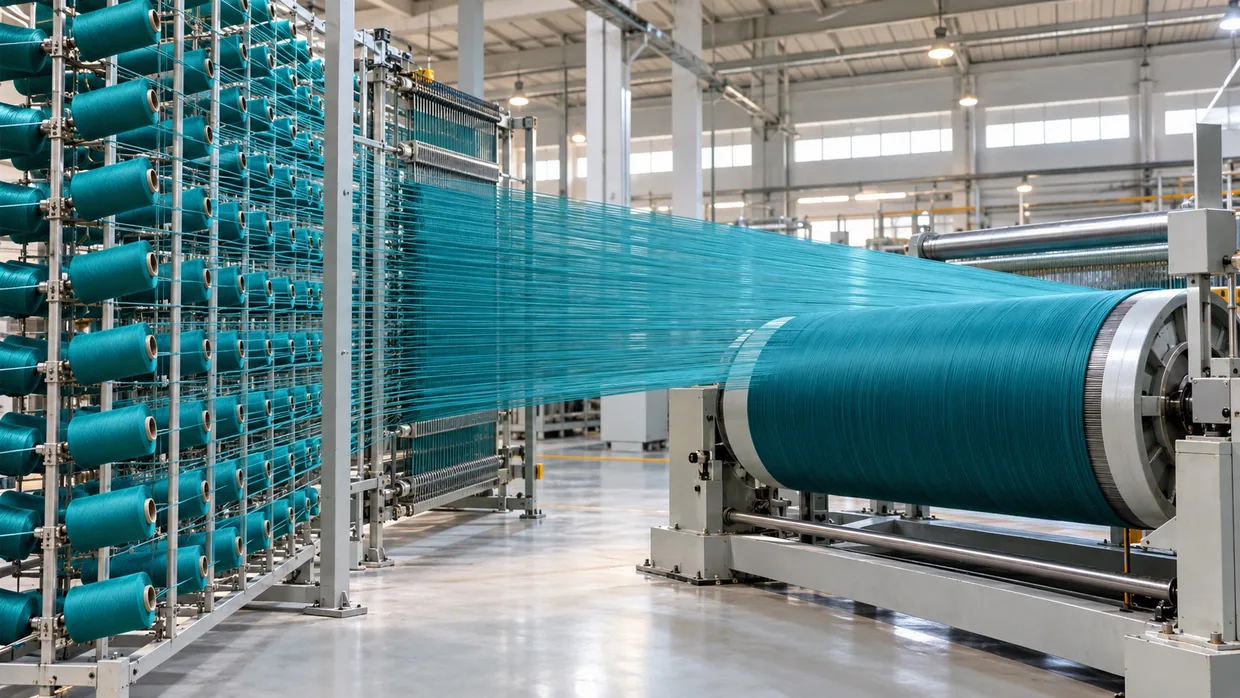
Warping is the step that turns many separate cones of yarn into one warp beam: a large roller with thousands of lengthwise threads, called ends, wound side by side at the same tension and the same length. The cones sit on a rack called a creel, and their yarn is pulled forward together onto the beam. Direct warping winds the full width in one go and suits long runs of single-colour warps. Sectional warping builds the beam in narrow bands, which suits striped, yarn-dyed and short runs. Weft needs much less preparation, because on modern shuttleless looms it is fed straight off a cone.
Why a loom needs a warp beam
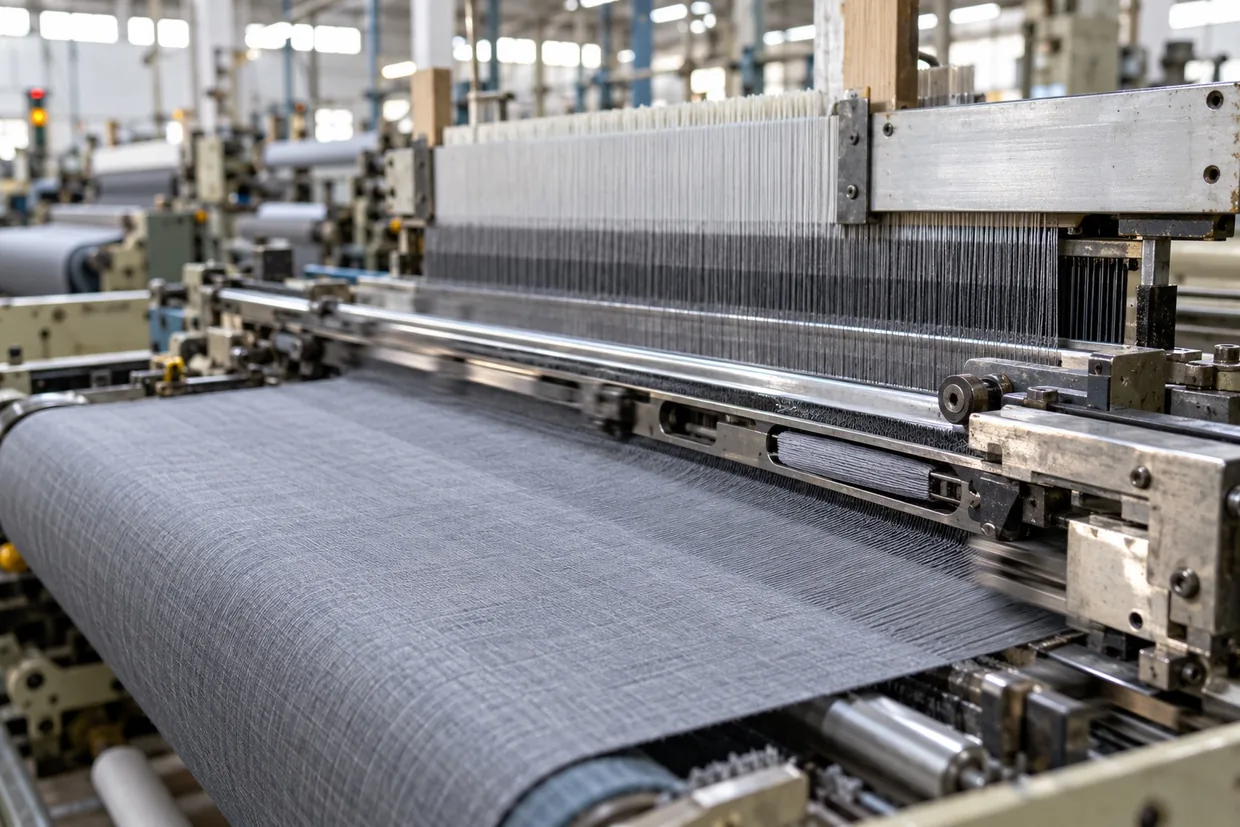
A loom weaves by laying a crosswise thread, the weft, through a sheet of lengthwise threads, the warp. That warp sheet has to be ready before weaving starts: every thread parallel to its neighbour, in the right order, the same length and pulled with the same force. You cannot feed a loom from thousands of loose cones. So the threads are first wound together onto one big roller, the warp beam. It sits at the back of the loom and lets the warp out a little at a time.
Think of it like setting up the strings of a very wide harp before anyone can play it. Building that beam is called warping, and it is the first step of weaving preparation. The previous lesson, yarn quality: what to check, covered the yarn that arrives on cones. This lesson follows what happens to it next.
At Benny Cotts, warping and the other preparation steps happen at our own weaving unit in Village Atoon, Bhilwara, as part of getting each warp ready for our looms.
Ends: thousands of threads side by side
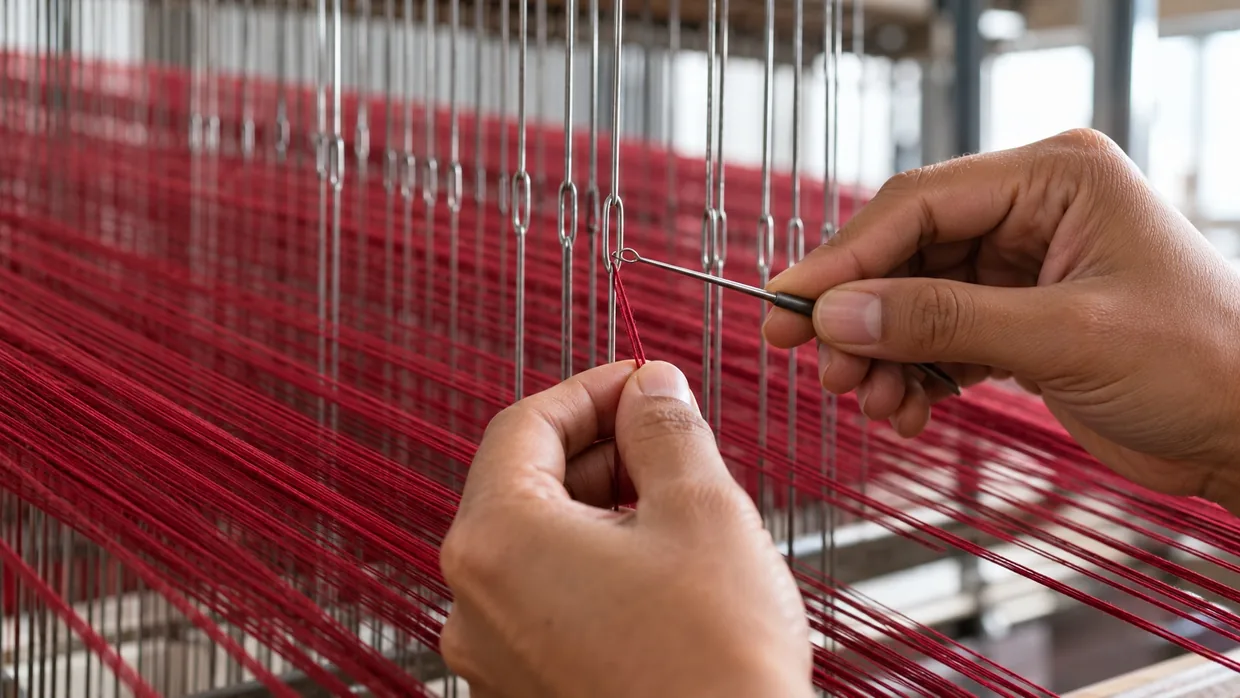
Each lengthwise thread in the warp is called an end. A fabric's width multiplied by its ends per inch (EPI, how many threads sit in one inch across the cloth) gives the total number of ends. For a typical suiting or shirting fabric that easily runs to several thousand ends, often well over five thousand on a wide, closely set cloth.
Every one of those ends has to reach the beam in its correct place. One missing or crossed end becomes a visible line running down the whole length of the fabric, which is why warping is done slowly and carefully compared with weaving itself.
The creel: where the cones sit
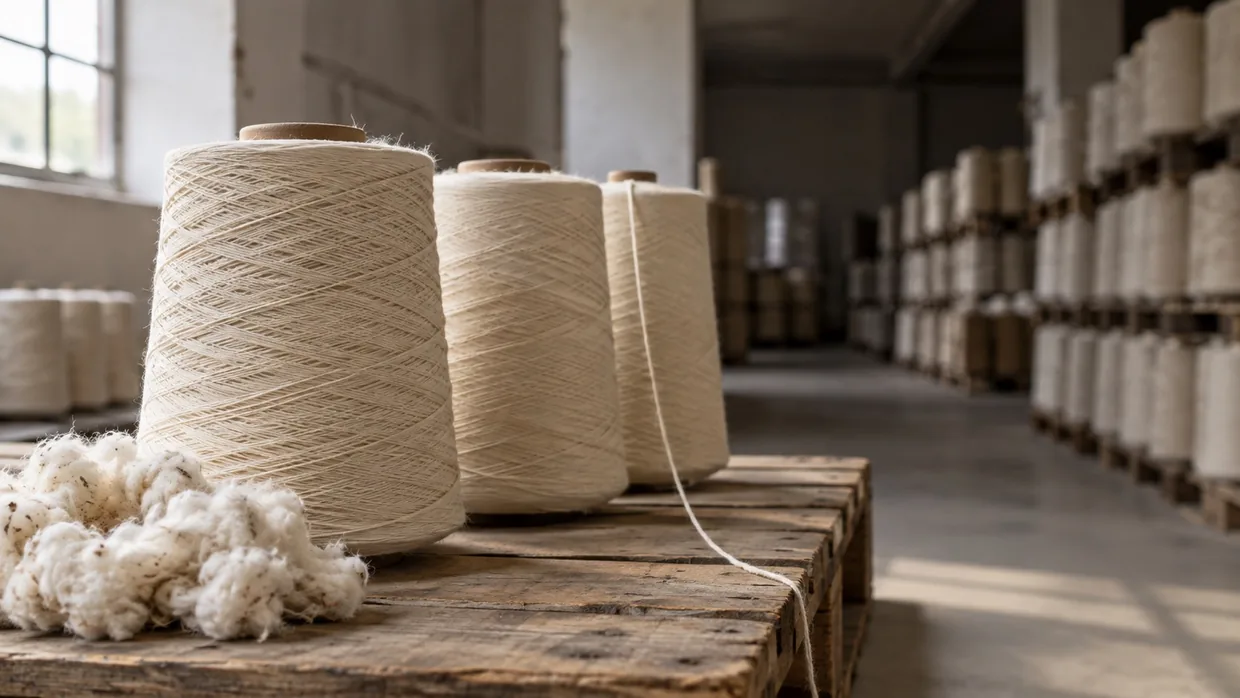
The yarn arrives from the spinning mill on cones. In warping, these cones are placed on a creel, a large frame with rows of pegs, one cone per peg. The yarn from each cone runs through its own small tensioner, a device that grips the thread lightly so it is pulled at a steady force, and then through guides toward the warping machine.
A creel holds several hundred cones, and a big direct warping creel up to around a thousand. But a fabric can need many thousands of ends, so the warp is usually built up in batches. How the batches are combined is the difference between the two main warping methods.
Direct warping: full width in sheets
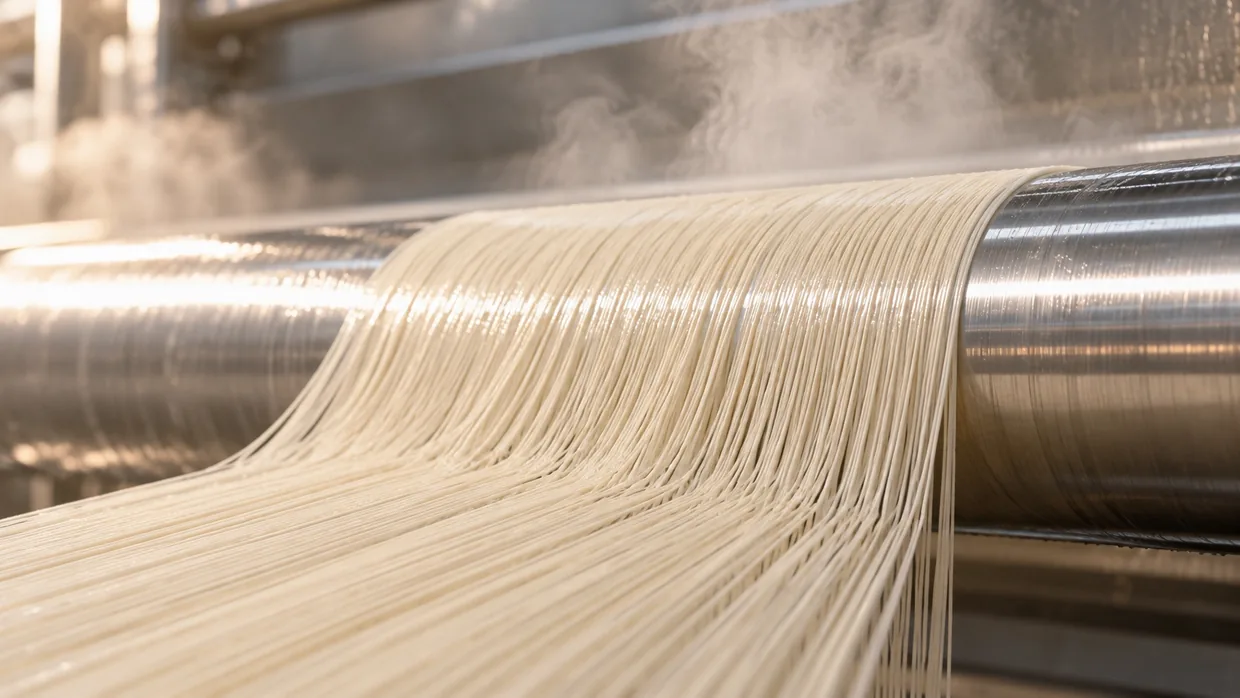
In direct warping, the yarn from the whole creel is wound straight onto a large beam, often called a warper's beam, across its full width. One creel load fills one beam with as many ends as the creel has cones, often several hundred and up to around a thousand. Several of these beams are made, and later they are combined into the final weaver's beam, usually during sizing, the next step.
Direct warping is fast and simple. It suits long runs of a single colour or a simple warp, such as the greige warps that are woven first and dyed later. Most solid-colour suiting and shirting warps are built this way.
Sectional warping: band by band
In sectional warping, the machine winds a narrow band of ends, a section, onto a large drum, then moves across and winds the next band beside it, until the full width is built up. The whole sheet is then transferred from the drum onto the weaver's beam in one go.
Because each band is made separately, the colour order within a band can be set exactly, thread by thread. That is why sectional warping is the usual choice for yarn-dyed fabrics, stripes and checks, where the warp has a colour pattern, and for shorter runs, where making several full beams by the direct method would waste yarn. Our yarn-dyed vs piece-dyed guide explains why those fabrics use coloured yarn in the first place.
Why even tension matters
Every end should be wound at the same tension. If some ends go onto the beam tighter than others, they sit at a different length and behave differently on the loom: the tight ones break more often, the slack ones float loose, and the cloth can show tight or slack lines, or ripples across the width.
Tension is controlled at the creel tensioners and by keeping the winding speed and beam pressure steady. A well-made beam is firm, flat across its width and the same diameter edge to edge, with no hard or soft patches.
Faults that start at warping
Many weaving faults are really warping faults that only show up later. A broken end that is not tied back properly, a missing end, ends crossed out of order, or a cone of slightly different yarn mixed in all travel down the full length of the beam.
- Missing or broken end: a thin line running lengthwise down the cloth.
- Wrong cone in the creel: a lengthwise streak that dyes or looks different.
- Uneven tension: tight or slack ends that break more on the loom or look wavy.
- Crossed ends: threads out of order, which cause breaks and pattern errors.
Our guide to woven fabric defects shows what these look like in finished fabric and who is responsible for fixing them.
Weft preparation
The weft, the crosswise thread, needs far less preparation than the warp. On modern shuttleless looms, such as rapier looms (which carry the weft across with a thin arm) and air-jet looms (which blow it across with compressed air), the weft is pulled straight off a large cone standing beside the loom. A small storage device beside the loom, called a weft feeder or accumulator, keeps a few turns of yarn ready on a drum. Each pick (the single row of weft laid across) is then pulled from that store at an even tension, instead of being pulled straight off the cone.
Older shuttle looms are different. The shuttle, a boat-shaped carrier thrown from side to side, holds only a small bobbin, so weft for those looms first has to be wound onto little bobbins called pirns.
Weft prep is lighter because the weft is under less strain. It is not held under tension for the whole run and is not rubbed by the loom parts thousands of times, so it does not need a beam, sizing or threading. The how a loom works lesson explains that difference in more detail.
Next lesson: Sizing: why warp yarn gets starched, the protective coating every warp gets before it goes on the loom. Browse the full course on the Textile Decoded hub.
FAQ
Frequently asked questions
- What is warping in weaving?
- Warping is winding the lengthwise threads (ends) from many cones onto one warp beam, side by side, at the same length and tension, so the loom can be fed a ready warp sheet.
- What is the difference between direct and sectional warping?
- Direct warping winds the full width from the creel onto beams that are combined later, and suits long, single-colour runs. Sectional warping builds the width in narrow bands on a drum, and suits stripes, yarn-dyed patterns and short runs.
- How many ends does a fabric have?
- It depends on width and ends per inch, but a typical suiting or shirting fabric commonly has several thousand ends across its width.
- Why does weft need less preparation than warp?
- The weft is not held under tension for the whole run or rubbed by the loom parts on every cycle. On shuttleless looms it runs straight off a cone; only shuttle looms need it wound onto small pirns first.
- Does Benny Cotts do its own warping?
- Yes. Warping and the rest of weaving preparation happen at our weaving unit in Village Atoon, Bhilwara. Dyeing and finishing are done by partnered Bhilwara process houses. You can Request Catalog at /quote to see the fabrics we weave.
Cite this guide
Quoting this page? Paste the line below so the credit links back.
<a href="https://www.bennycotts.com/guides/warping-building-the-warp-beam">Warping: Building the Warp Beam</a>, Benny Cotts, 2026Next in Preparing to weave
Sizing: Why Warp Yarn Gets Starched
More in Preparing to weave
- Warping: Building the Warp Beam
- Sizing: Why Warp Yarn Gets Starched
- Drawing-In: Getting the Beam Ready for the Loom
Updated 17 October 2026 · Benny Cotts, Bhilwara
Fabrics
Fabrics mentioned in this guide
Spec, price and MOQ on every fabric page.

Nano
Poly-Viscose blend · 180-200 GSM
Our entry-level uniform fabric for large-volume programs.

Sonata
Poly-Viscose blend · 190-210 GSM
Cost-efficient uniform fabric without compromising weave quality.

Grado 1st
Poly-Viscose blend · 220-240 GSM
Tailoring-grade fabric built for everyday durability.
Industries this applies to
Uniform programs these fabrics are used for
- Fabric for Business Attire
- Fabric for Corporate Uniforms
- Fabric for Corporate Shirts
- Fabric for Corporate Trousers
- Fabric for Blazers & Waistcoats
- Fabric for School Uniforms
- Fabric for College & University Uniforms
- Fabric for Sports & PT Uniforms
- Fabric for Pre-School & Kindergarten Uniforms
- Fabric for Doctor Coats
- Fabric for Nurse Scrubs
- Fabric for Lab Coats
- Fabric for OT & Surgical Wear
- Fabric for Patient Gowns
- Fabric for Hospital Staff Uniforms
- Fabric for Chef Coats
- Fabric for Salon & Spa Uniforms
- Fabric for Cabin Crew Uniforms
- Fabric for Ground Staff Uniforms
- Fabric for Army Uniforms
- Fabric for Police Uniforms
- Fabric for Security Guard Uniforms
- Fabric for Industrial Uniforms
- Fabric for Construction Workwear
- Fabric for Housekeeping Uniforms
- Fabric for Business Suits
- Fabric for Black-Tie Attire
- Fabric for Formal Event Wear
Fabric types covered here
Keep reading
Related guides
Ready to place an enquiry?