
Fabric basics
Yarn Counts and Blends Explained
A plain-language guide to how yarn count and yarn blend work, and why they quietly decide the weight, hand and cost of the uniform fabric you end up buying.

Jump to section
Quick answer
Yarn count is a numeric measure of how thick or fine a yarn is, and in the common Ne (English cotton count) system, a higher number means a finer yarn spun from the same weight of fiber. Count decides how many yarns can be packed into a given width, which in turn drives the fabric's GSM, drape and price. Uniform suiting typically uses yarns in the 20s to 40s Ne range, finer for premium formal fabrics, coarser for heavy-duty industrial cloth. The fiber blend chosen at the yarn stage, usually polyester and viscose in varying ratios for our fabrics, then decides how that yarn takes dye, handles heat in weaving, and behaves in the finished garment.
What yarn count actually measures
Yarn count is simply a way of describing how thick or thin a yarn is. Most mills in India, including us, use the Ne (English cotton count) system, where the count number tells you how many hanks of 840 yards fit into one pound of yarn. So a 20s count yarn is coarser and heavier per unit length, and a 40s count yarn is finer and lighter per unit length, spun from the same amount of raw fiber pulled out longer and thinner.
It helps to think of it the way you'd think of thread thickness for sewing. A low count number gives you a thick, sturdy yarn. A high count number gives you a fine, smooth yarn. Neither is better on its own, it depends what you're weaving and what the fabric needs to do once it's stitched into a uniform.
How count shapes the finished fabric
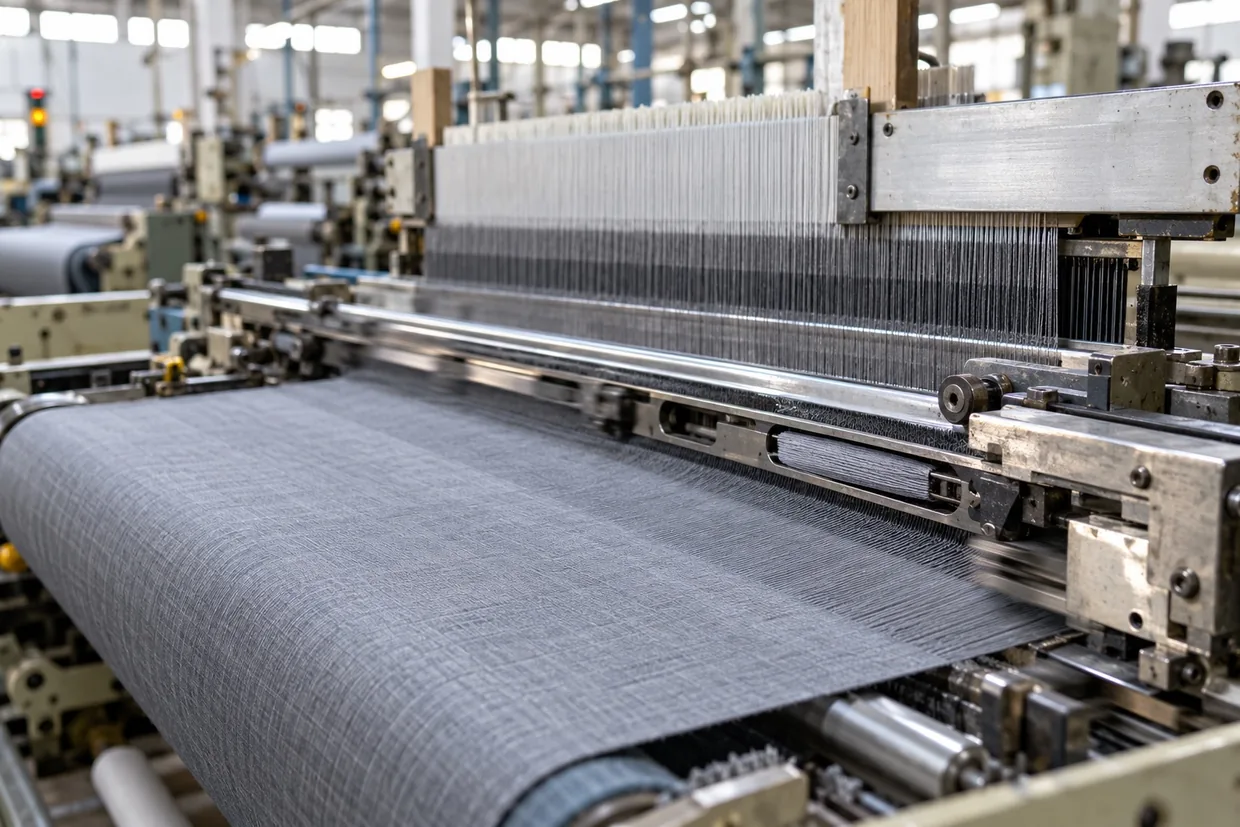
Once yarn goes onto a loom, its count decides how many ends and picks can be packed into the weave without the fabric becoming too stiff or too sheer. Finer yarns let the weaver pack more threads per inch, which usually gives a smoother surface, a softer hand, and a lighter but denser cloth. Coarser yarns give you a heavier, more textured fabric that tends to be tougher and more abrasion-resistant, at the cost of some softness and drape.
This is why GSM and yarn count are so closely linked. A fabric woven from finer count yarn at a tight weave can still come in at 200-230 GSM with a soft, almost shiny hand, the kind you'd want for formal corporate wear. A fabric meant for hard daily wear, like housekeeping or industrial uniforms, is often woven from a coarser count yarn to get durability and abrasion resistance, even if the hand is firmer.
Common count ranges in uniform suiting yarns
Uniform fabric doesn't use the very fine counts you'd see in shirting or the very coarse counts used in canvas or denim. Most of the suiting-weight yarns we buy and weave with sit somewhere in the 20s to 40s Ne range, and where a fabric falls in that band tells you a lot about what it's built for.
- 20s to 24s: heavier, coarser yarn, used for tough, high-wear fabrics meant to survive repeated hard use and washing, like industrial or housekeeping cloth.
- 28s to 32s: a middle ground, giving durable, easy-care fabric with a reasonably smooth hand, common in general corporate and institutional suiting.
- 36s to 40s: finer yarn, used where a softer hand, better drape and a more lustrous finish matter more, typically in premium formal and corporate fabrics.
Twist and ply: the other half of the yarn spec
Count tells you how thick a yarn is, but not how tightly it is twisted. Twist is what holds the fibers together, and it is usually given as turns per inch (TPI). A finer yarn needs more turns to hold together than a coarser one. So spinners also use a twist multiplier, a figure that scales the twist to the count, so yarns of different counts get a comparable degree of twist.
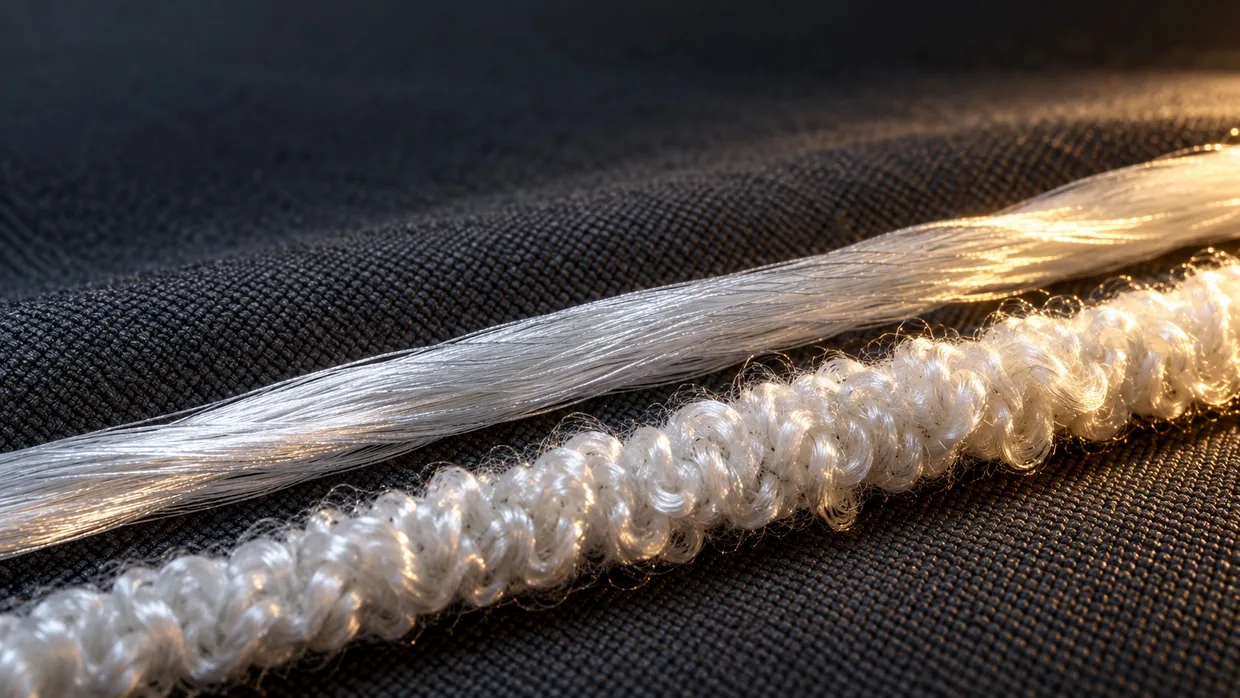
Twist direction is written as S or Z, after the slope of the spiral when the yarn is held upright. Within limits, more twist makes a yarn stronger, less hairy and firmer, but it also makes the handle harsher and the cloth less soft. Push twist very high and the yarn starts to kink and curl. Crepe fabrics use this on purpose to get their grainy, pebbled surface.
Ply is a separate step. A count written as 2/40 means two 40s singles yarns twisted together into one plied yarn. Plying evens out the thick and thin places in each single, so the result is stronger, rounder and more even than a single yarn of similar overall thickness, and it weaves into a cleaner, smoother cloth. That is why two-ply yarns are used in better suiting and premium shirting, where evenness and a crisp face matter. Most everyday uniform fabric is woven from singles.
Why blend matters as much as count
Count tells you how thick the yarn is. Blend tells you what it's made of, and that decision is made even before the yarn reaches our looms. Most of our uniform fabrics are woven from polyester-viscose (PV) blended yarn, with the ratio between the two fibers set at the spinning stage. Polyester brings strength, shape retention and wash durability. Viscose brings softness, better dye uptake and a more natural, less plasticky feel against the skin.
If the blend ratio is wrong for the end use, no weaving or finishing can fully fix it. A blend too heavy in polyester can feel stiff and hold onto heat, which is a problem for daily-wear uniforms in a hot climate. A blend too heavy in viscose can lose shape and durability faster under the wash-and-wear cycle a work uniform goes through. This is why we choose the blend ratio to match the fabric's job, not just its look.
How count and blend set up everything downstream
This is the core point of this guide: how a uniform fabric performs after it is cut and stitched is not decided at the end. It is decided at the yarn stage, in the count chosen and the fiber blend spun into that yarn, well before the yarn reaches a weaver's loom.
| Stage | What count and blend decide |
|---|---|
| Weaving | Count sets how tightly the yarn can be packed, deciding GSM, hand and drape of the greige fabric |
| Dyeing | Blend ratio decides how evenly and deeply the fabric takes colour, since polyester and viscose accept dye differently |
| Finishing | Blend and count together decide how the fabric responds to heat-setting and finishing treatments applied by our processing partners |
| Wear and wash | Blend ratio decides long-term durability, shrinkage and shape retention once the uniform is in daily use |
What this means for you as a buyer
You don't need to become a spinning expert to buy fabric well, but it helps to ask a mill two simple questions before you commit to a fabric for a large uniform order. First, what yarn count and blend ratio is this fabric woven from. Second, does that combination match how the uniform will actually be worn and washed.
At Benny Cotts, we weave at our own unit in Atoon, Bhilwara, and our fabric is finished through trusted processing partners in the region. Knowing the yarn count and blend behind a fabric gives you a straightforward way to compare options on substance, GSM, hand, durability, rather than on shade or price alone.
FAQ
Frequently asked questions
- Does a higher yarn count always mean a better fabric?
- No. A higher count means a finer yarn, which usually gives a softer hand and lighter, smoother cloth, but that isn't automatically better. A uniform that needs to survive rough daily wear, like housekeeping or industrial workwear, often does better with a coarser, lower-count yarn woven into a heavier, more abrasion-resistant fabric.
- What yarn counts does Benny Cotts typically use for uniform suiting?
- Our uniform suiting yarns generally fall between 20s and 40s Ne. Coarser counts around 20s to 24s go into tougher, heavy-duty fabrics, mid-range counts around 28s to 32s suit general corporate and institutional wear, and finer counts around 36s to 40s go into softer, more lustrous premium formal fabrics.
- Why do you use polyester-viscose blends instead of pure polyester or pure viscose yarn?
- A blend lets you get the strengths of both fibers and manage the weaknesses of each. Polyester alone gives strength and durability but can feel stiff and hold heat. Viscose alone feels soft and takes dye well but wears out and loses shape faster. Blending the two at the yarn stage balances durability against comfort for uniform wear.
- Can yarn count and blend be checked once the fabric is already woven?
- A mill can identify approximate count and blend composition through basic tests on woven fabric, but it's far more reliable to ask upfront what count and blend a fabric is built from before you place a large order, since these decisions are locked in at the yarn stage and shape everything that follows in weaving, dyeing and finishing.
- Why does yarn count affect fabric GSM?
- Finer, higher-count yarn lets the weaver pack more ends and picks into the same width, giving a denser but lighter cloth with a smoother hand. Coarser, lower-count yarn produces a heavier, more textured fabric. That's why count and GSM move together rather than independently.
- Does yarn blend affect how a fabric takes dye?
- Yes. Polyester and viscose accept dye differently, so the blend ratio set at the yarn stage decides how evenly and deeply a fabric takes colour during dyeing. This is one of the reasons blend ratio is chosen to match the fabric's end use, not just decided for looks.
Cite this guide
Quoting this page? Paste the line below so the credit links back.
<a href="https://www.bennycotts.com/guides/yarn-counts-and-blends-explained">Yarn Counts and Blends Explained</a>, Benny Cotts, 2026Next in Yarn
Combed, Carded, Sanforized: Spec-Sheet Terms Explained
More in Yarn
- How a Spinning Mill Works
- Ring, Open-End and Air-Jet Spinning Explained
- Yarn Counts and Blends Explained
- Combed, Carded, Sanforized: Spec-Sheet Terms Explained
- Texturised Yarn in Suiting: What It Is and What It Changes
- What Moves Yarn Prices: Fiber, Count, Spinning and the Market
- Yarn Quality: What to Check Before It Becomes Fabric
Updated 12 October 2026 · Benny Cotts, Bhilwara
Fabrics
Fabrics mentioned in this guide
Spec, price and MOQ on every fabric page.

Grado 1st
Poly-Viscose blend · 220-240 GSM
Tailoring-grade fabric built for everyday durability.

Sonata
Poly-Viscose blend · 190-210 GSM
Cost-efficient uniform fabric without compromising weave quality.

Nano
Poly-Viscose blend · 180-200 GSM
Our entry-level uniform fabric for large-volume programs.
Industries this applies to
Uniform programs these fabrics are used for
- Fabric for Business Attire
- Fabric for Corporate Uniforms
- Fabric for Corporate Shirts
- Fabric for Corporate Trousers
- Fabric for Blazers & Waistcoats
- Fabric for School Uniforms
- Fabric for College & University Uniforms
- Fabric for Sports & PT Uniforms
- Fabric for Pre-School & Kindergarten Uniforms
- Fabric for Doctor Coats
- Fabric for Nurse Scrubs
- Fabric for Lab Coats
- Fabric for OT & Surgical Wear
- Fabric for Patient Gowns
- Fabric for Hospital Staff Uniforms
- Fabric for Chef Coats
- Fabric for Salon & Spa Uniforms
- Fabric for Cabin Crew Uniforms
- Fabric for Ground Staff Uniforms
- Fabric for Army Uniforms
- Fabric for Police Uniforms
- Fabric for Security Guard Uniforms
- Fabric for Industrial Uniforms
- Fabric for Construction Workwear
- Fabric for Housekeeping Uniforms
- Fabric for Business Suits
- Fabric for Black-Tie Attire
- Fabric for Formal Event Wear
Fabric types covered here
Keep reading
Related guides


Ready to place an enquiry?