
Fabric basics
Combed, Carded, Sanforized: Spec-Sheet Terms Explained
What combed and carded yarn actually mean, why sanforizing applies to cotton and heat-setting to polyester blends, and which of these terms belong on a uniform fabric specification.

Jump to section
- Carded and combed yarn
- What the difference means in a uniform
- Sanforizing and residual shrinkage
- Shrinkage is two numbers, and the test conditions matter
- Why poly-viscose fabrics are heat-set, not sanforized
- Mercerised, and other cotton-only terms
- Choosing for your program
- Common buyer mistakes
- What belongs on your specification
Quick answer
Combed and carded describe how a yarn was prepared before spinning: carded yarn keeps the short fibers, combed yarn has them removed, which makes it smoother, stronger and more expensive. Sanforized describes a mechanical pre-shrinking process applied to cotton-containing fabric so it shrinks less in the first wash. Polyester and poly-viscose fabrics are stabilised by heat-setting instead, which is why sanforized is the wrong term to ask for on a poly-viscose suiting and heat-set is the right one.
Carded and combed yarn
Before staple fibers can be spun into yarn they have to be cleaned and aligned. Carding does the first pass, opening the fiber mass and laying the fibers roughly parallel. A yarn spun straight after carding is a carded yarn, and it still contains the full range of fiber lengths, including short ones.
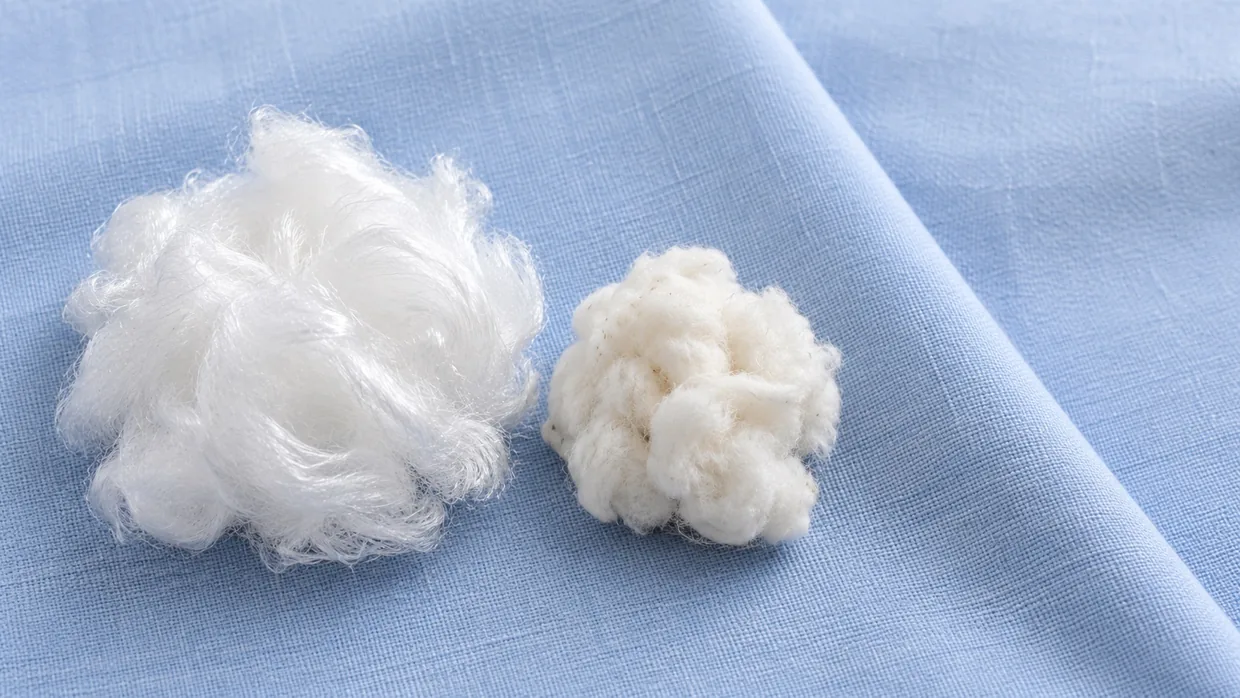
Combing is an extra step after carding that removes the shortest fibers and aligns the rest more precisely. A combed yarn is therefore made from longer, more parallel fibers. Removing material costs money twice, once in the processing and once in the fiber thrown away. That is why combed yarn always costs more than carded yarn of the same count.
| Carded yarn | Combed yarn | |
|---|---|---|
| Short fibers | Retained | Removed |
| Surface | More hairy, more protruding fiber ends | Smoother, cleaner |
| Strength | Lower for the same count | Higher for the same count |
| Pilling tendency | Higher | Lower |
| Cost | Lower | Higher |
| Typical use | Everyday and volume programs | Finer shirtings and premium suitings |
What the difference means in a uniform
The protruding fiber ends on a carded yarn are what a wearer eventually notices. They give a slightly warmer, less smooth handle, and under abrasion they are what forms pills on the fabric surface. A combed yarn, with those short fibers already removed, stays smoother through more wash and wear cycles.
That does not make carded yarn the wrong choice. For a high-volume program where cost per metre governs and the garment will be replaced on a cycle, carded yarn is often the sensible specification. Where the fabric is close to the skin, or the garment is expected to look presentable for years, combed is usually worth the difference. The decision depends on the program, not on a general rule about quality.
Sanforizing and residual shrinkage
Cotton-containing fabric shrinks when it is first washed, because weaving and finishing leave the yarns held under tension that the first wash releases. Sanforizing is a controlled mechanical pre-shrinking process: the fabric is compressed and shrunk under steam before it ever reaches a buyer, so that most of the shrinkage that would have happened in the first wash has already happened at the mill.
A sanforized fabric is not a fabric that cannot shrink. Its remaining shrinkage has been brought within a stated limit, usually given as a residual shrinkage percentage. That figure is the number worth asking about. The word sanforized on its own describes a process, not a guaranteed value. Our shrinkage guide covers how residual shrinkage is tested and what to specify.
Shrinkage is two numbers, and the test conditions matter
Shrinkage is reported separately along the length (the warp direction) and across the width (the weft direction), and the two are rarely equal. A fabric can be well controlled in one direction and not in the other, so a single figure on a spec sheet can hide the one that matters for your garment. Ask for both.
The wash conditions of the test matter just as much. A gentle cool wash and a hot wash release different amounts of shrinkage, so a figure with no stated wash method cannot be compared with another supplier's. Ask which method and temperature were used, and match it to how your uniforms will really be laundered. Our shrinkage guide explains how the test works.
Why poly-viscose fabrics are heat-set, not sanforized
Polyester is a thermoplastic fiber, which means its shape can be fixed with heat. Poly-viscose and poly-cotton fabrics are therefore stabilised by heat-setting, passing the fabric through controlled heat so the polyester component is locked into a stable dimension. It is the equivalent step to sanforizing, achieved by an entirely different mechanism.
This is why asking for a sanforized poly-viscose suiting is a specification error, not a strict requirement. It matters most where the cloth is bonded to something else, as in collar and cuff fusing. The correct question for a polyester-rich blend is what the dimensional stability is after a stated wash, and whether the fabric has been heat-set. Most of our range is poly-viscose, poly-cotton and polyester, so heat-setting rather than sanforizing is the relevant process across the catalogue.
Mercerised, and other cotton-only terms
A few other spec-sheet terms apply only where cotton is present, and they get quoted loosely on blends where they mean nothing. Mercerising treats cotton with a caustic solution under tension, which increases shine, strength and dye uptake. It is a real and visible improvement on a cotton fabric, and it has no meaning on a fabric with no cotton in it.
The general point is worth carrying into every specification you read. Process terms belong to fibers. A term borrowed from cotton finishing and applied to a polyester blend is a sign the specification was copied together without care. Question it before it becomes a contract requirement that nobody can test.
Choosing for your program
A simple way to decide is to ask three questions. How close to the skin is the garment? A shirt or polo sits against the body all day and shows surface wear first, so smoothness pays back. How long must it look good? A uniform replaced every year or two does not need the extra life, while one expected to last for years does. And how hard will it be washed? Frequent laundering rubs the surface fibers again and again, which is where carded yarn starts to pill first.
If the answers point both ways, ask the mill for a tested pilling grade on each option and compare the two. Sometimes a combed yarn at a slightly coarser count, or a carded yarn in a tighter weave, meets the need at a better cost. Fiber type matters as well: in a polyester-rich blend, pilling is often driven more by the polyester than by the yarn preparation, so the combed premium buys less there.
Common buyer mistakes
- Asking for combed yarn in the belief that it is a quality grade in itself. It is a preparation step with a cost, and it only pays back where smoothness and pilling matter.
- Asking for sanforized on a polyester-rich cloth, which names the wrong process and cannot be tested in a meaningful way.
- Accepting the word sanforized with no residual shrinkage figure and no stated wash method.
- Comparing a combed and a carded quote as if they were the same cloth. The price gap is real, so compare yarn count and pilling results too.
- Copying cotton finishing terms such as mercerised onto a blend specification, where they mean nothing.
- Assuming a fabric looks combed because it feels smooth. Finish can make a carded cloth feel smooth for a while, so ask for the yarn preparation in writing.
What belongs on your specification
Rather than requesting process names, specify the outcome you need and let the mill state the process that achieves it. Outcomes can be tested. Process names are not always relevant to the blend in question.
- The blend and its ratio, since that determines which processes even apply
- Yarn count, and combed or carded where the handle and pilling behaviour matter to you
- Dimensional stability as a permitted shrinkage percentage after a stated wash
- Whether the fabric is heat-set, for polyester-rich blends, or sanforized, where cotton is present
- Pilling resistance, where the garment will see heavy abrasion
Our guide to reading a fabric spec sheet covers how these fields sit alongside GSM, width and weave, and the yarn counts guide explains how count is written and what it implies.
FAQ
Frequently asked questions
- Can I tell combed from carded by looking at the fabric?
- Not reliably. Under a magnifier a combed yarn shows fewer protruding fiber ends, but finishing can make a carded cloth look and feel smooth when new. The dependable answer is the mill's written statement of the yarn preparation, backed by a tested pilling grade.
- Do I need to specify combed for a poly-viscose suiting?
- The terms describe how staple fiber is prepared, so they can apply to spun blends. For a polyester-rich suiting, though, the tested pilling grade, the yarn count and heat-setting tell you more about wear than the word combed does. Ask the mill what it does and ask for the test result.
- Is combed yarn always better than carded?
- It is smoother, stronger for the same count and less prone to pilling, and it costs more. Whether that is better depends on the program. For high-volume uniforms on a replacement cycle, carded yarn is often the right economic choice; for garments worn close to the skin or expected to look presentable for years, combed usually earns its cost.
- Can a poly-viscose fabric be sanforized?
- Sanforizing is a pre-shrinking process for cotton-containing fabric. A polyester-rich blend is stabilised by heat-setting instead, which fixes the polyester component's dimensions with controlled heat. For a poly-viscose suiting, ask about heat-setting and about dimensional stability after a stated wash rather than about sanforizing.
- Does sanforized mean the fabric will not shrink at all?
- No. It means most of the first-wash shrinkage has already been taken out at the mill and the remainder has been brought within a stated limit. The useful figure is that residual shrinkage percentage, not the word itself.
- Why does carded fabric pill more?
- Because the short fibers that combing removes are still present, and their ends protrude from the yarn surface. Under abrasion those ends tangle into small balls on the fabric face. Removing them at the combing stage is what makes a combed yarn stay smoother for longer.
- Does mercerising apply to uniform suitings?
- Only where cotton is present, since it is a treatment of cotton fiber. On a poly-viscose or all-polyester suiting the term has no meaning, and seeing it in a specification for such a fabric is usually a sign the specification needs querying.
Cite this guide
Quoting this page? Paste the line below so the credit links back.
<a href="https://www.bennycotts.com/guides/combed-carded-sanforized-explained">Combed, Carded, Sanforized: Spec-Sheet Terms Explained</a>, Benny Cotts, 2026Next in Yarn
Texturised Yarn in Suiting: What It Is and What It Changes
More in Yarn
- How a Spinning Mill Works
- Ring, Open-End and Air-Jet Spinning Explained
- Yarn Counts and Blends Explained
- Combed, Carded, Sanforized: Spec-Sheet Terms Explained
- Texturised Yarn in Suiting: What It Is and What It Changes
- What Moves Yarn Prices: Fiber, Count, Spinning and the Market
- Yarn Quality: What to Check Before It Becomes Fabric
Updated 25 October 2026 · Benny Cotts, Bhilwara
Fabrics
Fabrics mentioned in this guide
Spec, price and MOQ on every fabric page.

Cambery
Poly-cotton blend · 150-180 GSM
Chambray-style fabric with a soft, breathable finish.

Commander Shirting 36"
Poly-Viscose 70/30 · 168 GSM
Fine 1/20 poly-viscose shirting in a narrow 36-inch width.

Spun Shirting
Micro 1/40s spun polyester · 67 GSM
Lightweight micro shirting, spun 1/40s count, in 74 shades.

Grado 1st
Poly-Viscose blend · 220-240 GSM
Tailoring-grade fabric built for everyday durability.

Cotton Cool-3200
Poly-Viscose 65/35 · 249 GSM
Breathable poly-viscose with a cool, cotton-like handle for uniforms.
Industries this applies to
Uniform programs these fabrics are used for
- Fabric for Business Attire
- Fabric for Corporate Uniforms
- Fabric for Corporate Shirts
- Fabric for Corporate Trousers
- Fabric for Blazers & Waistcoats
- Fabric for School Uniforms
- Fabric for College & University Uniforms
- Fabric for Pre-School & Kindergarten Uniforms
- Fabric for Doctor Coats
- Fabric for Nurse Scrubs
- Fabric for Lab Coats
- Fabric for OT & Surgical Wear
- Fabric for Patient Gowns
- Fabric for Hospital Staff Uniforms
- Fabric for Hotel Uniforms
- Fabric for Chef Coats
- Fabric for Waiter Uniforms
- Fabric for Salon & Spa Uniforms
- Fabric for Cabin Crew Uniforms
- Fabric for Ground Staff Uniforms
- Fabric for Police Uniforms
- Fabric for Business Suits
- Fabric for Black-Tie Attire
- Fabric for Formal Event Wear
Fabric types covered here
Keep reading
Related guides





Ready to place an enquiry?