Textile Decoded
Drawing-In: Getting the Beam Ready for the Loom
How every warp end is threaded through a drop wire, a heald eye and a reed dent, how that threading sets the weave and the ends per inch, and when mills tie in instead.
Jump to section
Quick answer
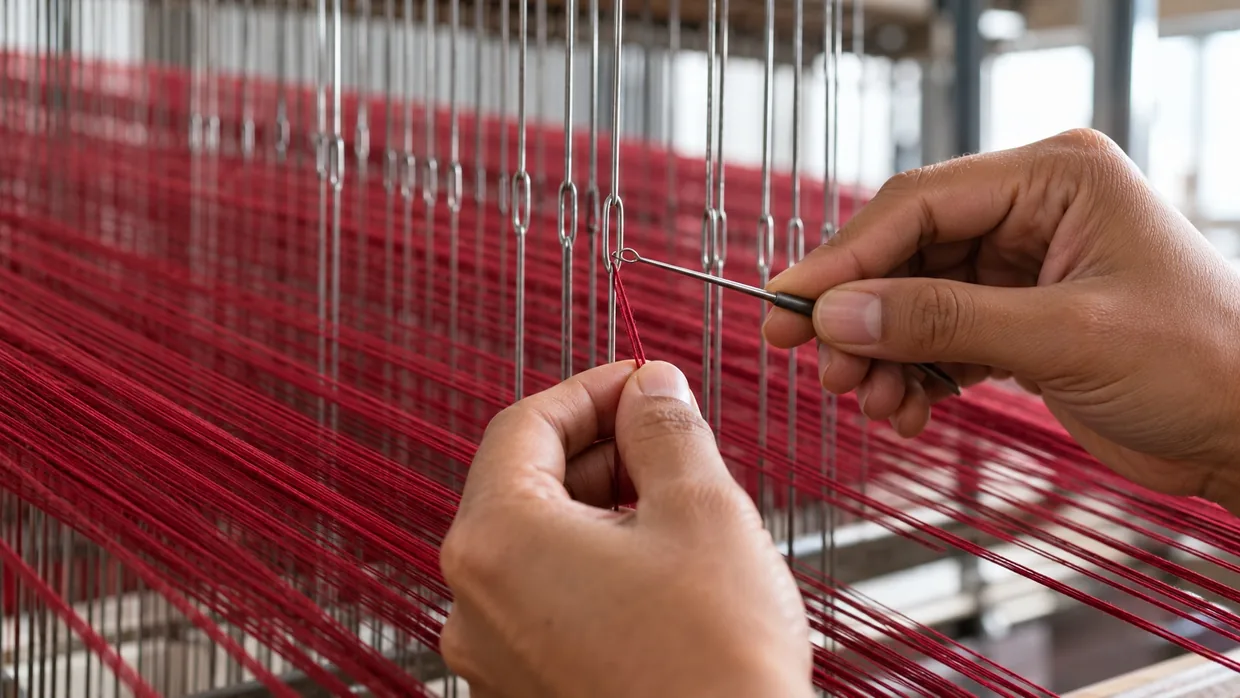
Drawing-in is threading every warp end through three loom parts in a planned order. These are a drop wire that stops the loom if the end breaks, the eye of a heald wire that lifts or lowers the end, and a gap in the reed, the comb that spaces the ends and beats in the weft. The order of threading through the heald frames, together with how those frames lift, decides the weave, such as plain or twill. How many ends go through each reed gap, and how many gaps the reed has per inch, set the ends per inch. It is done by hand or by automatic machines. When the same style is woven again, mills often skip it and simply tie the new warp's ends to the old ones.
The last step before weaving
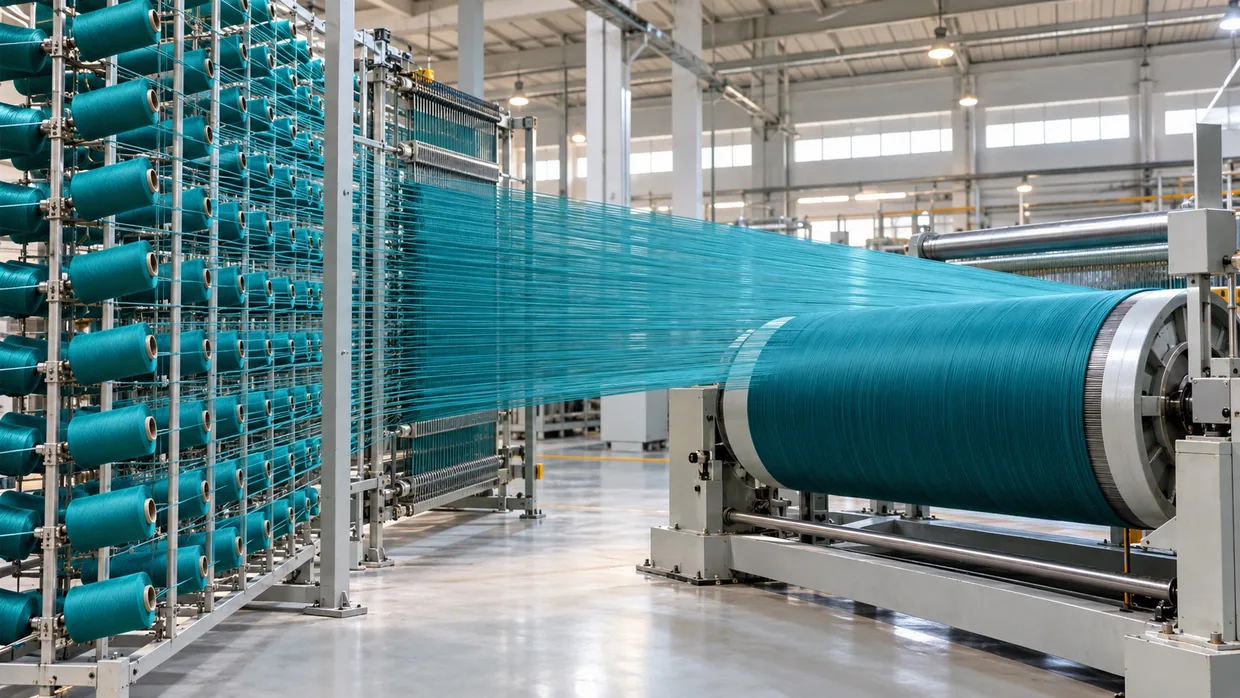
After warping built the beam and sizing coated the yarn, the warp is still just a sheet of thousands of parallel threads on a roller. The loom cannot use it yet. Each thread, or end, has to pass through the parts of the loom that will control it, in exactly the right order.
Picture threading thousands of needles, each through three different eyes, without skipping or crossing a single one. That job is drawing-in. At Benny Cotts it is done as part of weaving preparation at our weaving unit in Village Atoon, Bhilwara.
Three things every end passes through
Read from the back of the loom to the front, each end goes through:
- Drop wire: a thin metal strip that rides on the end. If the end breaks, the strip falls and stops the loom so the weaver can mend it.
- Heald eye: a heald (also called a heddle) is a wire with a small eye in the middle, hung in a heald frame. The frame rises and falls on the loom, lifting or lowering every end threaded through its healds.
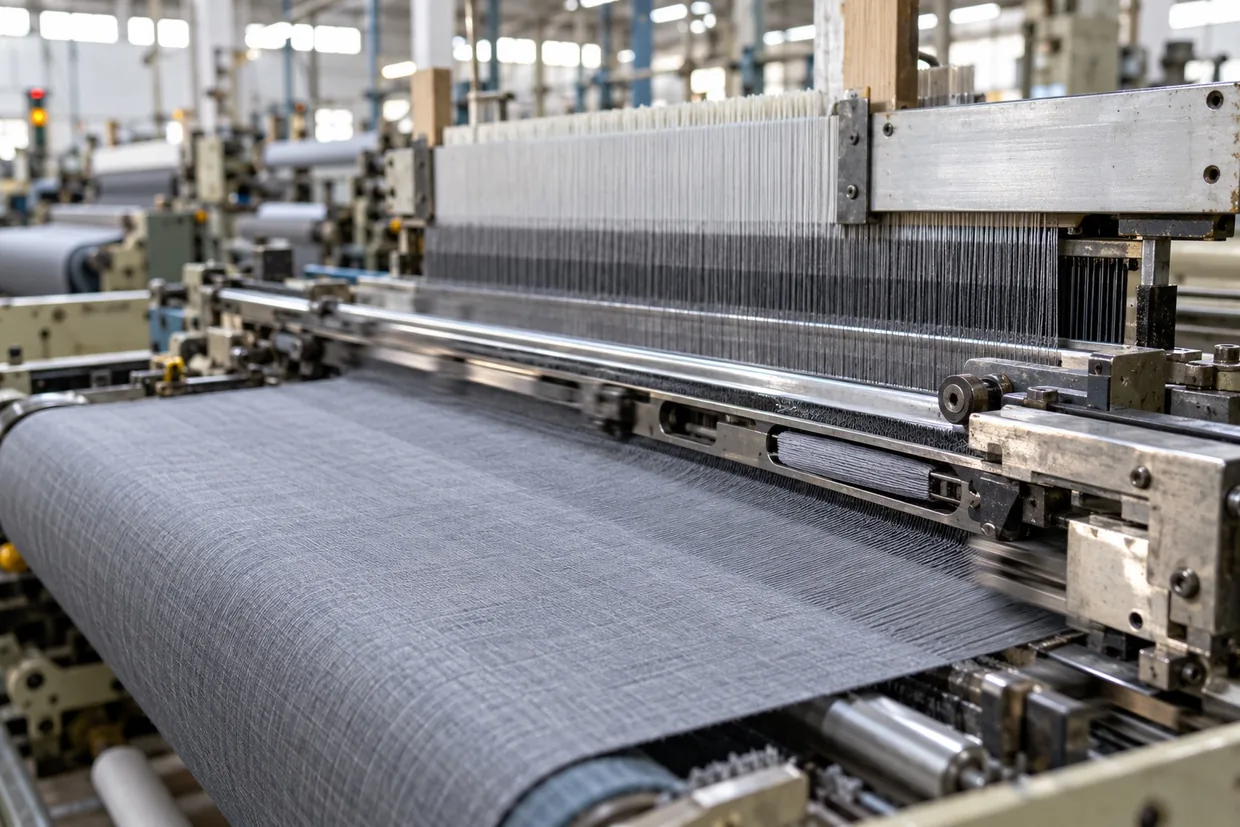
- Reed dent: the reed is a fine metal comb across the width of the loom. Each gap between its wires is a dent. The reed keeps the ends evenly spaced and pushes each new weft row into the cloth.
The how a loom works lesson shows where each of these parts sits and what it does while weaving.
The drawing-in plan decides the weave
A loom has several heald frames, and drawing-in follows a plan, called the draft, that says which frame each end goes to. On the loom, a separate lifting plan says which frames rise for each weft row. Together, the draft and the lifting plan decide the weave.
For a plain weave, the simplest case, the ends are threaded alternately onto two groups of frames, so every other end lifts together and each weft row goes over one end and under the next. For a twill, the ends are threaded across three or more frames in a repeating order. The frames lift in a stepping sequence, which creates the diagonal line. Our twill vs plain weave guide shows how those weaves differ in a uniform.
Because the draft is fixed once the beam is threaded, changing to a weave that needs a different threading means drawing in again. Some changes, like moving from one twill to another on the same threading, need only a change in the lifting plan.
Denting and the reed count
Putting the ends into the reed is called denting. A reed is described by its count, how many dents it has in a given width, such as per inch. The weaver also decides how many ends go into each dent, often two, sometimes more.
Multiply the two and you get, roughly, the ends per inch (EPI) of the warp in the loom: for example, a reed with 40 dents per inch and 2 ends per dent gives about 80 ends per inch. The finished fabric usually ends up with a somewhat higher EPI, because the cloth narrows slightly as it is woven and again in finishing. This is why EPI is decided at drawing-in. Changing it means a new warp, as the loom lesson explains.
Hand drawing vs automatic machines
Traditionally, drawing-in is done by hand. One worker, often helped by a second, picks each end in turn and pulls it through its drop wire, heald and dent with a slim hook, following the draft. It is slow, careful work, and a beam of several thousand ends can take many hours.
Automatic drawing-in machines do the same job mechanically: they separate one end at a time from the sheet and pass it through the drop wire, heald and reed in the programmed order. They are much faster and make fewer mistakes, but they are a large investment. Many mills use a mix, depending on the style and how often it changes.
Knotting: tying in the next warp
When a beam runs out and the next beam is for the same style, there is no need to thread everything again. The old ends are left in the drop wires, healds and reed, and each new end is simply tied to the matching old end. This is called knotting or tying-in, and it is usually done with a knotting machine that ties the ends one by one.
Once all the knots are made, the new warp is pulled forward through the loom parts, the knots pass through, and weaving carries on with the same threading. Tying-in is much quicker than full drawing-in, which is one reason repeat orders of a running style are easier for a weaver than a brand new construction.
Faults that start at drawing-in
A mistake here repeats down the full length of the warp.
- Wrong draft: an end on the wrong frame shows as a lengthwise line where the weave is broken.
- Wrong denting: too many or too few ends in a dent leaves a lengthwise reed mark or gap.
- Crossed ends: ends threaded out of order rub against each other and break.
- Missed drop wire: a broken end may not stop the loom, so the fault runs on.
Our guide to woven fabric defects shows how these appear in the cloth.
What this means for a fabric buyer
Drawing-in fixes two things a buyer cares about: the weave and the ends per inch. That is why a new construction takes longer to set up than a repeat of a running style, and part of why custom weaving carries a minimum order quantity, which our uniform fabric MOQ guide explains.
Once the beam is drawn in, it is carried to the loom and weaving begins. The greige fabric then goes to our partnered Bhilwara process houses for dyeing and finishing.
Next lesson: How a loom works, the parts and motions that turn the threaded warp into cloth. Browse the full course on the Textile Decoded hub.
FAQ
Frequently asked questions
- What is drawing-in in weaving?
- Drawing-in is threading each warp end through its drop wire, heald eye and reed dent in a planned order, so the loom can control every end during weaving.
- How does drawing-in decide the weave?
- The draft says which heald frame each end is threaded onto. Combined with the order in which the frames lift on the loom, it decides whether the cloth comes out as plain weave, twill or another weave.
- How does reed count relate to ends per inch?
- Roughly, dents per inch multiplied by ends per dent gives the ends per inch in the loom. The finished fabric usually ends up a little denser because it narrows during weaving and finishing.
- What is knotting or tying-in?
- When a new beam is for the same style, each new end is tied to the matching end of the old warp still threaded in the loom, and pulled through. It is much faster than drawing in from scratch.
- Does Benny Cotts do its own drawing-in?
- Yes. Drawing-in is part of weaving preparation at our weaving unit in Village Atoon, Bhilwara. Dyeing and finishing are done by partnered Bhilwara process houses. You can Request Catalog at /quote to see the fabrics we weave.
Cite this guide
Quoting this page? Paste the line below so the credit links back.
<a href="https://www.bennycotts.com/guides/drawing-in-loom-ready-beam">Drawing-In: Getting the Beam Ready for the Loom</a>, Benny Cotts, 2026More in Preparing to weave
- Warping: Building the Warp Beam
- Sizing: Why Warp Yarn Gets Starched
- Drawing-In: Getting the Beam Ready for the Loom
Updated 17 October 2026 · Benny Cotts, Bhilwara
Fabrics
Fabrics mentioned in this guide
Spec, price and MOQ on every fabric page.

Nano
Poly-Viscose blend · 180-200 GSM
Our entry-level uniform fabric for large-volume programs.

Sonata
Poly-Viscose blend · 190-210 GSM
Cost-efficient uniform fabric without compromising weave quality.

Grado 1st
Poly-Viscose blend · 220-240 GSM
Tailoring-grade fabric built for everyday durability.
Industries this applies to
Uniform programs these fabrics are used for
- Fabric for Business Attire
- Fabric for Corporate Uniforms
- Fabric for Corporate Shirts
- Fabric for Corporate Trousers
- Fabric for Blazers & Waistcoats
- Fabric for School Uniforms
- Fabric for College & University Uniforms
- Fabric for Sports & PT Uniforms
- Fabric for Pre-School & Kindergarten Uniforms
- Fabric for Doctor Coats
- Fabric for Nurse Scrubs
- Fabric for Lab Coats
- Fabric for OT & Surgical Wear
- Fabric for Patient Gowns
- Fabric for Hospital Staff Uniforms
- Fabric for Chef Coats
- Fabric for Salon & Spa Uniforms
- Fabric for Cabin Crew Uniforms
- Fabric for Ground Staff Uniforms
- Fabric for Army Uniforms
- Fabric for Police Uniforms
- Fabric for Security Guard Uniforms
- Fabric for Industrial Uniforms
- Fabric for Construction Workwear
- Fabric for Housekeeping Uniforms
- Fabric for Business Suits
- Fabric for Black-Tie Attire
- Fabric for Formal Event Wear
Fabric types covered here
Keep reading
Related guides
Ready to place an enquiry?