
Fabric basics
How to Read a Fabric Spec Sheet
A plain-language guide to the terms on a uniform fabric spec: composition, GSM, width, weave, colour and finish, and what each one tells a buyer.
Jump to section
- The seven fields on a spec sheet
- Composition: the blend decides behaviour
- GSM and width: the numbers that cost money
- Weave and finish: how it wears
- Testing and certification: how a claim gets verified
- Strength and abrasion: the methods behind the numbers
- Breathability: what a spec sheet can actually prove
- The chemical rows: pH, azo dyes and formaldehyde
- A worked read of a real spec
- Building a spec from a swatch when you are changing supplier
Quick answer
A fabric spec sheet describes seven things: composition (the blend), GSM (the weight), width (usable meters), weave (the construction), colour options, finish (how it behaves in wear), and testing or certification (how those claims are verified). Read together, they tell you how a fabric will feel, wear, wash and cut, which is everything you need to compare two fabrics or brief a mill.
The seven fields on a spec sheet
| Field | What it means | Why it matters |
|---|---|---|
| Composition | The fiber blend, e.g. poly-viscose 65/35 | Decides comfort, durability, care and cost |
| GSM | Grams per square meter (weight) | Heavier wears longer and warmer |
| Width | Usable fabric width, commonly 147 or 150 cm on suitings | Determines meters needed per garment |
| Weave | Construction: plain, twill, dobby | Affects strength, drape and texture |
| Colour | Available shades and custom options | Consistency across a program |
| Finish | Treatments: wash-fast, wrinkle-resistant | How it behaves in real wear |
| Testing / certification | How claims like wash fastness or shrinkage are verified | Turns a claim into a number you can hold a mill to |
Composition: the blend decides behaviour
Composition is the first line to read because it governs everything else. A poly-viscose 65/35 blend behaves very differently from pure cotton: more wrinkle resistance, better wash fastness, lower cost, slightly less breathability. Every Benny Cotts suiting states its blend, so you know what you are comparing.
GSM and width: the numbers that cost money
GSM is weight, covered in depth in our GSM guide. Width is the one buyers forget. At 150 cm you fit more garment pieces across the cloth than at 110 cm, so the fabric needed per uniform, and therefore the cost, changes with width. Always compare fabrics at the same width, and read the width from the specific spec sheet instead of assuming a standard. Most of our qualities are 147 cm (58 inch), and narrower shirting and lining cloths run 142, 91 or 89 cm. On shirting the choice between the two common formats is a cutting-room decision, covered in 36 inch vs 58 inch shirting.
Weave and finish: how it wears
Weave is the construction. Plain is simple and even; twill (the diagonal line in trousers and structured suiting) is stronger and drapes well; dobby adds a subtle woven texture. Finish is the treatment layer: wash-fast holds colour through laundering, wrinkle-resistant reduces ironing, and abrasion-resistant survives high-wear points.
Read weave and finish together with GSM: a 220 GSM twill with a wash-fast finish tells you far more than the weight alone.
Testing and certification: how a claim gets verified
A finish label such as "wash-fast" or "wrinkle-resistant" is a claim; testing is how that claim is checked. Colour fastness is tested separately against washing, light and rubbing, each on its own numbered scale. Shrinkage is tested by measuring a swatch before and after a standard wash cycle. Ask a mill what tests it runs in-house and against what standard, instead of accepting the finish name alone.
This is also where it matters whether you buy from a mill or a trader. A mill that wove the cloth knows the yarn, the loom and the lot behind it. It holds the processing records for that lot and can test a specific batch against a named method and a filed reference standard. A trader reselling finished cloth is repeating whatever the original mill claimed, usually without the lot number that would let anyone check it. Dyeing, finishing and testing often sit with a partnered processing house, not under the mill's own roof, as they do for us. Our weaving is in-house at Village Atoon and our processing runs through partnered houses in Bhilwara. What matters is not whose roof the machine is under. It is whether the mill can name the lot and produce the report for it.
Strength and abrasion: the methods behind the numbers
Colour fastness reaches a spec sheet already numbered, because everyone quotes an ISO 105 method and a grey scale grade. The physical properties usually do not. A specification may say the cloth must be rated to twenty thousand cycles, or to a number of double rubs, or just that it needs good tear strength. None of those means anything until the method is written next to it. Several of our guides tell a buyer to ask which abrasion method and cycle count a fabric is rated to. This section shows how to read the answer.
Two abrasion methods are most common, and their results cannot be converted into each other. Martindale rubs a mounted specimen against an abradant (a rubbing material) along a figure-of-eight path under a set load, and reports cycles to a stated end point. Wyzenbeek draws the specimen across an abradant on an oscillating cylinder, and reports double rubs. No reliable conversion factor exists between them. So a specification quoting both numbers for the same cloth is quoting two different tests. A result from one method cannot be judged against a limit written for the other.
The second thing to check is where a large number came from. Cycle counts in the tens of thousands belong to furnishing fabric, where a seat cover takes the same rub in the same place for years. Apparel and uniform methods stop at a much lower end point, because a garment gives way at a cuff, an elbow or a seam long before a seat cover wears through. A uniform specification that has copied an upholstery figure will look impossible to every mill bidding on it. The useful conversation is about which method and end point the programme actually needs.
| Property | Methods a specification names | What the number means | What to check |
|---|---|---|---|
| Abrasion, apparel | ISO 12947, ASTM D4966 (Martindale) | Cycles to a stated end point | The end point has to be defined, commonly two threads broken or a set appearance change. A cycle count with no end point is not enforceable |
| Abrasion, furnishing | ASTM D4157 (Wyzenbeek) | Double rubs | Not convertible to Martindale cycles. Worth checking whether the figure was lifted from an upholstery specification |
| Tear strength | ISO 13937, ASTM D1424 | Force to continue a tear, measured warp and weft separately | Ask for both directions. One can pass comfortably while the other fails |
| Tensile strength | ISO 13934, ASTM D5034 | Force to rupture a strip, measured warp and weft separately | Specimen width and grip differ between the strip and grab methods, so the two sets of numbers are not interchangeable |
| Pilling | ISO 12945-2, ASTM D4970 | A visual grade from 1 to 5, not a cycle count | Runs on the same Martindale instrument as abrasion but is a different test with a different output, so a bare Martindale rating is ambiguous until you know which |
| Dimensional stability | ISO 5077, with ISO 3759 for marking and ISO 6330 for the wash; AATCC 135 | Percentage change in length, warp and weft separately | Three separate choices decide the answer: how the specimen is marked and measured, which wash programme and temperature was used, and how it was dried. A shrinkage limit with none of those stated is why two laboratories disagree about the same cloth |
| Weight | ISO 3801, ASTM D3776 | Grams per square meter | The specimen is conditioned before weighing, so a quick check on a balance reads differently |
Ask which laboratory ran the test and against which method. Check that the laboratory is one your tender or your export customer accepts, because a report from outside that list can be rejected on procedure alone. Our weaving is in-house at Village Atoon. Our dyeing, finishing and testing run through partnered processing houses in Bhilwara, not an accredited laboratory of our own. So where a programme needs a physical-strength number on record, we will say plainly which independent laboratory it should come from. How we test our fabric sets out what gets checked at each stage, and pilling covers the grade side in full.
Breathability: what a spec sheet can actually prove
Breathability is the most repeated claim on this site and across the trade, and it is the one least often tied to a test method. Our own guides and product pages describe poly-viscose, chambray and lightweight shirting as breathable many times. Each of those statements is a reasoned judgement from the blend, yarn count, weave and cover. That is a fair thing to say, but it is not a measurement. Two mills can both call a cloth breathable and mean different things, and a buyer comparing them has nothing to compare.
The part that can be measured is air permeability: how easily air passes through the cloth under a stated pressure difference. It appears on a spec sheet as a flow rate, and it can be tested on the actual lot instead of being argued from the construction. The methods a specification names are ISO 9237 and ASTM D737. Both clamp a specimen, pull air through a defined test area and report the rate. Both mean something only if the pressure difference is written next to the figure, because a result taken at one pressure drop cannot be compared with a limit written for another. The units also differ between the two methods. So a figure with no method and no pressure beside it is not a specification. It is an adjective with a number attached.
Two limits are worth stating plainly. First, air permeability measures airflow only. It adds to what a wearer calls comfort, but it is not the whole of it. Moisture movement matters as much as air movement, and a cloth can test well on airflow and still feel clammy in a hot kitchen. Second, a number belongs to the lot that was cut and tested. It is not a permanent property of the quality, because a resin or water-repellent finish, a tighter sett (yarn spacing) or a heavier construction will all change it. If a programme cares about the figure, it belongs in the specification and in the pre-dispatch check, not only in the enquiry.
It is worth being clear about what we can and cannot do here. We do not run an accredited laboratory of our own. So an air permeability figure on our cloth comes from a third-party laboratory test on the lot, arranged the same way as our other test reports. If a tender asks for one, ask for it as a numbered method with a stated pressure difference, on the shipping lot. Treat any breathability claim without those two things, ours included, as a description and not a result.
| What appears on the sheet | Method or basis | What it reports | What to check |
|---|---|---|---|
| Air permeability | ISO 9237 | Air flow rate through a defined test area at a stated pressure difference | The pressure difference must be printed with the figure. Results at different pressures are not comparable, and neither are results across the two method families |
| Air permeability | ASTM D737 | The same property, reported in the units of that method | Do not convert between this and ISO 9237 by eye. If a tender names one method, have the lot tested to that method |
| "Breathable", with no method | Structural inference from blend, yarn, weave and cover | Nothing enforceable | Fine as a description and useless as an acceptance criterion. Ask what construction the claim rests on, and whether a lot figure exists |
This follows the same approach as the abrasion section above. The property is real and the claim is common, but the only version a buyer can hold a supplier to is a numbered method on a stated lot. Related reading: summer and winter fabric weight, poly-viscose against cotton and shirting GSM and opacity.
The chemical rows: pH, azo dyes and formaldehyde
Most of a spec sheet describes how the cloth is built and how it performs. A short block near the bottom describes what is left in the cloth after processing. Buyers most often skip this block, until a tender clause or an importing authority asks for it.
Three rows matter most. pH is the acidity or alkalinity of a water extract of the fabric. It is really a test of whether dyeing and finishing chemicals were properly washed off, and specifications usually ask for a near-neutral band. Azo dyes are tested not for the dyes themselves, but for the aromatic amines that a small group of them can release when chemically broken down. This is the restriction written into European law and copied in many tender documents. Formaldehyde is tested as free and hydrolysed content. It comes from easy-care and crease-resistant finishing, not from dyeing, which is why this row changes when a finish changes.
Two things about these rows are worth knowing before you read one. First, they belong to the lot, not to the fabric quality in general, because they depend on the processing run and not on the construction. A report belongs to the delivery it was drawn from. Second, they are issued by an accredited testing laboratory against a named method, so a row with a number and no method behind it is not yet a result.
Where these reports come from on our side is worth stating plainly, because it is often misunderstood. We weave in house at Village Atoon. Dyeing, processing, finishing and testing run through partnered processing houses in Bhilwara and independent laboratories. So a chemical report on our cloth is a third-party document that we obtain and pass on, not one we issue. We also do not hold OEKO-TEX or GOTS certification. A passing chemical report is not a certification. It is a test result on a lot, which is the difference we explain in certifications for uniform fabric.
If your tender or your importing country asks for these rows, ask for them at the enquiry stage, not at despatch. Some are cheap to add to a routine test plan and some are not. What does not work is finding out about a required row after the lot has shipped. The wider set of documents an importer may be asked for is in conformity certificates for fabric imports, and where the requirement comes from a public buyer it usually sits in the technical bid, as set out in government tender uniform fabric supply.
A worked read of a real spec
Take Officer Choice: composition poly-viscose blend, 210-230 GSM, 147 cm width, plain or structured suiting weave, khaki/navy/olive plus custom shades, wash-fast and wrinkle-resistant. That reads as a mid-weight, durable, colour-stable suiting made for uniforms that must keep their shape and shade. This is exactly what a force or security buyer wants, and the same reading applies to the range on our police uniform fabric page.
Building a spec from a swatch when you are changing supplier
The hardest case in reading a spec sheet is when there is no spec sheet. A buyer with a running uniform programme decides to change supplier, or the old supplier stops answering. All that is left of the specification is cloth: a length in the store, a roll end, sometimes only a garment already in use. Everything on the sheet has to be worked out backwards from that.
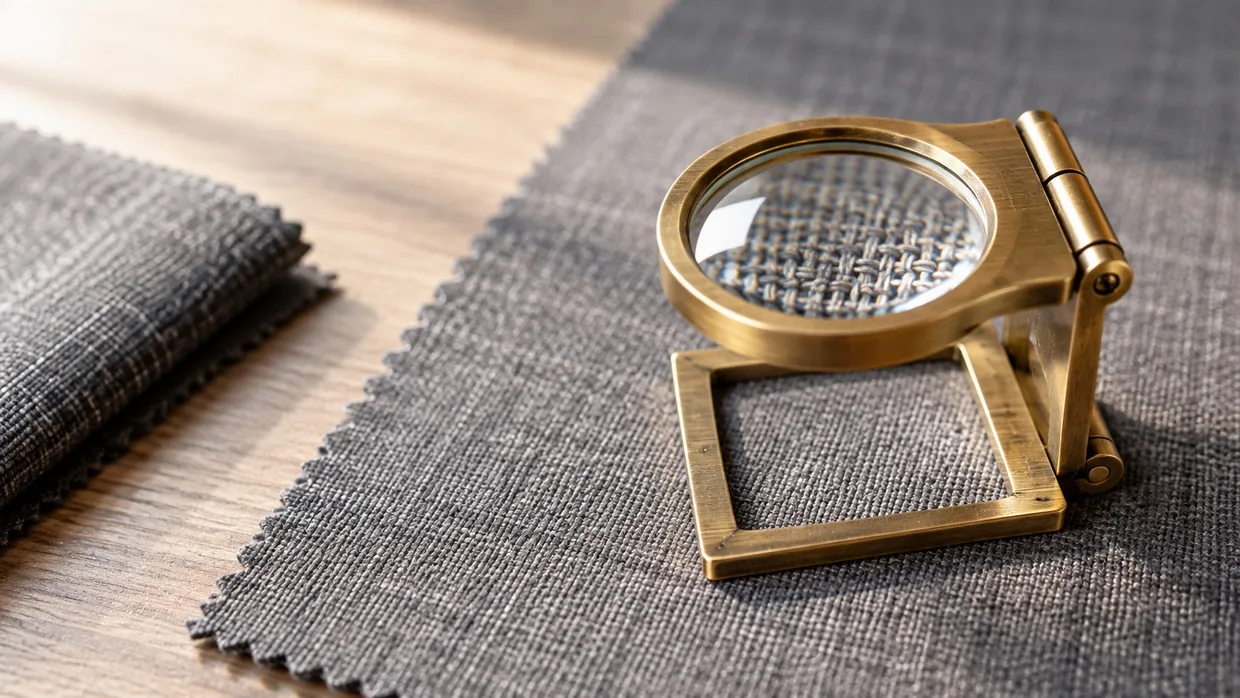
Most of it can be recovered. The weave can be read directly from the cloth under a lens: plain, twill or dobby. Ends and picks can be counted in a marked square, which gives you the construction. Weight comes from a cut disc on a balance. Width is measured on a full roll, edge to edge. Cuttable width is measured on the same roll inside the selvedges, and this is the number your cutting room actually uses. Yarn count can be estimated from the counted construction and the measured weight, closely enough to specify a like-for-like quality. Composition needs a laboratory, and it is worth doing properly. A blend ratio guessed from the feel of the cloth is the most common reason a replacement cloth behaves differently in wear.
Two things never come back. The first is the finish recipe. Whether a cloth was given a resin treatment, a softener or a particular calendering, and in what order, cannot be read from the finished fabric. The same construction finished two ways will feel and wash differently. The second is the dye recipe. A shade can be matched closely and repeatably, but it is matched by lab dip against a physical reference, not rebuilt from the old mill's recipe. Accept that both are being rebuilt, not copied, and the switch goes smoothly. Assume they carry over, and you find out at the first bulk lot.
One trap when switching: match the shade to what the cloth looked like when new, not to the garment on the table. A uniform in use for a year has faded, been washed dozens of times and picked up soiling. Matching to it locks in the wear, not the colour. If the only reference is a worn garment, use a part that was not exposed, such as an inside seam allowance, a pocket bag or the underside of a collar. Tell the mill plainly that this is what is being matched.
- Send a physical swatch, never a photograph. Screen white balance and phone processing change a colour. A photo can confirm weave, check repeat and roll condition, but it cannot approve a shade.
- Send it large enough to test: a piece that can be cut for composition, weight and a wash trial, not a corner clipping.
- Get composition done by an independent accredited laboratory and put the report with the swatch, so the new mill is quoting against a measured ratio rather than a claimed one.
- Ask the new mill for its nearest running quality first, before ordering anything custom. A running construction that is close is faster, cheaper and easier to repeat than an exact copy woven to order, and often the difference cannot be seen in the garment.
- Run a lab dip against the swatch, then a trial length, then bulk. Do not compress those three into two.
- File the approved reference under your programme name at the mill, so the next reorder is judged against it rather than against the last delivery.
Where the difference between the nearest running quality and a woven-to-order copy actually matters, custom production versus ready stock sets out what each one costs you in time and minimum quantity.
FAQ
Frequently asked questions
- What is the most important number on a spec sheet?
- There is no single one. Composition and GSM together tell you the most: the blend decides behaviour, the weight decides durability and warmth.
- Why does fabric width matter?
- Wider fabric fits more garment pieces per meter, so it changes how many meters a uniform needs and therefore the cost. Always compare fabrics at the same width, and check the figure on the product page: most of ours are 147 cm, and the narrower shirting and lining cloths run 142, 91 or 89 cm.
- What does a wash-fast finish guarantee?
- That the colour is made to survive repeated laundering without significant fading. It is essential for any uniform washed often.
- Where can I see full specs for your fabrics?
- Every product page lists composition, GSM, width, weave, colours and finish, with a shade card available on request.
- How do I know a wash-fast or wrinkle-resistant claim is real?
- Ask what test the mill runs and against what standard, for example a numbered wash-fastness or shrinkage test on a swatch before and after a standard cycle. A mill that dyes and finishes in-house can back a claim with its own test results; a trader reselling finished cloth usually cannot.
- What is the difference between plain, twill and dobby weave?
- Plain weave is simple and even, twill has the diagonal line seen in trousers and structured suiting and drapes well, and dobby adds a subtle woven texture. The weave affects strength and drape as much as GSM does.
- Can a mill reproduce my existing fabric from a swatch alone?
- It can reproduce the construction closely. Weave, ends and picks, weight, width and an approximate yarn count can all be read from the cloth, and composition comes back from a laboratory. It cannot reproduce the previous mill's finish recipe or dye recipe, because neither can be read from finished fabric. The shade is matched by lab dip against your swatch instead.
- What should I send a new mill when I am switching supplier?
- A physical swatch big enough to cut for testing, an independent composition report if you have one, your width and consumption requirement, and the end use. Photographs are useful for weave and check repeat but useless for shade, so they add to a swatch and do not replace it.
- My only reference is a uniform that has been worn for a year. What now?
- Match to a part that was not exposed, such as an inside seam allowance, a pocket bag or the underside of a collar, and tell the mill that is what is being matched. Matching to the visible outer face locks a year of fading into the new order, so the replacement is correct against the wrong target.
- A specification says 20,000 Martindale cycles. Is that the same as 20,000 double rubs?
- No, and no conversion factor makes them comparable. Martindale cycles come from ISO 12947 or ASTM D4966, where the specimen is rubbed along a figure-of-eight path under a set load. Double rubs come from ASTM D4157, the Wyzenbeek method, where the specimen is drawn back and forth across an abradant on an oscillating cylinder. The two wear the cloth differently, so a result from one cannot be judged against a limit written for the other. Where a specification quotes both figures for the same fabric, ask which one the technical evaluation will actually use, and settle it before the bid, not after.
- Our tender asks for a breathability figure. What do we ask the mill for?
- Ask for air permeability to a named method, either ISO 9237 or ASTM D737, with the pressure difference stated next to the result. It should be tested on the lot being shipped, not on a past sample. Say in the specification which of the two methods you will accept, because they are not interchangeable and a result at one pressure difference cannot be compared with a limit written for another. If the tender only says breathable with no method, no mill can be held to it. Fix this in the document before bids come in.
- My tender asks for pH and azo-free. What is it actually asking for?
- Two laboratory rows on a test report drawn from the lot. pH is the acidity or alkalinity of a water extract, which shows whether processing chemicals were fully washed off, and specifications normally want a near-neutral band. Azo-free means the cloth was tested for the aromatic amines that a restricted group of azo dyes can release. This restriction is written into European law and copied into many tender documents. Both depend on the processing run, not on the construction, so the report belongs to a delivery. Both must name the test method to mean anything.
- Does a passing chemical test report mean the fabric is certified?
- No. A test report is a result on a sample drawn from one lot, issued by a laboratory against a named method. A certification is membership of a scheme, with audits and a licence behind it, and it covers production, not a single lot. We obtain third-party chemical reports on our cloth, since dyeing, processing, finishing and testing run through partnered houses and independent laboratories, not in house. We hold no OEKO-TEX or GOTS certification.
- Why does one abrasion figure look enormous next to another?
- Usually because the larger figure was written for furnishing fabric. Upholstery specifications run into tens of thousands of cycles or double rubs, because a seat cover takes the same rub in the same place for years. Apparel and uniform methods stop at a much lower end point, since a garment fails at a cuff, an elbow or a seam long before a seat cover wears through. A uniform tender carrying an upholstery figure will look impossible to every mill bidding on it. Raise it as a specification query instead of treating it as a plain pass or fail line.
Cite this guide
Quoting this page? Paste the line below so the credit links back.
<a href="https://www.bennycotts.com/guides/how-to-read-a-fabric-spec-sheet">How to Read a Fabric Spec Sheet</a>, Benny Cotts, 2026Next in Reading a fabric
Fabric Construction: Reading Count x Count and EPI x PPI
More in Reading a fabric
- What GSM Means for Uniform Fabric
- Shirting GSM, Show-Through and Why Light Shirts Need More Than Weight
- How to Read a Fabric Spec Sheet
- Fabric Construction: Reading Count x Count and EPI x PPI
- Fabric Width and Cutting Yield Explained
- 36 Inch vs 58 Inch Shirting: Which Width to Order
- Than, Gaj, Panna: Fabric Unit Conversion Chart
- Fabric-Type Glossary: Gabardine, Matty, Twill, Serge
Updated 20 September 2026 · Benny Cotts, Bhilwara
Fabrics
Fabrics mentioned in this guide
Spec, price and MOQ on every fabric page.

Officer Choice
Poly-Viscose (PV) blend · 210-230 GSM
Crisp, structured suiting engineered for officer uniforms.

Power Gold
Premium Poly-Viscose blend · 230-250 GSM
Our premium-line suiting with a refined hand and superior drape.

Fine Strip Dobby
Poly-Viscose blend · 205-225 GSM
Subtle dobby texture for executive uniforms.

Grasima SF-5000
Poly-Viscose 65/35 · 262 GSM
Heavyweight poly-viscose matty with a rich, full-bodied handle.

Delux-999
Poly-Viscose 65/35 · 208 GSM
Mid-weight poly-viscose suiting with a clean, versatile finish.
Industries this applies to
Uniform programs these fabrics are used for
- Fabric for Business Attire
- Fabric for Corporate Uniforms
- Fabric for Corporate Trousers
- Fabric for Blazers & Waistcoats
- Fabric for College & University Uniforms
- Fabric for Hospital Staff Uniforms
- Fabric for Hotel Uniforms
- Fabric for Cabin Crew Uniforms
- Fabric for Ground Staff Uniforms
- Fabric for Army Uniforms
- Fabric for Police Uniforms
- Fabric for Security Guard Uniforms
- Fabric for Industrial Uniforms
- Fabric for Construction Workwear
- Fabric for Business Suits
- Fabric for Black-Tie Attire
- Fabric for Formal Event Wear
Fabric types covered here
From the blog
Keep reading
Related guides


Ready to place an enquiry?