
Fabric basics
Lab Dips and Shade Approval, Explained
How a colour reference becomes an approved shade standard: what a lab dip is, how a dye recipe is built, how submissions are assessed under controlled light, and how the approved shade is held for reorders.

Jump to section
Quick answer
A lab dip is a small trial dyeing, produced on the actual fabric, to match a colour reference before any bulk quantity is dyed. The reference goes to the dyehouse, a recipe is built and dyed at laboratory scale, and one or more submissions come back for assessment under controlled light. Once a submission is approved it becomes the shade standard, the physical reference every production lot for that program is measured against. Approving the lab dip carefully is the most important step in a colour-critical order, because everything after it is measured against what you signed off.
What a lab dip actually is
A lab dip is a small piece of your fabric, dyed at laboratory scale to a trial recipe, submitted so you can judge the colour before a full lot is committed. The important detail is that it is dyed on the same fabric the order will run on, not on a generic cloth, because the same dye recipe reads differently on different constructions and blends.
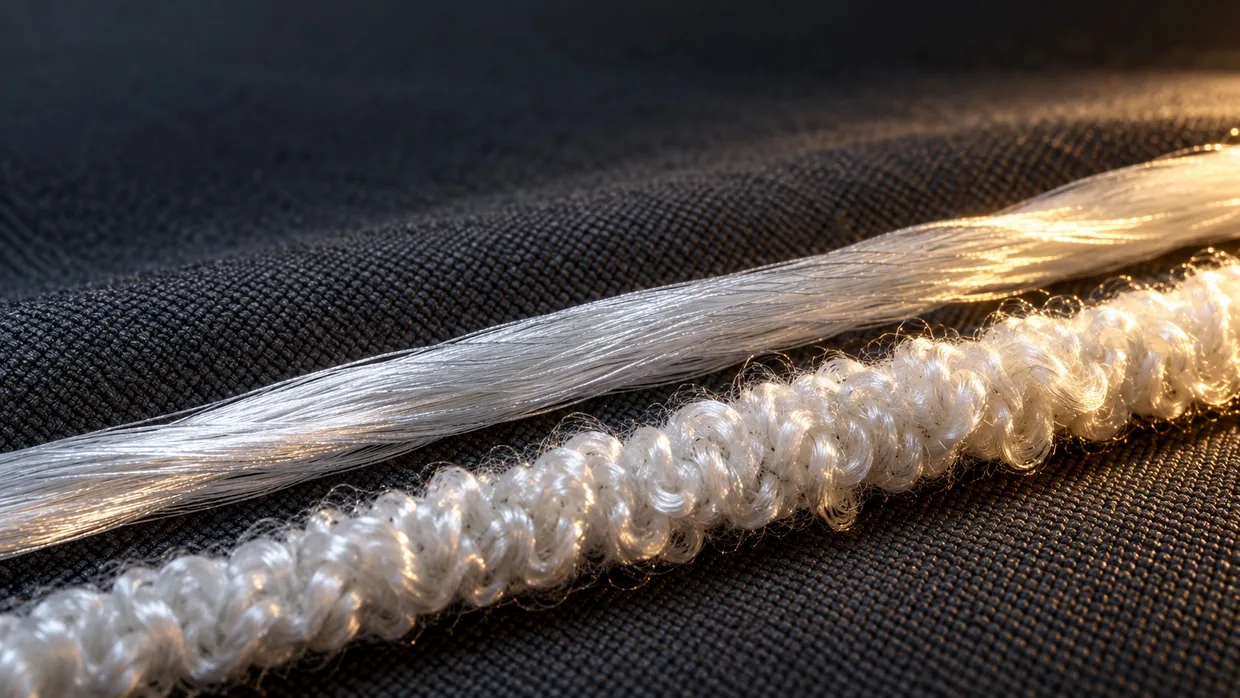
This matters most in poly-viscose and poly-cotton fabrics, where the polyester and the viscose or cotton components take up dye differently. A shade that looks right on one blend ratio may not look the same on another, so the lab dip is tied to the exact fabric quality it was dyed on.
From colour reference to recipe
The process starts with whatever reference you can provide. The quality of that reference limits how close the match can be. A physical swatch of the actual target is the strongest starting point. A colour system reference is workable. A printed image or a screen colour is the weakest, because both are reproductions in a different medium and neither carries the information a dyer needs.
From the reference, the dyehouse builds a recipe: which dyes, in what proportion, at what process conditions. Colour measurement equipment gives a starting point, but the recipe for a specific blend and construction is found by trial. That is why more than one submission is normal and not a sign of a problem.
- A physical fabric swatch of the target shade, ideally unworn and unwashed
- A recognised colour system reference, quoted with the exact code
- An existing garment, where nothing else exists, understanding that wear and washing have already shifted it
- The light source the uniform will actually be seen under, if it is unusual
Assessing a submission: light, angle and metamerism
How a lab dip is assessed decides whether the approval is meaningful. Two shades that match under one light can look clearly different under another. This effect is called metamerism, and it is a real property of dyes, not a trick of the eye. Judging under a single uncontrolled light is the most common way a shade approval goes wrong.
Assessment therefore happens under defined light sources, commonly a daylight simulator, a store or office light and an incandescent (bulb) light, so a match is confirmed under more than one condition. If a uniform will mostly be worn under one kind of light, for example a hospital corridor or a hotel interior, judge the shade under that light too and record the decision.
- Assess under more than one light source, not just whatever light is in the room
- Lay the submission edge to edge with the standard, with no gap between them
- View both at the same angle, since fabric surfaces reflect differently when tilted
- Check both sides of the fabric, and both directions of the weave, on a textured or twill construction
- Record which light source the decision was made under, so a reorder can be judged the same way
Visual assessment and colour measurement
Two methods run in parallel. Visual assessment is a trained eye comparing submission to standard under controlled light. Instrumental assessment uses a spectrophotometer (a colour-measuring instrument) to give a numeric difference between the two. This is usually reported as one colour-difference value, where a smaller number means a closer match.
Neither replaces the other. A numeric difference can be inside the stated limit while the eye still sees the shade as off, especially where the difference is in a direction the eye is sensitive to. If a program has a colour tolerance, agree it in advance, along with the method that will judge it, instead of raising it for the first time when a lot is in dispute.
From approved lab dip to bulk dye lot
Approval does not mean the recipe carries over unchanged to production. A laboratory dyeing and a full bulk lot differ in scale, machinery and process conditions, so the recipe is adjusted for bulk. This is why the first bulk lot is itself checked against the approved standard, not assumed to match because of the recipe.
For us, dyeing and finishing run through our partnered processing houses in Bhilwara, while weaving happens in-house on our own looms at Village Atoon. So the fabric and the shade approval are scheduled together. A custom shade is woven and dyed to order from 500 m per shade, the quantity at which a dedicated dye lot makes sense. Ready-stock shades already exist as running lots and start at 50 m.
Holding the standard for reorders
The approved submission becomes the shade standard, and it only does its job if it is kept properly. A standard that is stored loose in a drawer, exposed to light or handled often will itself change over months. Then every reorder is matched against a standard that has moved.
- Keep the approved swatch sealed and away from light, and keep a second copy
- Label it with the fabric quality, the shade name or code and the approval date
- Match every later lot against the standard, never against the most recent delivery
- Re-issue a fresh standard if the original has visibly aged, and record that you did
Matching each lot against the previous delivery rather than the original standard is how a program drifts. Each step looks acceptable, and after several lots the fabric no longer matches where it started. Our guide on dye-lot consistency covers that failure mode in more detail.
Matching one shade across two different cloths
A uniform programme is rarely one fabric. A school runs a blazer twill, a trouser suiting and a shirting. A corporate programme runs a structured suiting for front-of-house staff and something lighter behind it. When the brief says navy, all of these must look like the same navy when people stand next to each other in a corridor. They will not do this on their own, even when the dye recipe is nominally the same. When there is no swatch at all, see matching an incumbent's cloth from a worn garment.
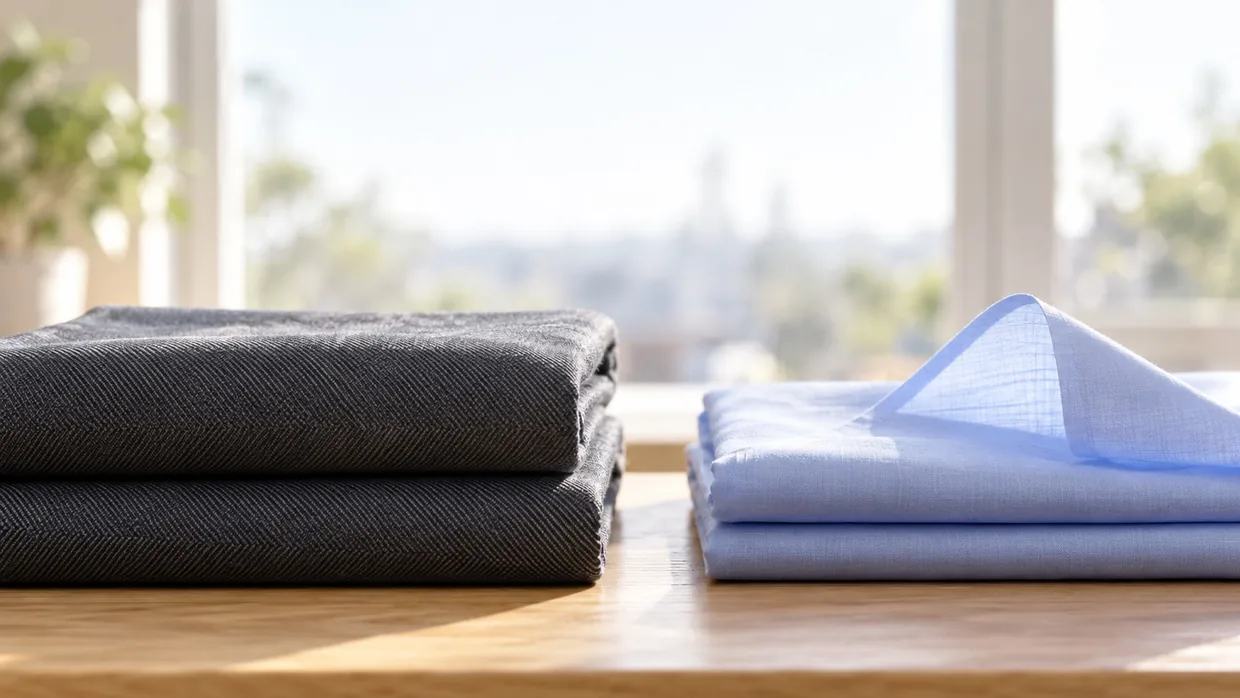
The reason is the base cloth (the substrate), not carelessness. Dye uptake depends on the fiber and the blend ratio, so a viscose-rich cloth and a polyester-rich cloth take the same recipe to different depths. The surface also changes what your eye sees, apart from the fiber. A twill's diagonal and a plain weave's flat face reflect light differently, so the same colour looks deeper on one and flatter on the other. A raised or peached (softly brushed) finish scatters light and makes the shade look lighter. A calendered (pressed smooth) surface reflects light and makes it look darker. Two cloths matched perfectly on an instrument can still look different across a room.
The fix is a clear procedure. Submit every cloth in the programme for approval together, in one submission, as one shade family. Do not approve the suiting in March and the shirting in June against your memory of the suiting. Assess them side by side under one agreed light source, and check them under a second light source too. A set that matches under a shop tube light but splits in daylight will split at the school gate. Agree a stated tolerance for variation between cloths up front. Demanding an exact instrumental match across three different constructions asks for something dyeing cannot deliver, and only produces repeated re-runs.
And never approve the second cloth against a photograph of the first, or against the first cloth's approved swatch viewed on a different day in a different room. The comparison has to be physical, side by side and under a stated light. Where the programme includes a check or a stripe, approve the base colour of the check in the same submission and shade family, because a check approved separately will clash with the plain cloth beside it.
This is the general form of a problem the women's institutional uniform guide covers for a kameez and dupatta, and the blazer guide covers for a blazer against its trouser. If your programme spans more than one cloth, treat this section as the rule and those two as worked examples.
FAQ
Frequently asked questions
- How many lab dip submissions are normal before approval?
- More than one is routine. A recipe for a specific blend and construction is arrived at by trial, and a second or third submission usually reflects the shade being tightened rather than anything going wrong. Deep and highly saturated shades typically take more submissions than mid tones.
- Can a shade be matched from a printed image or a screen colour?
- It can be attempted, but it is the weakest possible reference and the match cannot be held tightly. Printing and screens both reproduce colour in a different medium, so neither carries the information a dyer needs. A physical swatch of the target, or a recognised colour system code, is worth the effort of obtaining.
- Why does the same shade look different on two fabrics?
- Because dye uptake depends on the fiber. In a poly-viscose or poly-cotton blend the components take dye differently, and the construction and finish change how light reflects off the surface. A lab dip is therefore tied to the exact fabric quality it was dyed on.
- What is metamerism?
- Two samples that match under one light source but not under another. It is a genuine property of the dyes involved, not an error in assessment. This is why shade approval is done under more than one defined light and not under whatever light happens to be available.
- Does the approved lab dip guarantee the bulk lot will match?
- It sets the target the bulk lot is measured against. Because laboratory and bulk dyeing differ in scale and machinery, the recipe is adjusted for production and the first bulk lot is checked against the approved standard rather than assumed to match.
- Why do two fabrics dyed to the same shade look different?
- Because dye uptake and light reflection both depend on the cloth. A viscose-rich blend takes a recipe deeper than a polyester-rich one, a twill's diagonal reflects differently from a plain weave's flat face, and a raised finish scatters light while a calendered one reflects it. Two cloths can match on an instrument and still read differently across a room.
- How do I approve one shade across a blazer, a trouser and a shirt?
- Submit all three together as one shade family in a single submission. Assess them side by side under one agreed light source, and check them again under a second. Agree a stated tolerance for variation between the cloths before approval, not after a re-run. Approving them months apart, from memory, is what produces the mismatch.
- Can I approve a second cloth against a photo of the approved first one?
- No. Screen white balance, room lighting and handset processing all move a colour, so a photo can confirm weave, check repeat or roll condition but never a shade. The comparison has to be physical, simultaneous and under a stated light source.
Cite this guide
Quoting this page? Paste the line below so the credit links back.
<a href="https://www.bennycotts.com/guides/lab-dips-and-shade-approval">Lab Dips and Shade Approval, Explained</a>, Benny Cotts, 2026Next in Processing
Why Reorders Do Not Match: Dye-Lot Consistency
More in Processing
- What a Process House Does: Greige to Finished Fabric
- Dyeing: Which Dye for Which Fiber
- Lab Dips and Shade Approval, Explained
- Why Reorders Do Not Match: Dye-Lot Consistency
- Fabric Swatches vs Shade Cards Explained
- Fire-Retardant, Anti-Microbial and Moisture-Control Finishes Explained
- Water-Repellent, Oil-Repellent and Anti-Static Finishes Explained
- Easy-Care and Wrinkle Recovery in Shirting, Explained
- Why Uniforms Shrink, and How to Prevent It
- Does Viscose Pill? Uniform Fabric Pilling and How to Spec It
- Why Uniforms Fade: Colour Fastness and Hot Washing
- Why White Shirts Go Yellow or Grey, and How to Spec Against It
- What Moves Processing Costs: Dyes, Energy, Water, Shade and Lot Size
Updated 5 September 2026 · Benny Cotts, Bhilwara
Fabrics
Fabrics mentioned in this guide
Spec, price and MOQ on every fabric page.

Officer Choice
Poly-Viscose (PV) blend · 210-230 GSM
Crisp, structured suiting engineered for officer uniforms.

Power Gold
Premium Poly-Viscose blend · 230-250 GSM
Our premium-line suiting with a refined hand and superior drape.

Grado 1st
Poly-Viscose blend · 220-240 GSM
Tailoring-grade fabric built for everyday durability.

Sonata
Poly-Viscose blend · 190-210 GSM
Cost-efficient uniform fabric without compromising weave quality.

Delux-999
Poly-Viscose 65/35 · 208 GSM
Mid-weight poly-viscose suiting with a clean, versatile finish.
Industries this applies to
Uniform programs these fabrics are used for
- Fabric for Business Attire
- Fabric for Corporate Uniforms
- Fabric for Corporate Shirts
- Fabric for Corporate Trousers
- Fabric for Blazers & Waistcoats
- Fabric for School Uniforms
- Fabric for College & University Uniforms
- Fabric for Sports & PT Uniforms
- Fabric for Pre-School & Kindergarten Uniforms
- Fabric for Doctor Coats
- Fabric for Nurse Scrubs
- Fabric for Lab Coats
- Fabric for OT & Surgical Wear
- Fabric for Patient Gowns
- Fabric for Hospital Staff Uniforms
- Fabric for Chef Coats
- Fabric for Salon & Spa Uniforms
- Fabric for Cabin Crew Uniforms
- Fabric for Ground Staff Uniforms
- Fabric for Army Uniforms
- Fabric for Police Uniforms
- Fabric for Security Guard Uniforms
- Fabric for Industrial Uniforms
- Fabric for Construction Workwear
- Fabric for Housekeeping Uniforms
- Fabric for Business Suits
- Fabric for Black-Tie Attire
- Fabric for Formal Event Wear
Fabric types covered here
Keep reading
Related guides



Ready to place an enquiry?