
Buying guide
Understanding Fabric Quotations
What's normally itemized on an Indian mill's fabric quotation: composition, width, GSM, price basis, MOQ tier, lead time, payment terms and validity, and how to read each line.

Jump to section
- What a fabric quotation normally itemizes
- Price basis: per metre, ex-mill or delivered
- The MOQ tier the price is quoted against
- Lead time on the quote
- Payment terms: the categories you'll see
- Which currency an export quote is in, and who carries the move
- Why a quotation has a validity period
- Reading a quote alongside the spec sheet
- Comparing two quotes side by side
Quick answer
A fabric quotation from an Indian mill normally itemizes eight things: composition, width, GSM, price basis (per metre, and whether that price is ex-mill or delivered), the MOQ tier it's priced against, lead time, payment terms, and how long the quote stays valid. It is a commercial document, not a technical one, so it should always be read alongside a spec sheet rather than instead of one.
What a fabric quotation normally itemizes
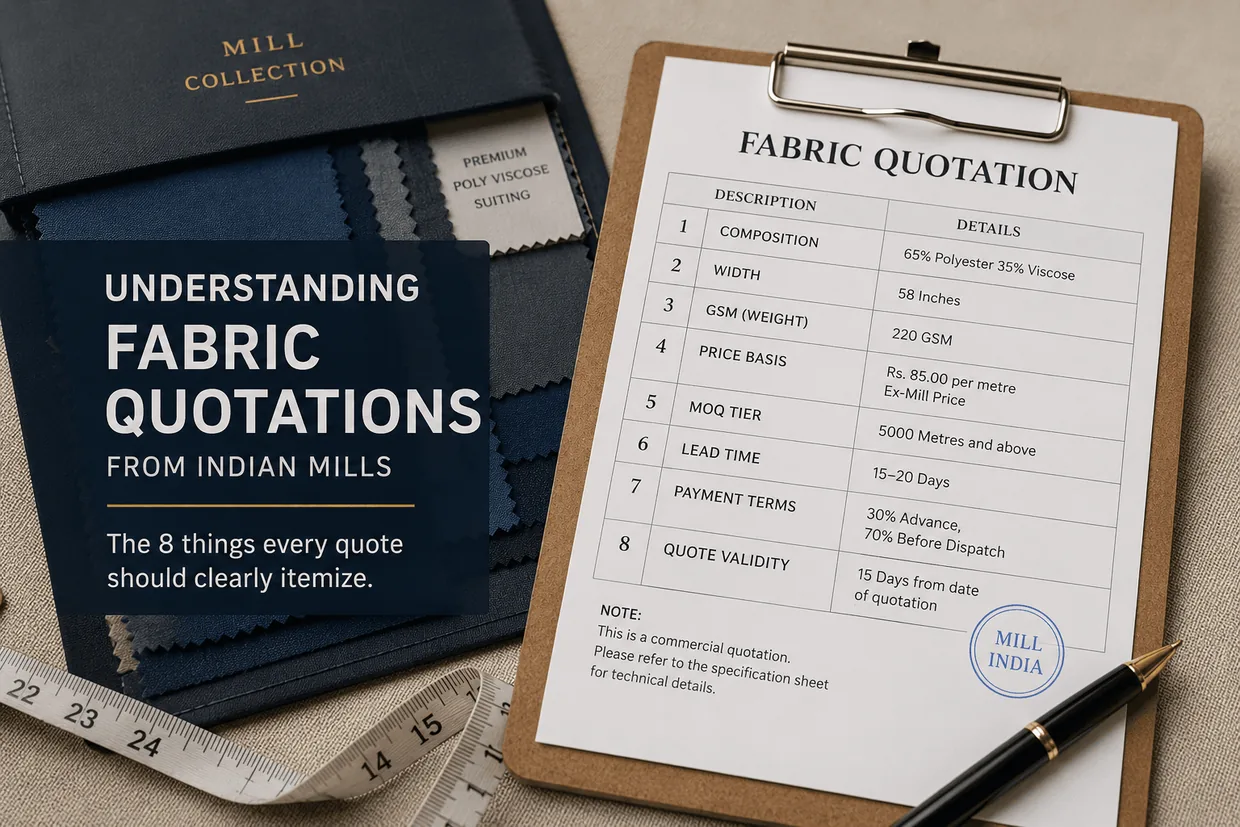
Formats vary by mill, but a complete quotation covers the same ground: what the fabric is, what it costs, what quantity that price applies to, when it will arrive, how you pay for it, and how long the price holds.
| Line item | What it tells you |
|---|---|
| Composition | The fiber blend the price is quoted against |
| Width | Usable width, since price is meaningless without it |
| GSM | The weight the quote is priced for |
| Price basis | Per metre, and whether ex-mill or delivered |
| MOQ tier | The order size the price is valid at, ready stock or custom |
| Lead time | Indicative despatch or production timeline for that order type |
| Payment terms | How the amount is split and when it's due |
| Validity period | How many days the quoted price stands before it needs reconfirming |
Composition, width and GSM are technical fields, covered in full in our guide on how to read a fabric spec sheet. A quotation restates them only to support the price. It doesn't replace the spec sheet.
Price basis: per metre, ex-mill or delivered
Indian mills quote per metre as standard. What varies, and what buyers most often miss, is whether that per-metre price is ex-mill or delivered.
Ex-mill (sometimes called ex-works) means the price is for the fabric at the mill gate, before any transport is added. Delivered means transport to your location is built into the price. Neither is more correct than the other, but the two are not comparable side by side: an ex-mill quote from one mill and a delivered quote from another will show a price gap that has nothing to do with the fabric itself.
For export orders, this same question is usually framed as an incoterm rather than ex-mill versus delivered; our incoterms guide covers FOB, CFR/CNF and CIF for that case.
The MOQ tier the price is quoted against
A quotation is priced against a specific order size, not a fabric in the abstract. At Benny Cotts that means 50 m per shade from ready stock, or 500 m per shade for a custom shade or construction woven to order, and the two tiers do not carry the same price. A custom order carries its own dyeing and loom setup as a batch cost.
If a quote doesn't state which tier it's priced against, ask before you compare it to another mill's number. Our MOQ guide sets out why the two tiers exist and how the economics behind them work.
Lead time on the quote
Lead time is usually shown as an indicative range rather than a fixed date. It depends on current loom and dye-house loading at the time you place the order, not just at the time you receive the quote. Ready stock despatches quickly since the cloth already exists; a custom shade or construction adds dyeing, weaving and finishing before despatch, so it takes longer.
Treat the lead time on a quote as a planning figure to confirm again at order confirmation, especially around seasonal peaks. Our lead times guide goes into what drives the range for each order type.
Payment terms: the categories you'll see
Payment terms describe how the amount is split and when each part is due, not a fixed number that applies across every mill or every order. The categories that commonly appear on an Indian mill's quotation are:
- Advance and balance: part of the value paid upfront before production or despatch, the remainder due at or before despatch
- Full advance: common for smaller ready-stock orders
- Letter of credit (LC): typical for larger orders or first-time export relationships, since it gives both sides a bank-backed guarantee
- Telegraphic transfer (TT): a direct bank transfer, often used alongside an advance-and-balance split
The exact split and which category applies is agreed per order and per buyer relationship. Ask for it in writing on the quotation itself rather than assuming a standard.
Which currency an export quote is in, and who carries the move
An export quotation is priced in a currency, and the currency named on the proforma invoice is the one the contract settles in. That sounds obvious, and it decides something important: whichever side does not keep its books in the invoice currency carries the exchange-rate move between the day the order is placed and the day each payment is made.
On an advance-and-balance split that exposure falls on two dates, not one. The advance converts at the rate on the day it is sent and the balance at the rate on the day it is paid, which can be the whole production period later. For that whole time one side is exposed to currency movement. It is worth knowing which side before the order is placed, not after the rate has moved.
- The invoice currency, named on the quotation and the proforma rather than left to the payment instruction
- Whether the price is fixed in that currency for the whole validity window, or only the fabric price, with freight or surcharges converted at the rate on the day
- Who pays the bank charges on a telegraphic transfer. The charge code on the payment instruction decides it: OUR means the sender pays all charges, BEN means the receiver pays them, and SHA means each side pays its own bank. A receipt that arrives short of the invoice is usually a charge code, not a dispute
- Which rate applies if an amount has to be converted later, for a credit note or an allowance after delivery
A move in the exchange rate after an order is placed is not by itself a reason to reopen the price, for the reasons set out in a weaker rupee does not make Indian fabric cheaper for you.
Why a quotation has a validity period
A quoted price normally stands for a stated number of days, not indefinitely. Yarn cost is the biggest input into a fabric's price, and yarn markets move, so a mill can't hold a per-metre number open forever without pricing in that risk.
If you plan to place an order close to or after a quote's validity date, ask for it to be reconfirmed rather than assuming the number still holds. This matters most for programs planned months ahead of a rollout date.
Reading a quote alongside the spec sheet
A quotation and a spec sheet answer different questions: the spec sheet describes what the fabric is, the quotation describes what it costs and on what terms. Comparing two mills' quotations only works once you've confirmed both are quoted against the same composition, GSM and width. Otherwise you're comparing price on two different fabrics.
Why the price lands where it does, from yarn cost to order size, is a separate question. We cover it in our guide to how uniform fabric pricing works.
Comparing two quotes side by side
Two quotes for what is described as the same fabric often differ for reasons that have nothing to do with which mill is cheaper. Before comparing the price per metre, put the two quotes next to each other and check that every line below matches. Where a line differs, either ask one supplier to requote on the other's basis, or adjust for it yourself before deciding. Before you sign, check the list of common mistakes when buying uniform fabric.
| Line up | Why it changes the number |
|---|---|
| Blend ratio, GSM and width | A different viscose share, a lighter weight or a narrower width is a different fabric, and a narrower width also means buying more metres per garment |
| Price basis | An ex-mill price leaves freight to add; a delivered price already includes it |
| MOQ tier | A ready-stock price and a custom-shade price for the same quality sit on different tiers |
| Shade | A running shade carries no fresh dye lot; a custom match does |
| Finish | A water-repellent, wrinkle-free or other added finish is a cost line one quote may include and the other omit |
| Lead time | A shorter lead time from stock and a longer one woven to order are different services |
| Payment terms and currency | Full advance against a balance on despatch, or a quote in a currency you do not hold, changes what the order really costs you |
| Validity | A quote that lapses before you can confirm is not a firm price |
Once every line matches, the remaining gap is the real price difference. Ask for a sample against each quote as well, because the same specification on paper can still differ in hand and appearance.
FAQ
Frequently asked questions
- How do I compare two fabric quotes fairly?
- Check that both are quoted on the same blend ratio, GSM and width, the same price basis (ex-mill or delivered), the same MOQ tier, shade type and finish, and comparable lead time, payment terms, currency and validity. Only once those match is the difference in price per metre a real difference. Ask for a sample against each quote too.
- What should a fabric quotation include at minimum?
- Composition, width and GSM to identify the fabric; price basis (per metre, ex-mill or delivered); the MOQ tier the price applies to; an indicative lead time; payment terms; and how many days the quote stays valid.
- What does "ex-mill" mean on a quotation?
- It means the quoted price is for the fabric at the mill gate, before any transport is added. A delivered price, by contrast, has transport to your location built in. Always confirm which basis a price is quoted on before comparing two quotes.
- Why does a fabric quote expire?
- Because yarn cost, the biggest input into fabric price, moves over time. A mill states a validity period rather than holding a price open indefinitely, and a lapsed quote should be reconfirmed before you place the order.
- Are payment terms the same across Indian mills?
- No. Advance-and-balance splits, full advance, letter of credit and telegraphic transfer are all common categories, but the exact terms are agreed per order and per buyer relationship rather than fixed industry-wide.
- Who carries the exchange-rate risk on an export fabric order?
- Whichever side does not keep its books in the invoice currency. The currency named on the proforma invoice is the one the contract settles in, so if you pay in your own currency against a quote in another, you carry the move between order and payment, on the advance and again on the balance. Confirm the invoice currency on the quotation itself, and whether the price is fixed in it for the whole validity window.
- Does a quotation replace a fabric spec sheet?
- No. A quotation covers price and commercial terms; a spec sheet covers composition, GSM, width, weave, colour and finish. Read them together, since comparing quotes only works when both are priced against the same specification.
- Why is the lead time on a quotation only a range, not a fixed date?
- Because it depends on current loom and dye-house loading at the time you place the order, not just when you receive the quote. Ready stock despatches quickly since the cloth already exists, while a custom shade or construction adds dyeing, weaving and finishing first, so treat the lead time as a planning figure to reconfirm at order confirmation.
Cite this guide
Quoting this page? Paste the line below so the credit links back.
<a href="https://www.bennycotts.com/guides/understanding-fabric-quotations">Understanding Fabric Quotations</a>, Benny Cotts, 2026Next in The trade
Uniform Fabric MOQ in India, Explained
More in The trade
- The Textile Value Chain: Who Does What, From Fiber to Uniform
- Uniform Fabric Pricing Explained
- Who Pays When Duty, Freight or Fiber Costs Move During a Fabric Contract
- Understanding Fabric Quotations
- Uniform Fabric MOQ in India, Explained
- Uniform Fabric Sampling Guide
- Custom Production vs Ready Stock Fabric
- Payment Terms for Bulk Fabric Orders: Advance, LC, Collections and Open Account
- Uniform Fabric Lead Times in India
- How Woven Fabric Is Packed and Shipped: Rolls, Bales, Labels and Paperwork
- When Bulk Fabric Arrives Wrong: Claims, Remedies and Tolerances
- HSN Codes and GST Basics for Uniform Fabric Buyers
- Incoterms Explained for Uniform Fabric Buyers Sourcing from India
- How to Import Uniform Fabric from India: A Buyer's Guide
- Certificates of Conformity: The Destination-Market Paperwork That Can Stop Fabric at Your Border
- EU Textile EPR, Explained for Indian Fabric and Garment Exporters
- The Digital Product Passport for Textiles: The Data Your Fabric Supplier Will Need to Give You
- Uniform Fabric for Government Tenders: A Supplier's Guide
- Tender Documentation for Uniform Fabric: What a Mill Must Actually Produce
- Selling Fabric: How a New Trader Finds Buyers for Uniform, Suiting and Shirting Cloth
Updated 19 October 2026 · Benny Cotts, Bhilwara
Fabrics
Fabrics mentioned in this guide
Spec, price and MOQ on every fabric page.

Nano
Poly-Viscose blend · 180-200 GSM
Our entry-level uniform fabric for large-volume programs.

Sonata
Poly-Viscose blend · 190-210 GSM
Cost-efficient uniform fabric without compromising weave quality.

Grado 1st
Poly-Viscose blend · 220-240 GSM
Tailoring-grade fabric built for everyday durability.
Industries this applies to
Uniform programs these fabrics are used for
- Fabric for Business Attire
- Fabric for Corporate Uniforms
- Fabric for Corporate Shirts
- Fabric for Corporate Trousers
- Fabric for Blazers & Waistcoats
- Fabric for School Uniforms
- Fabric for College & University Uniforms
- Fabric for Sports & PT Uniforms
- Fabric for Pre-School & Kindergarten Uniforms
- Fabric for Doctor Coats
- Fabric for Nurse Scrubs
- Fabric for Lab Coats
- Fabric for OT & Surgical Wear
- Fabric for Patient Gowns
- Fabric for Hospital Staff Uniforms
- Fabric for Chef Coats
- Fabric for Salon & Spa Uniforms
- Fabric for Cabin Crew Uniforms
- Fabric for Ground Staff Uniforms
- Fabric for Army Uniforms
- Fabric for Police Uniforms
- Fabric for Security Guard Uniforms
- Fabric for Industrial Uniforms
- Fabric for Construction Workwear
- Fabric for Housekeeping Uniforms
- Fabric for Business Suits
- Fabric for Black-Tie Attire
- Fabric for Formal Event Wear
Fabric types covered here
Keep reading
Related guides




Ready to place an enquiry?