
Buying guide
Fabric Swatches vs Shade Cards Explained
What a fabric swatch, a shade card and a sample book actually are, and when to ask for each one while comparing, approving or reordering uniform fabric.

Jump to section
Quick answer
A swatch is a small cutting of one fabric in one shade, the actual cloth rather than a picture or a colour code, used to check shade, weight and feel by hand. A shade card is a fanned or bound set of swatches showing the full colour range of one fabric quality, used to browse and choose a shade. A sample book, or header card, goes a step earlier: small cuttings across several different fabric qualities so you can compare weight and construction before you've settled on a fabric at all. Ask for a shade card or sample book while exploring, then keep the actual approved swatch as your permanent reference once a shade is locked.
What a swatch is
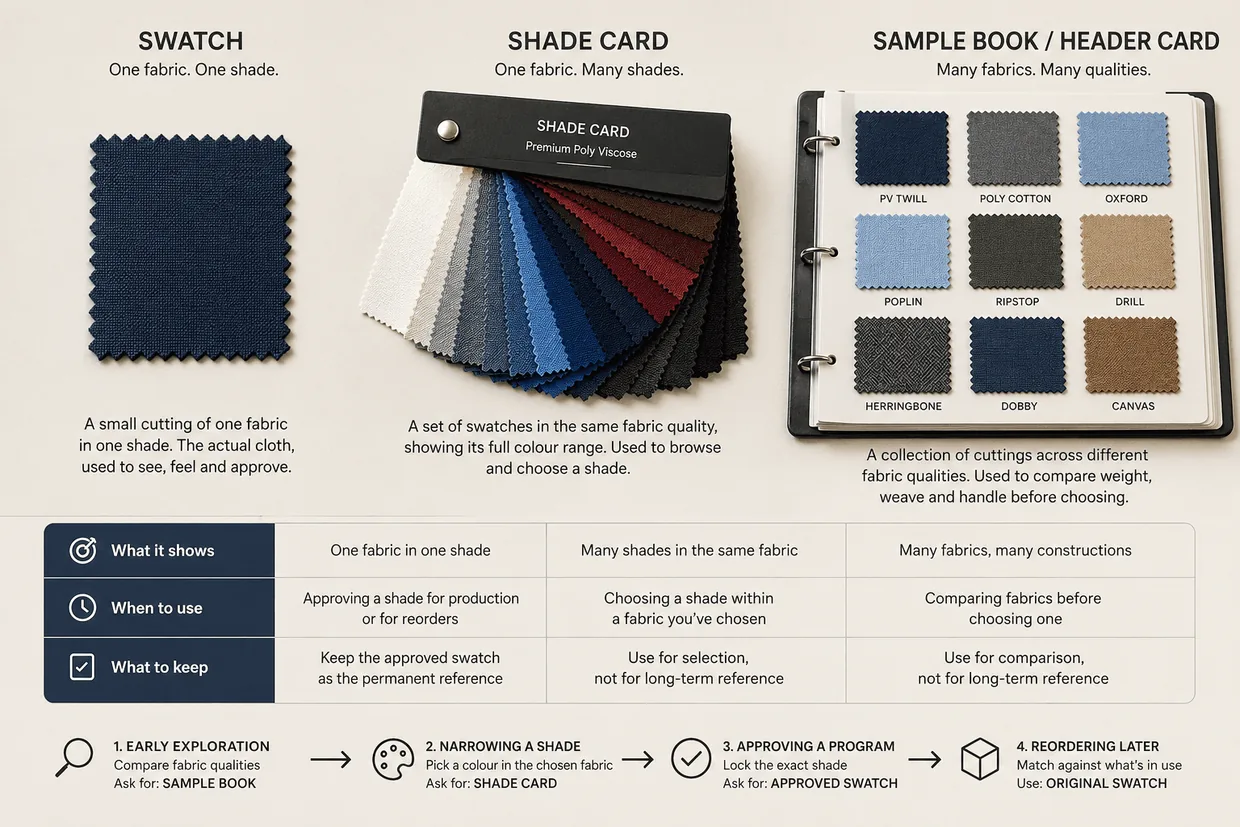
A swatch is a single small cutting of one fabric in one shade, usually a few inches square. It's not a picture or a printed colour code, it's the real cloth, so you can see the weave, feel the cloth and check the shade in real light rather than on a screen.
Once a shade is approved for a program, the swatch becomes the physical reference everyone works against, the mill, the buyer and any tailor, for as long as that program runs.
What a shade card is
A shade card is a fanned or bound set of swatches, all in the same fabric quality and construction, arranged across its full colour range. It answers one question: what shades does this fabric come in? Flip through a shade card and you're browsing colour, not comparing weight, weave or blend, those stay fixed across the whole card.
A shade card is the usual starting point once you've already picked a fabric quality: use it to settle on a colour within that fabric.
What a sample book or header card is
A sample book, sometimes called a header card, is a small bound collection of cuttings across several different fabric qualities rather than shades of one. It lets you compare one fabric against another, weight against weight, weave against weave, before you've decided which fabric you even want.
This sits a step earlier than a shade card. A sample book helps you choose the fabric; a shade card then helps you choose the colour within it.
Which one to ask for, and when
| Stage | What you're doing | Ask for |
|---|---|---|
| Early exploration | Comparing fabric qualities: weight, weave, feel | Sample book or header card |
| Narrowing a shade | Picking a colour within a fabric you've chosen | Shade card |
| Approving a program | Locking the exact shade before production | An approved swatch, signed off and kept as reference |
| Reordering years later | Matching new fabric against what's already in use | The original approved swatch, not the shade card |
The shade card gets you close; the swatch is what actually gets checked against, so it's worth holding on to long after the shade card has served its purpose.
Keep the swatch, not just the card
A shade card shows what's available today, but it isn't a fixed record: cards get reprinted, and a colour can shift slightly between print runs. The swatch you approved is fixed, cut from the actual fabric that shipped.
For that reason we recommend keeping a sealed copy of the approved swatch for the life of a uniform program, not just a note of the shade name or number. For the full process of requesting, approving and reserving samples before a bulk order, see our guide on sampling uniform fabric.
FAQ
Frequently asked questions
- What is the difference between a swatch and a shade card?
- A swatch is a single small cutting of one shade in one fabric. A shade card is a bound or fanned set of many such swatches, all in the same fabric quality, showing its full colour range. You browse a shade card to choose a colour; you approve and keep a swatch as the actual reference.
- What is a sample book or header card used for?
- A sample book, or header card, holds small cuttings across several different fabric qualities so you can compare weight, weave and feel before choosing which fabric to work with. It's a step earlier than a shade card, which only shows colours within one fabric you've already chosen.
- Which one should I keep for reorders?
- The approved swatch, not the shade card. A shade card can be reprinted and colours can shift slightly between print runs; the swatch is cut from the actual fabric that shipped, so it's the only reliable reference years later.
- Can I get a shade card before placing an order?
- Yes. Shade cards and swatches are available on request while you're comparing fabrics and narrowing a colour, well before you need to commit to any order quantity. Once a shade is approved, see our guide on uniform fabric MOQ in India for how much you can order from ready stock versus a custom shade.
- What should I ask for when approving a shade for full production?
- An approved swatch, signed off and kept as reference, rather than just a shade card or a colour name. The swatch is what production is actually checked against once a shade is locked in.
- Can I approve a shade from a photo instead of a physical swatch?
- No. A swatch is the actual cloth, not a picture or a printed colour code, so it's the only way to check shade under real light and confirm weight and feel by hand. Approve against a physical swatch, not a digital image.
Cite this guide
Quoting this page? Paste the line below so the credit links back.
<a href="https://www.bennycotts.com/guides/fabric-swatches-vs-shade-cards-explained">Fabric Swatches vs Shade Cards Explained</a>, Benny Cotts, 2026Next in Processing
Fire-Retardant, Anti-Microbial and Moisture-Control Finishes Explained
More in Processing
- What a Process House Does: Greige to Finished Fabric
- Dyeing: Which Dye for Which Fiber
- Lab Dips and Shade Approval, Explained
- Why Reorders Do Not Match: Dye-Lot Consistency
- Fabric Swatches vs Shade Cards Explained
- Fire-Retardant, Anti-Microbial and Moisture-Control Finishes Explained
- Water-Repellent, Oil-Repellent and Anti-Static Finishes Explained
- Easy-Care and Wrinkle Recovery in Shirting, Explained
- Why Uniforms Shrink, and How to Prevent It
- Does Viscose Pill? Uniform Fabric Pilling and How to Spec It
- Why Uniforms Fade: Colour Fastness and Hot Washing
- Why White Shirts Go Yellow or Grey, and How to Spec Against It
- What Moves Processing Costs: Dyes, Energy, Water, Shade and Lot Size
Updated 26 July 2026 · Benny Cotts, Bhilwara
Fabrics
Fabrics mentioned in this guide
Spec, price and MOQ on every fabric page.

Grado 1st
Poly-Viscose blend · 220-240 GSM
Tailoring-grade fabric built for everyday durability.

Sonata
Poly-Viscose blend · 190-210 GSM
Cost-efficient uniform fabric without compromising weave quality.

Colour-5555
100% Polyester · 188 GSM
Colour-fast polyester trovin in a mid-weight everyday uniform cloth.
Industries this applies to
Uniform programs these fabrics are used for
- Fabric for Business Attire
- Fabric for Corporate Uniforms
- Fabric for Corporate Shirts
- Fabric for Corporate Trousers
- Fabric for Blazers & Waistcoats
- Fabric for School Uniforms
- Fabric for College & University Uniforms
- Fabric for Sports & PT Uniforms
- Fabric for Pre-School & Kindergarten Uniforms
- Fabric for Doctor Coats
- Fabric for Nurse Scrubs
- Fabric for Lab Coats
- Fabric for OT & Surgical Wear
- Fabric for Patient Gowns
- Fabric for Hospital Staff Uniforms
- Fabric for Chef Coats
- Fabric for Salon & Spa Uniforms
- Fabric for Cabin Crew Uniforms
- Fabric for Ground Staff Uniforms
- Fabric for Police Uniforms
- Fabric for Housekeeping Uniforms
- Fabric for Business Suits
- Fabric for Black-Tie Attire
- Fabric for Formal Event Wear
Fabric types covered here
Keep reading
Related guides




Ready to place an enquiry?