
Fabric basics
Suiting vs Shirting Fabric: What Is the Difference?
Suiting is the heavier cloth for trousers, jackets and skirts; shirting is the lighter, finer cloth for shirts and blouses. How they differ on weight, weave, yarn, finish and what each one has to survive, with our own GSM ranges for both.
Jump to section
Quick answer
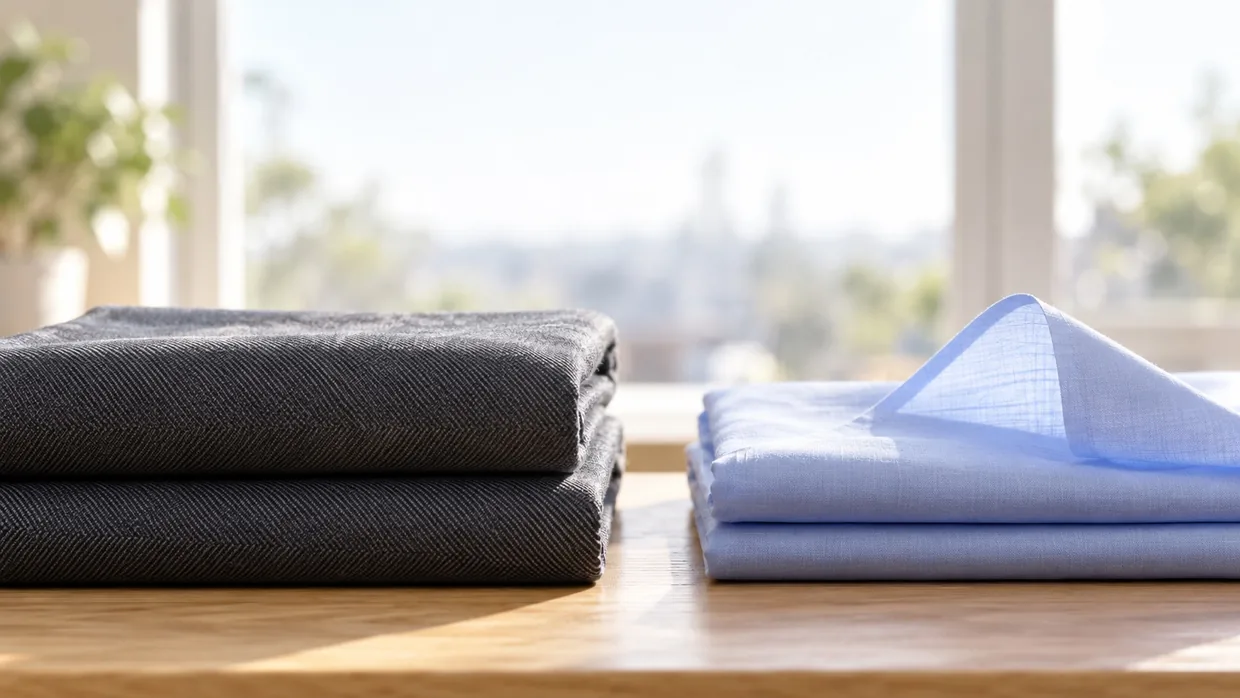
Suiting is woven for trousers, jackets, skirts and blazers: heavier, more opaque and built to resist abrasion at seats, knees and cuffs and to hold a crease. Shirting is woven for shirts and blouses: lighter and finer, worn next to the skin, so comfort, opacity, collar behaviour and wrinkle recovery after washing matter more than abrasion. In our range, PV suitings run from about 210 to 250 GSM and our PV shirting sits at 168 GSM. The two are specified, priced and dyed separately, which is why the same shade name on a shirt and a trouser will not always read identically.
The difference at a glance
| Suiting | Shirting | |
|---|---|---|
| Garments | Trousers, jackets, blazers, skirts, waistcoats | Shirts, blouses, kurtas, lab-coat bodies |
| Weight | Heavier (our PV suitings about 210 to 250 GSM) | Lighter (our PV shirting 168 GSM) |
| Common weaves | Twill, serge, gabardine, structured plain | Plain, poplin, oxford, chambray, fine dobby |
| Main demand | Abrasion, crease holding, drape | Comfort, opacity, wrinkle recovery |
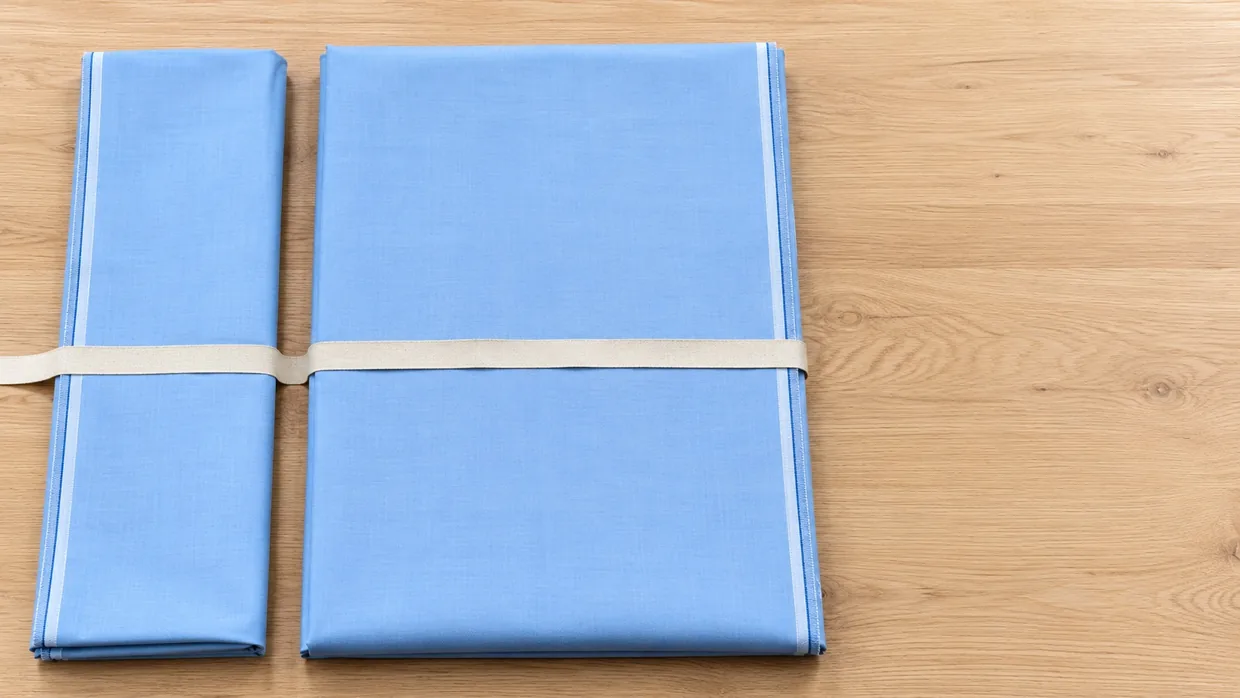
| Usual width | 58 inch | 36 or 58 inch |
GSM is explained in what is GSM; the width choice for shirting in 36 vs 58 inch shirting.
Weight and weave
Suiting needs body. A heavier cloth hangs straight from the waist, holds a pressed crease and stands up to rubbing, so suitings are usually woven heavier and often as a twill, whose diagonal structure packs more yarn into the cloth; see twill vs plain weave.
Shirting needs to be light and breathable, so it is woven from finer yarn in a plain weave or a fine dobby. The challenge is keeping a light cloth opaque, especially in white and pale shades, which is covered in shirting GSM and opacity.
What each one has to survive
- Suiting fails at the points of wear: seat, knees, pocket edges and hems. Pilling and shine on the seat are the usual complaints; see fabric pilling explained.
- Shirting fails in the wash: collars and cuffs fray or pucker, whites yellow or grey and the shirt comes out creased; see white shirting yellowing and greying and easy-care and wrinkle recovery.
Matching shirt and trouser on one programme
Because suiting and shirting are different constructions dyed in different lots, the same colour name will rarely read exactly the same on both. Where a uniform needs shirt and trouser to match, approve both against one standard and hold both lots; see lab dips and shade approval and dye lot consistency.
Quantities differ too: a trouser and a shirt use different lengths of different widths. The fabric consumption by garment guide gives the meterage for each. To compare our suiting and shirting side by side, Request Catalog.
FAQ
Frequently asked questions
- Can suiting fabric be used for shirts?
- Not usually. Suiting is too heavy and stiff to sit comfortably next to the skin and does not drape like a shirt. Lightweight suitings are sometimes used for overshirts or jackets worn over a shirt.
- Can shirting fabric be used for trousers?
- It is not advised. Shirting is too light to hold a crease and wears through quickly at the seat and knees.
- Is suiting always heavier than shirting?
- In practice yes, though the ranges can meet at the edges: a summer suiting may be lighter than a heavy oxford shirting. Compare GSM on the spec sheet rather than relying on the label.
- Are suiting and shirting made from the same fibers?
- Often. Poly-viscose and polyester are used for both; the difference lies in yarn count, weave, weight and finish rather than in the fiber alone.
Cite this guide
Quoting this page? Paste the line below so the credit links back.
<a href="https://www.bennycotts.com/guides/suiting-vs-shirting-fabric">Suiting vs Shirting Fabric: What Is the Difference?</a>, Benny Cotts, 2026Updated 18 October 2026 · Benny Cotts, Bhilwara
Fabrics
Fabrics mentioned in this guide
Spec, price and MOQ on every fabric page.

Officer Choice
Poly-Viscose (PV) blend · 210-230 GSM
Crisp, structured suiting engineered for officer uniforms.

Power Gold
Premium Poly-Viscose blend · 230-250 GSM
Our premium-line suiting with a refined hand and superior drape.

Commander Shirting 58"
Poly-Viscose 70/30 · 168 GSM
Fine 1/20 poly-viscose shirting in a full 58-inch width.

Commander Shirting 36"
Poly-Viscose 70/30 · 168 GSM
Fine 1/20 poly-viscose shirting in a narrow 36-inch width.
Industries this applies to
Uniform programs these fabrics are used for
- Fabric for Business Attire
- Fabric for Corporate Shirts
- Fabric for Corporate Trousers
- Fabric for Blazers & Waistcoats
- Fabric for Waiter Uniforms
- Fabric for Cabin Crew Uniforms
- Fabric for Ground Staff Uniforms
- Fabric for Army Uniforms
- Fabric for Police Uniforms
- Fabric for Security Guard Uniforms
- Fabric for Industrial Uniforms
- Fabric for Construction Workwear
- Fabric for Business Suits
- Fabric for Black-Tie Attire
- Fabric for Formal Event Wear
Fabric types covered here
Keep reading
Related guides



Ready to place an enquiry?