
Buying guide
Blazer Fabric for School and Corporate Uniforms
How to specify fabric for a blazer programme: the GSM range that holds a tailored shape, when a check beats a plain cloth, and how much fabric a jacket actually needs.

Jump to section
Quick answer
A blazer is the most structured garment in a uniform, so it takes the heaviest cloth in the range: a poly-viscose twill from roughly 230 GSM upwards, and 280 to 300 GSM where a school or corporate jacket has to hold its shape through a full year of wear. Weave matters as much as weight, since the diagonal float of a twill is what gives a jacket drape and shape retention. Budget 1.8 to 2.2 m per blazer, more if the fabric is a check that has to match across seams, and 500 m per shade if a crest or house colour is being woven to order.
Why a blazer needs heavier cloth than the rest of the uniform
A shirt and a trouser are worn against the body, so they are specified for comfort first: light enough to breathe, heavy enough to survive laundering. A blazer is specified for the opposite reason. It has to stand slightly away from the body, hold a collar and lapel roll, keep a clean shoulder line, and look the same on a hanger at the end of the day as it did in the morning.
That structure comes from the cloth, not the tailoring alone. A lightweight suiting cut into a jacket collapses at the lapel, bags at the elbow and loses its line after a few pressings, no matter how well it was made. This is why almost every blazer programme ends up specifying a heavier fabric than the trousers issued alongside it, even when both come from the same range.
The GSM range that works for a blazer
There is no single blazer weight, but there are three usable bands. Which one you pick depends on climate, how many months a year the jacket is actually worn, and how much structure the design needs.
| Weight band | Catalogue fabric | Suits |
|---|---|---|
| 220-240 GSM | Grado 1st | Lighter school and college blazers, warmer regions, jackets worn most of the year |
| 230-250 GSM | Power Gold | Corporate and executive jackets where drape and finish lead the brief |
| 300 GSM | Premium Twill Check | Structured school and corporate blazers, winter programmes, patterned jackets |
Below about 220 GSM you are choosing a soft jacket rather than a structured blazer, which is a valid choice for hospitality and smart-casual programmes but not for a crested institutional blazer.
Plain, check or patterned
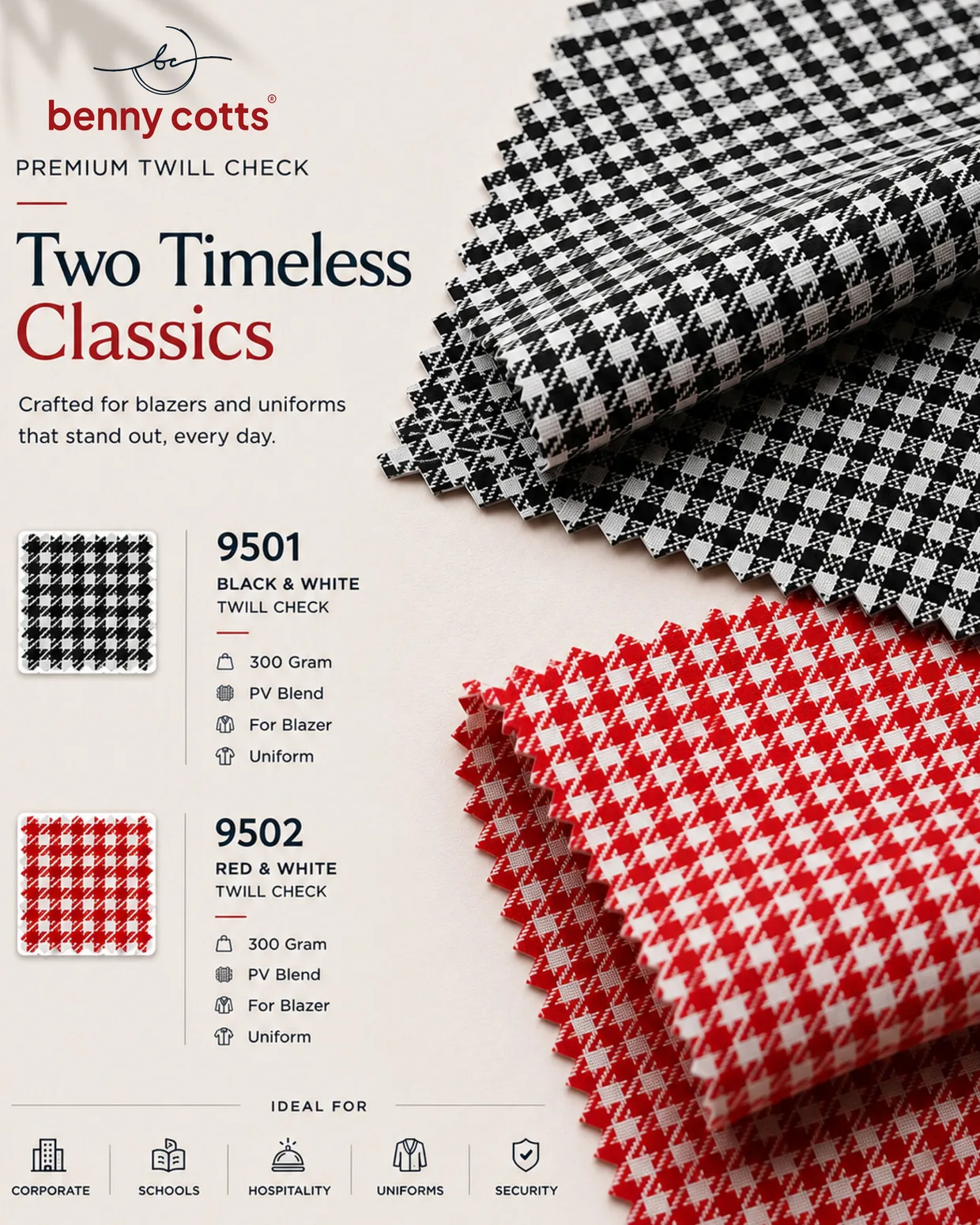
A plain blazer cloth in navy, charcoal or bottle green is the default for corporate programmes, where the jacket is a neutral frame for a name badge and a crest. Checks work differently: the pattern is the identity. A house check or a school check is instantly recognisable at a distance, ages well as a design, and does not depend on a shade being matched exactly to a logo.
Our Premium Twill Check is built for that job: a 300 GSM poly-viscose twill woven as a classic check, held in two colourways, 9501 in black and white and 9502 in red and white. The weight gives a blazer its structure and the check carries the identity, which means one fabric covers both requirements without a printed finish that can wear off.
A patterned blazer cloth also hides more than a plain one. Small marks, pressing shine and the general wear a school jacket collects over a year read far less on a check than on a flat navy twill, which is one reason checks have stayed in institutional blazers for as long as they have.
Blend and finish for a jacket that keeps its shape
Poly-viscose is the standard blazer blend for institutional programmes, and the ratio does real work. The polyester share carries crease recovery and shape retention, so the jacket comes back to its line after a day of wear and a wash cycle. The viscose share carries handle and dye depth, so the cloth does not feel plasticky against a shirt sleeve and holds a deep, even shade.
Ask for the finish on the spec sheet alongside the blend. For a blazer the finish lines that matter are wrinkle resistance, dimensional stability so the jacket does not shrink out of a fitted size, and colour fastness to rubbing, since a jacket spends its life against chair backs, bag straps and desks.
Our blazer-weight cloth is woven at our own unit in Atoon, Bhilwara, and dyed and finished through partnered processing houses in the region, with each batch checked against an approved standard before despatch.
Sizing a blazer programme
A blazer needs roughly 1.8 to 2.2 m of fabric per jacket at 147 to 150 cm width, against about 1.2 to 1.4 m for a trouser. Multiply by headcount, then add wastage. Standard cutting wastage on a plain cloth runs 5 to 10 percent, but a check needs the pattern matched across the centre front, the sleeves and the collar, so allow 10 to 15 percent instead.
A 200-student senior school blazer programme is therefore roughly 400 m of cloth plus matching allowance, so about 440 to 460 m. That sits just under the 500 m custom threshold, which is worth knowing before you commit to a bespoke house shade: a ready-stock colourway can ship from 50 m per shade, while a custom shade needs the programme sized to 500 m per shade or planned across two years.
What to send with the enquiry
- Garment and headcount, so the meterage and wastage allowance can be worked out rather than guessed.
- Whether the blazer is worn year-round or only for a winter term, which decides the weight band.
- Plain or check, and if check, whether an existing pattern has to be matched or a catalogue colourway will do.
- The trouser and shirt fabrics already in the programme, so the blazer is specified to sit with them rather than against them.
- Any tender or institutional test parameters the cloth has to be certified against.
FAQ
Frequently asked questions
- Should blazers be dry cleaned or washed?
- Dry cleaned, for a structured blazer. The canvas, fusing and shoulder construction that hold a jacket's shape do not survive repeated wet washing well, and solvent barely swells the cloth so the dimensional risk is lower too. Tell the cleaner the blend and the pressing limit, because an over-hot finishing press leaves a permanent shine on a polyester-rich cloth. Our care and washing guide covers both routes.
- What GSM should a school blazer be?
- 230 GSM upwards for a structured blazer, and 280 to 300 GSM where the jacket has to hold its shape through a full year of daily wear. Warmer regions and year-round jackets sit at the lower end of that range, winter-term blazers at the upper end.
- Is a check harder to cut than a plain blazer fabric?
- Yes, slightly. The pattern has to line up across the centre front, sleeves and collar, so cutting wastage runs closer to 10 to 15 percent instead of the 5 to 10 percent typical of a plain cloth. Factor that into the meterage before ordering rather than after.
- Can the blazer and trouser come from the same fabric?
- They can, and a matched suit sometimes calls for it, but most programmes do better with a heavier cloth for the jacket and a lighter one for the trouser. A single fabric heavy enough to structure a blazer is usually uncomfortable as a trouser worn all day.
- How many meters of fabric does one blazer take?
- Roughly 1.8 to 2.2 m at 147 to 150 cm width, depending on size and cut. Add 10 to 15 percent for a check that needs pattern matching, or 5 to 10 percent for a plain cloth.
- Do you hold blazer check fabric in ready stock?
- Premium Twill Check is held in two colourways, 9501 black and white and 9502 red and white, both at 300 GSM. Ready-stock colourways can be ordered from 50 m per shade; a custom house check or shade is woven to order from 500 m per shade.
Cite this guide
Quoting this page? Paste the line below so the credit links back.
<a href="https://www.bennycotts.com/guides/blazer-fabric-schools-corporates">Blazer Fabric for School and Corporate Uniforms</a>, Benny Cotts, 2026Updated 30 July 2026 · Benny Cotts, Bhilwara
Fabrics
Fabrics mentioned in this guide
Spec, price and MOQ on every fabric page.

Premium Twill Check
Poly-Viscose blend · 300 GSM
Heavy 300 GSM poly-viscose twill check for blazers and uniforms.

Power Gold
Premium Poly-Viscose blend · 230-250 GSM
Our premium-line suiting with a refined hand and superior drape.

Grado 1st
Poly-Viscose blend · 220-240 GSM
Tailoring-grade fabric built for everyday durability.

School Check Twill
Poly-Viscose 70/30 · 225 GSM
Twill-woven poly-viscose check built for school uniforms.

Premium Twill Makkhi
Poly-Viscose 70/30 · 205 GSM
Fine twill poly-viscose with a subtle makkhi speckle.

Officer Choice
Poly-Viscose (PV) blend · 210-230 GSM
Crisp, structured suiting engineered for officer uniforms.

Shemray 36"
Poly-Viscose 70/30 · 139 GSM
Lightweight poly-viscose cloth in a compact 36-inch width.
Industries this applies to
Uniform programs these fabrics are used for
- Fabric for Business Attire
- Fabric for Corporate Uniforms
- Fabric for Corporate Shirts
- Fabric for Corporate Trousers
- Fabric for Blazers & Waistcoats
- Fabric for School Uniforms
- Fabric for College & University Uniforms
- Fabric for Doctor Coats
- Fabric for Lab Coats
- Fabric for Hospital Staff Uniforms
- Fabric for Cabin Crew Uniforms
- Fabric for Ground Staff Uniforms
- Fabric for Army Uniforms
- Fabric for Police Uniforms
- Fabric for Security Guard Uniforms
- Fabric for Industrial Uniforms
- Fabric for Construction Workwear
- Fabric for Business Suits
- Fabric for Black-Tie Attire
- Fabric for Formal Event Wear
Fabric types covered here
Keep reading
Related guides


Ready to place an enquiry?