
Fabric basics
36 Inch vs 58 Inch Shirting: Which Width to Order
The same shirting quality woven in 36 inch and 58 inch: how each width changes the cutting plan, metres per shirt and what you should actually compare on a quote.
Jump to section
Quick answer
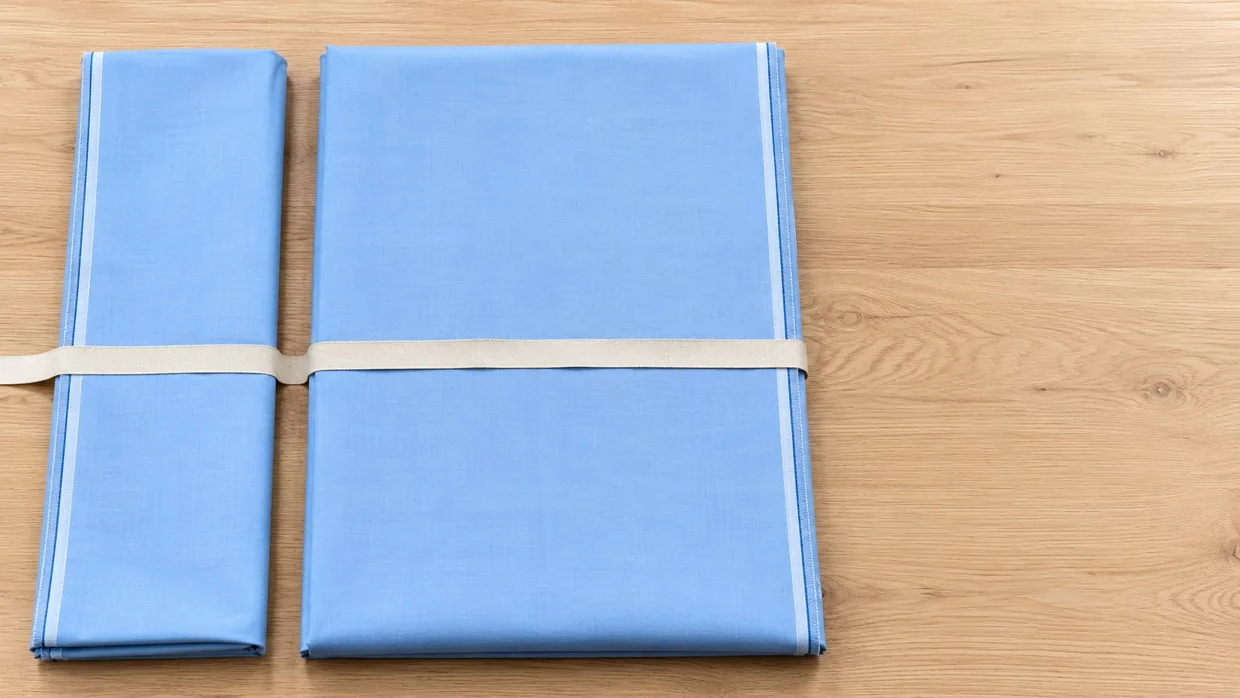
A 36 inch shirting is about 91 cm of cloth and a 58 inch shirting is about 147 cm, and the difference decides how many shirt pieces fit across the roll rather than how good the cloth is. Both of those are total width, so take an inch or two off each before you plan a marker, since the selvedge is not cuttable. On 91 cm most adult shirt patterns fit only a front and a back across the width, so sleeves, collars and cuffs come out of extra length. A full-sleeve shirt typically takes somewhere around 2 to 2.3 m. On 147 cm the front, back and both sleeves usually nest into a single cut, and the same shirt typically takes somewhere around 1.4 to 1.6 m. That is why width has to be settled with the cutting unit, not the buyer alone. A small tailoring setup with short tables often cuts the narrow width faster and wastes less on short runs. A volume unit with a full cutting table almost always lands cheaper per shirt on the full width. We weave Commander Shirting, Commander PV Ultima and Shemray in both 36 inch and 58 inch, so a program can standardise on one cloth and still let each stitching unit take the format its tables cut best. Check the spec sheet per width rather than assuming they are identical. Commander Shirting holds the same 1/20 poly-viscose at 168 GSM in both. Shemray is 139 GSM narrow and 134 GSM wide, which is close but not the same number.
What the two widths actually give you
Shirting widths in India are still quoted in inches, and the two you will meet most often are 36 inch and 58 inch. In centimetres that is about 91 cm and about 147 cm of finished cloth. Neither is a quality grade. The same yarn, the same construction and the same dye recipe can be woven at either width, and on our range they largely are. Commander Shirting is a 1/20 poly-viscose at 168 GSM in both formats. Shemray is a lighter poly-viscose cloth in both, at 139 GSM narrow and 134 GSM wide. Commander PV Ultima is woven in both, with its standard 2/40 against 1/20 range shipping in the two widths and its premium 2/40 against 2/40 range carrying the full 135 shade card.
What changes is the marker, the layout plan that shows how the pattern pieces sit across the cloth. A shirt front and a shirt back will sit side by side on 91 cm and leave nothing usable beside them, so the sleeves have to be found further down the roll. On 147 cm the same front and back leave enough width for both sleeves alongside, and the collar, cuffs and placket strips come out of the band underneath. Extra width can remove a whole extra length of cloth from the plan.
This is the part buyers underestimate: the width is not a preference, it is an input to the cutting room. Two units given the identical fabric and the identical order will report different consumption per shirt if one is cutting 91 cm and the other 147 cm, and neither of them is wrong.
Metres per shirt, and why we give a range
For a full-sleeve adult uniform shirt, planning numbers of roughly 2 to 2.3 m on 36 inch and roughly 1.4 to 1.6 m on 58 inch will get you close enough to place an order. Half-sleeve shirts come down by roughly 0.15 to 0.25 m in either width. School shirts in smaller sizes come down further, and the gap between the two widths narrows as the pieces get smaller, because a small front and back leave more spare width on 91 cm than an adult pattern does.
We give a range rather than a number because three things move it and none of them are the cloth. Size mix moves it, since a run weighted towards XL and XXL pushes consumption up in both widths. Pattern shape moves it, since a fitted shirt with a yoke, a back pleat and a two-piece collar nests less tidily than a straight-cut school shirt. Cutter skill moves it most of all: a well-planned marker with sizes nested together can land at the bottom of the range, and a rushed single-size layout will land above the top of it.
- Full-sleeve adult shirt on 36 inch: about 2 to 2.3 m as a planning figure
- Full-sleeve adult shirt on 58 inch: about 1.4 to 1.6 m as a planning figure
- Half-sleeve: roughly 0.15 to 0.25 m less than the full-sleeve figure for the same width
- School and small sizes: lower in both widths, and the gap between the widths shrinks
- Mixed-size runs nested on one marker: better yield than cutting each size separately
Treat these as figures for ordering, not for costing a tender. Before a bulk order, ask your cutting unit to run a trial marker on the width you actually intend to buy and give you the consumption it produces. That one number replaces every estimate on this page.
The comparison that misleads buyers
The most common mistake in shirting is comparing two quotes on price per metre when the widths differ. A metre of 91 cm cloth and a metre of 147 cm cloth are not the same amount of fabric, so the per-metre figure is not comparable and the narrow width will always look cheaper on it.
There are two honest comparisons. The first is cost per square metre, which removes the width from the comparison: divide the per-metre price by the width in metres. The second, and the one that actually decides your cost, is cost per finished shirt, which includes the marker as well as the width. A narrow width can win on cost per square metre and still lose on cost per shirt, because the pieces do not nest as well. It can also win on both, if your unit cuts short runs where the offcut on a wide roll goes to waste.
| What you compare | What it tells you | When it misleads |
|---|---|---|
| Price per running metre | Almost nothing on its own | Always, when the two widths differ |
| Price per square metre | The true cost of the material | When one width nests your pattern much better than the other |
| Cost per finished shirt | What you will actually pay per uniform | Only if the marker used was not run on the real width and real size mix |
Ask for the width in centimetres on every quote and spec sheet, not just the inch label. A cloth sold as 58 inch and finished at 142 cm is a real thing, and planning a marker at 147 cm on 142 cm cloth means every layout comes up short.
When the narrow width is the right answer
Full width is not automatically better, and the mills that tell you otherwise are describing their own convenience. The 36 inch format exists because a large share of Indian uniform stitching happens on tables and in setups where it is genuinely the better fit.
A short cutting table cannot lay 147 cm cloth flat without folding it, and a folded lay is where mismatched pairs and off-grain pieces come from. A single-tailor or small-unit operation cutting ten or twenty shirts at a time gets very little benefit from the wide roll's nesting advantage and pays for the wasted selvedge strip on every lay. And any operation that handles the cloth manually will find a 91 cm roll lighter, easier to spread and easier to store in shade-wise stacks.
- Short or narrow cutting tables, where a wide lay would have to be folded
- Small-batch and made-to-measure stitching, where nesting gains never materialise
- Repair, alteration and top-up work against an existing program shade
- Units where cloth is spread and handled by hand rather than on a spreading machine
- Programs where the same shade also feeds linings or smaller panels
How to run one program across both widths
The reason we weave the same shirting in both formats is that uniform programs rarely have one stitching unit. A corporate program might have a Delhi vendor cutting on full tables and a regional vendor doing top-ups on a short one, and forcing both onto one width means one of them works around it.
The way to keep that clean is to fix everything except the width. Lock the quality, lock the shade against a physical reference swatch held on file at the mill, and let the width be a line item per vendor. Where both widths come off the same construction and are processed to the same locked recipe at our partnered processing house, a shirt cut from the 36 inch roll and a shirt cut from the 58 inch roll read as the same uniform on the same floor. Confirm this on the spec sheet per width rather than assuming it. What you must not do is treat the widths as interchangeable inside one order: consumption, and therefore the quantity you book, has to be worked out per width.
One more practical point on reorders. Record the width alongside the quality and shade code on the spec sheet. A top-up ordered a year later against a spec sheet that only says Commander Shirting will come in whichever width is quoted. The vendor who planned around 91 cm will then find their marker no longer fits.
FAQ
Frequently asked questions
- Is 58 inch shirting always cheaper per shirt than 36 inch?
- Usually, but not always. On volume runs with adult full-sleeve patterns the wide width nests better and lands cheaper per shirt. On short runs, small sizes, or units cutting on short tables, the nesting advantage does not materialise and the selvedge waste on the wide roll can cancel it out. Work it out on cost per finished shirt using a trial marker, not on price per metre.
- How much fabric does one uniform shirt take in 36 inch and 58 inch?
- As planning figures, roughly 2 to 2.3 m for a full-sleeve adult shirt on 36 inch and roughly 1.4 to 1.6 m on 58 inch. Half-sleeve takes about 0.15 to 0.25 m less. Size mix, pattern shape and how well the marker nests will move these, so confirm with a trial layout before booking a bulk quantity.
- Which shirtings does Benny Cotts weave in both widths?
- Commander Shirting is woven in both 36 inch and 58 inch as a 1/20 poly-viscose at 168 GSM. Shemray is woven in both as a lighter poly-viscose cloth, at 139 GSM narrow and 134 GSM wide. Commander PV Ultima is woven in both, with the standard 2/40 against 1/20 range shipping in the two widths and the premium 2/40 against 2/40 range carrying the full 135 shade card. Spun Shirting runs narrow at 89 cm, which is 35 inch rather than 36. Confirm the exact finished width on the spec sheet for the quality you choose, since the inch label is a trade name and the centimetre figure is the one your marker needs.
- Can one uniform program use both widths at the same time?
- Yes, and it is common when a program has more than one stitching vendor. Keep the quality and the shade fixed against a reference swatch held on file, and treat width as a per-vendor line item with its own consumption calculation. Do not mix widths inside a single quantity, since the metres you need differ.
- Why does the width on my delivery not match the width on the quote?
- Finished width can sit slightly below the nominal inch label after processing, so a cloth sold as 58 inch may finish at 142 or 147 cm depending on the quality. That is why the spec sheet should carry the width in centimetres. If you planned a marker at 147 cm and received 142 cm, every layout comes up short, so raise it at inspection rather than at the cutting table.
- Does the width affect the shade or the feel of the fabric?
- It should not, as long as you have checked the spec sheet for both widths rather than assuming they match. Where the construction, yarn and dye recipe are the same across the two widths, as on Commander Shirting, the feel and the shade read the same; Shemray sits a few grams apart between its widths, so confirm the number you are planning against. What can differ is the loom the cloth ran on, which is why every width and every lot is still checked against the same physical reference swatch before dispatch rather than against the previous delivery.
Cite this guide
Quoting this page? Paste the line below so the credit links back.
<a href="https://www.bennycotts.com/guides/shirting-fabric-36-vs-58-width">36 Inch vs 58 Inch Shirting: Which Width to Order</a>, Benny Cotts, 2026Next in Reading a fabric
Than, Gaj, Panna: Fabric Unit Conversion Chart
More in Reading a fabric
- What GSM Means for Uniform Fabric
- Shirting GSM, Show-Through and Why Light Shirts Need More Than Weight
- How to Read a Fabric Spec Sheet
- Fabric Construction: Reading Count x Count and EPI x PPI
- Fabric Width and Cutting Yield Explained
- 36 Inch vs 58 Inch Shirting: Which Width to Order
- Than, Gaj, Panna: Fabric Unit Conversion Chart
- Fabric-Type Glossary: Gabardine, Matty, Twill, Serge
Updated 23 August 2026 · Benny Cotts, Bhilwara
Fabrics
Fabrics mentioned in this guide
Spec, price and MOQ on every fabric page.

Commander Shirting 58"
Poly-Viscose 70/30 · 168 GSM
Fine 1/20 poly-viscose shirting in a full 58-inch width.

Commander Shirting 36"
Poly-Viscose 70/30 · 168 GSM
Fine 1/20 poly-viscose shirting in a narrow 36-inch width.

Commander PV Ultima Shirting
Poly-Viscose (PV Ultima), 2/40 x 2/40 premium, 2/40 x 1/20 standard
PV Ultima spun shirting in 135 shades, 36" and 58", grey ready year-round.

Shemray 58"
Poly-Viscose 70/30 · 134 GSM
Lightweight poly-viscose cloth in a full 58-inch width.

Shemray 36"
Poly-Viscose 70/30 · 139 GSM
Lightweight poly-viscose cloth in a compact 36-inch width.
Industries this applies to
Uniform programs these fabrics are used for
Fabric types covered here
Keep reading
Related guides



Ready to place an enquiry?