
Buying guide
How Woven Fabric Is Packed and Shipped: Rolls, Bales, Labels and Paperwork
Rolled on tubes or folded, poly wrap, bales or cartons, what a roll label should carry, how the packing list ties it together and why moisture is the main transit risk. What to write into your purchase order.
Jump to section
Quick answer
Woven fabric usually travels wound on a core or tube, or folded, then wrapped against dirt and moisture and packed in bales or cartons. Each roll should carry a label tying it to its lot, shade group, length and piece number, and the packing list should repeat those details for every roll. The main transit risk is moisture, because textiles absorb it readily. Put the packing format, the label fields and the packing list format in your purchase order. Do not leave them to habit.
Rolled or folded
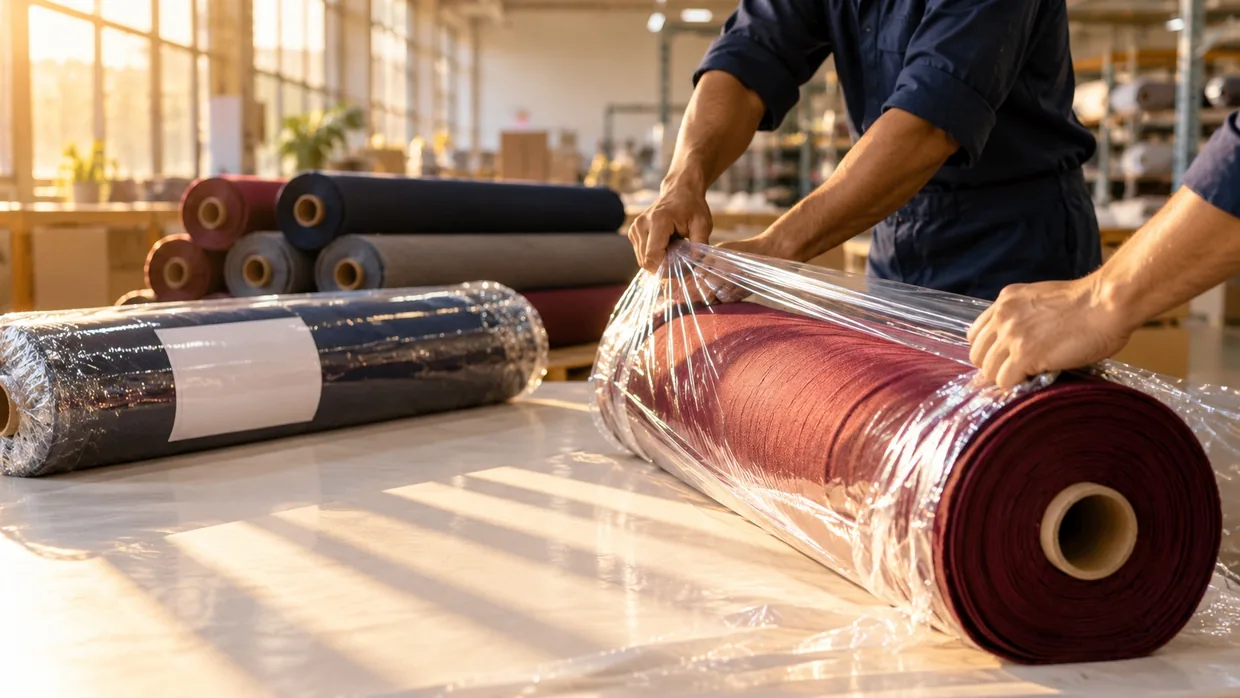
Most woven cloth leaves a mill in one of two forms. Rolled cloth is wound around a cardboard or plastic tube, which keeps it flat and ready to go straight onto a cutting room's spreading table. Folded, or lapped, cloth is laid back and forth in flat layers. Some buyers and markets prefer this for handling and storage.
Neither is right in itself. What matters is whether the form suits the cloth and the way your cutting room works. If a fabric is easily marked by pressure or fold lines, ask the mill which form it recommends for that quality and why. Agree it before production, not at dispatch.
What a roll label should tell you
A label lets you trace one roll back to the production it came from. Without it, a shade or defect complaint cannot be matched to anything. Ask for these fields by name:
- Quality or article name and the order reference.
- Lot or batch number, the dyeing run the roll came from.
- Shade group, where rolls have been sorted into groups that can be cut together.
- Piece or roll number, unique within the shipment.
- Length, in the unit your contract uses, and width if it varies by lot.
- Gross and net weight, where your paperwork or freight needs it.
Shade grouping is explained in dye lot consistency, and the units question in meters, yards and other fabric units. Ask for the label on the outside of the wrap and a second one at the roll end or inside the tube, so it survives if the outer wrap is torn.
Wrapping, bales and cartons
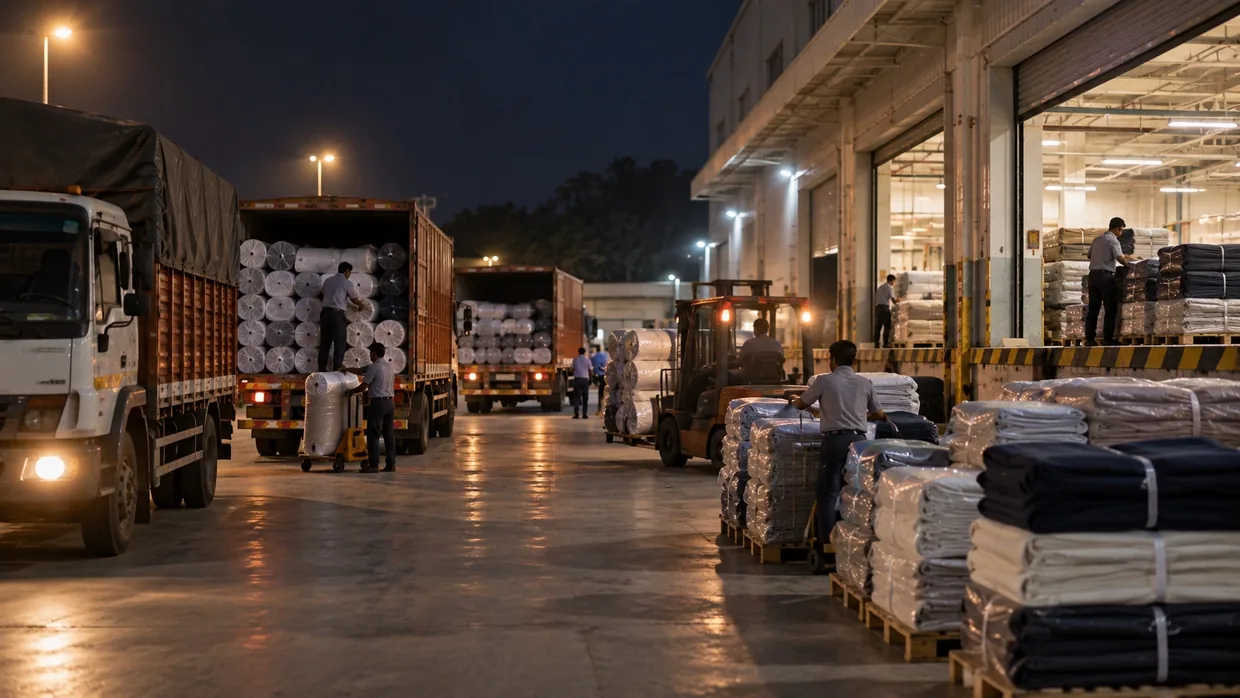
After labelling, rolls are typically wrapped in polyethylene film to keep out dirt and damp, then packed for transport. The German insurers' Transport Information Service (TIS) cargo handbook describes textiles as packed in bales, boxes or cartons. Yard goods are wound on cores and sometimes cartoned.
The same handbook gives two warnings worth passing to anyone packing or handling your goods. Metal strapping can corrode and leave rust stains on the cloth. Hooks should not be used on textile cargo, because they very easily cause damage. India also has a standard for this, IS 14463, which prescribes a method of packing cotton yarn and cloth for transport in freight containers. You can name it in a contract if it fits your goods.
Moisture is the main transit risk
Textiles are hygroscopic, which means they take up moisture from the air around them. The TIS handbook notes that moisture absorbed in transit, or present when the goods were packed, can come from rain, seawater or condensation. It leads to mildew staining, mould, mustiness and, in the worst case, rotting of the cloth. It also warns that dirt, dust and leakage from other cargo can spoil textiles.
In a closed container, moisture has little way out. The Container Handbook published by the same insurers states the key prevention simply: cargo, packaging, dunnage (loose packing material) and accompanying material should go into the container dry. It also shows that a sealed plastic wrap can trap moisture already inside the package instead of keeping it out. That is why dry packing matters more than the wrap itself.
- Ask that cloth is packed dry, and not taken straight off a damp floor or out of rain.
- Ask that the container is inspected clean and dry before loading.
- Do not let moisture-sensitive goods share a container with wet cargo.
- Use non-corroding straps, or require that metal straps do not touch the cloth.
The packing list ties it together
The packing list is the roll-by-roll record of the shipment: each piece number with its lot, shade group, length and weight, grouped by bale or carton. Your warehouse checks the delivery against it. A cutting room uses it to lay one shade group at a time. Any claim is built on it. Commercial documents under a letter of credit are checked against the credit's own wording. So if you pay that way and want specific details on the packing list, say so in the credit as well as in the order. Roll labels matter after resale too: see the cloth was sold on, and the complaint came back.
On arrival, check the delivery against the packing list before the cloth is cut, as set out in how to inspect uniform fabric on delivery. If something is wrong with the cloth itself, woven fabric defects and who fixes them covers what to do next.
What to write into your purchase order
- Packing form: rolled on a tube or folded, and any limit on length per piece.
- Wrap: film wrap per roll, plus the outer packing, bale or carton.
- Label fields: quality, order reference, lot, shade group, piece number, length, weight.
- Label placement: outside the wrap and at the roll end or inside the tube.
- Packing list: roll by roll, grouped by bale, with shade groups shown.
- Strapping: non-corroding, or kept off the cloth.
- Moisture: dry packing and a clean, dry container before loading.
- Bale or carton marks: your consignee marks and a running package number.
Who arranges and pays for carriage and insurance is a separate question. The trade term you buy on answers it: see Incoterms for uniform fabric export. To see the qualities available before you write the order, Request Catalog.
FAQ
Frequently asked questions
- Is rolled fabric better than folded?
- Not in itself. Rolled cloth on a tube suits cutting rooms that spread straight from the roll, and some buyers prefer folded cloth for handling and storage. Ask the mill which form suits the specific quality, especially if the cloth is easily marked by fold lines or pressure. Fix it in the order.
- What should be printed on each roll?
- At minimum the quality, order reference, lot number, shade group, piece number and length, plus weight if your paperwork needs it. Ask for a second label at the roll end or inside the tube so the roll stays identifiable if the outer wrap is damaged.
- Does plastic wrap stop fabric getting damp?
- It keeps rain and dirt off, but it cannot remove moisture already inside the package, and a sealed wrap can trap it. Transport insurers' guidance stresses packing the goods and the container dry in the first place. Dry packing matters more than the wrap.
- Why does the packing list matter so much?
- It is the roll-by-roll record that your warehouse checks against, that your cutting room uses to keep shade groups together, and that any claim refers to. If you pay by letter of credit, the documents are checked against the credit's wording, so state any required packing list details there too.
- Why should metal strapping be avoided?
- Metal straps can corrode in damp conditions and leave rust stains on the cloth. Ask for non-corroding straps, or for metal straps to be kept clear of the fabric itself.
Cite this guide
Quoting this page? Paste the line below so the credit links back.
<a href="https://www.bennycotts.com/guides/how-fabric-is-packed-and-shipped">How Woven Fabric Is Packed and Shipped: Rolls, Bales, Labels and Paperwork</a>, Benny Cotts, 2026Next in The trade
When Bulk Fabric Arrives Wrong: Claims, Remedies and Tolerances
More in The trade
- The Textile Value Chain: Who Does What, From Fiber to Uniform
- Uniform Fabric Pricing Explained
- Who Pays When Duty, Freight or Fiber Costs Move During a Fabric Contract
- Understanding Fabric Quotations
- Uniform Fabric MOQ in India, Explained
- Uniform Fabric Sampling Guide
- Custom Production vs Ready Stock Fabric
- Payment Terms for Bulk Fabric Orders: Advance, LC, Collections and Open Account
- Uniform Fabric Lead Times in India
- How Woven Fabric Is Packed and Shipped: Rolls, Bales, Labels and Paperwork
- When Bulk Fabric Arrives Wrong: Claims, Remedies and Tolerances
- HSN Codes and GST Basics for Uniform Fabric Buyers
- Incoterms Explained for Uniform Fabric Buyers Sourcing from India
- How to Import Uniform Fabric from India: A Buyer's Guide
- Certificates of Conformity: The Destination-Market Paperwork That Can Stop Fabric at Your Border
- EU Textile EPR, Explained for Indian Fabric and Garment Exporters
- The Digital Product Passport for Textiles: The Data Your Fabric Supplier Will Need to Give You
- Uniform Fabric for Government Tenders: A Supplier's Guide
- Tender Documentation for Uniform Fabric: What a Mill Must Actually Produce
- Selling Fabric: How a New Trader Finds Buyers for Uniform, Suiting and Shirting Cloth
Updated 8 October 2026 · Benny Cotts, Bhilwara
Fabrics
Fabrics mentioned in this guide
Spec, price and MOQ on every fabric page.

Benzer Special
Poly-Viscose blend · 200-220 GSM
Versatile PV blend optimized for uniform programs at scale.

Nano
Poly-Viscose blend · 180-200 GSM
Our entry-level uniform fabric for large-volume programs.

Officer Choice
Poly-Viscose (PV) blend · 210-230 GSM
Crisp, structured suiting engineered for officer uniforms.
Industries this applies to
Uniform programs these fabrics are used for
- Fabric for Corporate Trousers
- Fabric for School Uniforms
- Fabric for College & University Uniforms
- Fabric for Sports & PT Uniforms
- Fabric for Pre-School & Kindergarten Uniforms
- Fabric for Patient Gowns
- Fabric for Hospital Staff Uniforms
- Fabric for Hotel Uniforms
- Fabric for Waiter Uniforms
- Fabric for Ground Staff Uniforms
- Fabric for Army Uniforms
- Fabric for Police Uniforms
- Fabric for Security Guard Uniforms
- Fabric for Industrial Uniforms
- Fabric for Construction Workwear
- Fabric for Housekeeping Uniforms
Fabric types covered here
Keep reading
Related guides



Ready to place an enquiry?