
Export & sourcing
How to Import Uniform Fabric from India: A Buyer's Guide
What overseas buyers, agents and importers should expect when sourcing uniform fabric from an Indian mill: the enquiry-to-shipment process, what to ask for in writing, and how terms get agreed.

Jump to section
- Step 1: Send a detailed enquiry, not a generic one
- Step 2: Confirm feasibility and request samples
- Step 3: Agree terms for that specific order
- Step 4: Production, inspection and shipment
- Step 5: Landing the shipment, and the clocks that start when it arrives
- The origin document, and which one your customs actually needs
- What to ask for in writing before you commit
- The five steps at a glance
- Where Benny Cotts is on this today
- Working out whether your volume is a container or a part load
Quick answer
Importing uniform fabric from an Indian mill generally follows five steps. First, you send a detailed enquiry (destination country, quantity, specification, timeline). Second, the mill confirms feasibility and sends samples and a quote. Third, you and the mill agree payment terms, incoterms and lead time for that specific order. Fourth, the fabric is produced, inspected and shipped. Fifth, on arrival the documents are surrendered so the container can be released and cleared before the free days run out. Terms vary by mill and by order, so get MOQ, payment and shipping terms confirmed in writing before you commit. Do not assume a standard.
Step 1: Send a detailed enquiry, not a generic one
A vague enquiry ("send your catalogue and prices") gets a vague reply. A useful first enquiry states your destination country, target quantity, the application (school uniform, corporate, workwear, hospitality), any known specification (GSM, composition, width) and your timeline. The more specific the enquiry, the faster and more relevant the reply. You also find out sooner whether a particular mill can actually serve your volume.
If you don't know the exact specification yet, describe the end use instead. A mill experienced in institutional uniform fabric can usually recommend a GSM and composition range from the application alone.
Step 2: Confirm feasibility and request samples
Not every mill can serve every destination or volume. Before going further, get a direct answer on whether your order is feasible at all, what lead time it implies, and whether swatches or a sample cutting can be sent so you can verify the fabric yourself rather than relying on photos.
Treat this step as a filter. A mill that avoids a direct answer on feasibility, or pushes straight to a quote without confirming they can actually produce and ship your volume, is one to be cautious of.
Step 3: Agree terms for that specific order
Export terms are rarely the same across mills. MOQ, payment terms (such as advance payment, letter of credit or telegraphic transfer) and incoterms (such as FOB or CIF) can all vary by mill, by destination and by order size. Do not assume a standard. Ask directly what terms apply to your specific enquiry and get them confirmed in writing before production begins.
This is also the point to clarify who arranges shipping and insurance, what documentation will accompany the shipment (commercial invoice, packing list, and any certificate of origin your customs authority requires), and what happens if the shipment doesn't match the approved sample.
Step 4: Production, inspection and shipment
Once terms are agreed, the mill produces against the approved sample or shade standard. Ask whether you'll get an inspection report or photos before the shipment leaves, particularly on a first order where you haven't yet built trust with a new supplier.
Lead time depends on whether the fabric comes from ready stock or is woven and dyed to order. A custom shade or construction takes much longer than a running shade, since it needs its own dye lot and loom setup.
One change to the Indian export paperwork takes effect from 1 November 2026. CBIC Circular 42/2026-Customs of 24 September 2026, as reproduced in the trade press because CBIC's own site cannot be read without a browser session, makes an extra identifier mandatory on the shipping bill. It applies to listed woven and knitted fabric lines in Chapters 52, 55 and 60. The exporter must declare each such line as either flame retardant fabric (qualifier FR001) or other than flame retardant fabric (FR009). The listed lines include heading 5515, where polyester blended with viscose sits, so it covers most poly-viscose suiting and shirting leaving India. The purpose is to identify flame retardant cloth for the textiles Production Linked Incentive scheme. It adds no duty, and nothing changes on your side of the border. It is still worth knowing, because the declaration should match what you were sold. If you are buying certified flame retardant cloth, the shipping bill should say FR001, and one that says FR009 is a mismatch to raise before the goods leave. We do not supply flame retardant cloth, so our own declarations for these lines will read FR009.
Step 5: Landing the shipment, and the clocks that start when it arrives
Every step above ends at despatch, and that is where a first import usually goes wrong. The moment the vessel discharges, time-based charges start running against your consignment. Two different parties bill them, and none of them is included in your fabric price or in your incoterm. They are also the one cost on an import that you can fully avoid, because they are charged for delay, not for any service done for you.
The carrier gives a stated number of free days and then bills beyond it. Internationally the split is by location. Demurrage applies while the full container is still inside the terminal past free time. Detention applies once it has been taken out and is in your possession, and it runs until the empty is returned to the line's nominated depot. Indian port and container freight station tariffs use the words differently. They call the custodian's cargo storage charge demurrage, and they charge separate ground rent on the laden container occupying their ground. The shipping line then bills detention on top. Read each charge by what it actually measures, not by its name. One slow week can produce three invoices from two parties, and none of them cancels the others.
Free periods are set per facility and per direction, not by one global rule, and charges rise in slabs, not at a flat daily rate. The published tariff at one government-run container freight station at Mundra shows the pattern. Import cargo storage is chargeable from day one, while export cargo gets a free period of a fortnight. Laden container ground rent has its own separate free days on top of that. The per-container ground rent in the highest slab is around seven times the first chargeable slab. Ask for the free days and the slab structure in writing for your actual port and facility before the vessel sails, not after it berths.
The delay is almost always caused by paperwork, not by the cargo. A container is not released against a paid invoice. It is released against a delivery order. The line issues that only once the bill of lading has been surrendered. This is done either with the original set or, where the mill tells the carrier to release without them, as a telex release (also called an express release). Where payment runs through a letter of credit, the originals travel through two banks. A discrepancy raised on the documents, or a courier delay, then holds the delivery order while both clocks are already running. Agree at order stage which release method applies. Ask for scanned copies of the invoice, packing list, bill of lading and certificate of origin the day they are issued. Appoint your customs broker before the estimated arrival, not on it.
| Charge | Who bills it | What the clock measures | What stops it |
|---|---|---|---|
| Demurrage (carrier) | Shipping line | Time the full container stays inside the terminal past the free days | The container being gated out |
| Detention (carrier) | Shipping line | Time the container is outside the terminal in your possession | The empty container reaching the line's nominated depot |
| Cargo storage, often called demurrage in Indian tariffs | Port, terminal or container freight station custodian | Time your cargo occupies the custodian's premises past its free period | Cleared cargo being removed from the facility |
| Ground rent on a laden container | Container freight station or inland container depot | Time the loaded container occupies ground at the facility | The container being de-stuffed or moved out |
None of this is the mill's charge and none of it is ours. It is worth knowing before a first shipment because the amounts have no link to the value of the cloth in the box. The fix also costs nothing: settle the release method and the free days in writing at order stage, and have the paperwork and the broker ready before arrival. What happens to the rolls once they reach you is a separate discipline, covered in how to inspect uniform fabric on delivery.
The origin document, and which one your customs actually needs
Several of our guides list a certificate of origin among the papers that travel with a shipment, and two of our posts tell a buyer to ask which authority issues the mill's. Neither says what the document is or where it comes from, so here it is. There are two types, and they are not interchangeable. A preferential certificate of origin is issued under a trade agreement, a free trade agreement or a preferential trade agreement. It is the evidence your own customs needs before it will apply a concessional duty rate. A non-preferential certificate of origin certifies the country of manufacture for clearance, compliance and trade-remedy purposes. It carries no tariff benefit at all. A buyer who asks for "a certificate of origin" without saying which one will often get the second while expecting the first.
The mill does not issue either of them. In India the certificate is issued by a designated issuing agency, typically a chamber of commerce or an export promotion council authorised for the purpose. The exporter applies to that agency through the Directorate General of Foreign Trade's electronic certificate of origin system on the Trade Connect e-Platform. So the honest answer to "which authority issues yours" is the name of an agency, not the name of the mill. Ask this before an order, not after a vessel sails, because the agency and the agreement together decide what the certificate can say.
That system now runs an open application programming interface (API). DGFT Trade Notice 25/2026-27, dated 7 September 2026, released a facility that lets an exporter connect its own enterprise resource planning or accounting software directly to the certificate of origin system. The exporter can then submit applications and retrieve issued certificates without typing the data in by hand. The same framework also has a certificate verification call. For a buyer this changes nothing about origin rules, and nothing about whether your cloth qualifies for a concession. It does affect the two things that actually go wrong on a first import: how long the certificate takes to come back, and whether the description, quantity and heading on it match the invoice. Retyped data is where those mismatches start.
A preferential claim is decided not by the certificate but by the product-specific rule in the agreement's origin annex. For woven fabric, that rule usually depends on where the yarn was spun and where the cloth was woven. The certificate is the evidence for the claim, and the annex decides it. Some agreements do not require an agency certificate at all. Under the India-UK agreement, for example, a claim into the United Kingdom can rest on an origin declaration completed by the exporter instead. Ask your customs broker which form your entry needs, and tell the mill before the order. Check that the tariff heading reads the same on the invoice, the packing list and the certificate. A heading that differs across the set is refused on its face, wherever the cloth was actually made.
| Document | Who issues it | What it is for | What decides whether you get it |
|---|---|---|---|
| Preferential certificate of origin | A designated issuing agency, applied for by the exporter | Claiming a concessional duty rate under a trade agreement | The product-specific origin rule in that agreement's annex |
| Non-preferential certificate of origin | A designated issuing agency, applied for by the exporter | Proving country of manufacture for clearance and compliance, with no duty benefit | The goods having been manufactured in the stated country |
| Origin declaration | The exporter or producer, on its own invoice or a separate statement | Claiming preference where the agreement accepts a self-issued declaration | The agreement permitting that route, and the same origin rule being met |
| Manufacturer declaration | The mill | Supporting either of the above, and answering a buyer's own vetting | Nothing official. It is the mill's own statement of what it made |
The most useful thing to settle at order stage is which of the first three your entry will be made on. The exporter has to apply for a certificate before despatch. It cannot be produced later to rescue a claim you decided to make after the container landed. Which agreement applies to your country, and what its origin annex asks of a woven fabric, is a separate question covered in rules of origin under the India-UK agreement and the India-Oman route for Gulf buyers.
What to ask for in writing before you commit
- A written specification: composition, GSM, width, weave, available shades and finish.
- MOQ for your specific order, not a generic headline figure.
- Payment terms and incoterms for that order.
- Estimated lead time from confirmed order to shipment.
- What documentation will accompany the shipment.
- Whether your entry needs a preferential certificate of origin, a non-preferential one or an exporter's origin declaration, and which issuing agency the mill applies to.
- The free days allowed at your destination port, and whether the bill of lading will be released as originals or by telex.
- Who the exporter of record is: the mill, its export arm, or a merchant exporter or consolidator. That decides who holds the export declaration filed with Indian Customs, which matters if your own customs ever asks for it, as US Customs is currently consulting on doing.
The five steps at a glance
| Step | What happens | Get in writing |
|---|---|---|
| 1. Enquiry | You share destination, quantity, specification and timeline | Nothing yet, this shapes the reply you get |
| 2. Feasibility and samples | Mill confirms it can serve your volume and sends swatches | A direct answer on feasibility and lead time |
| 3. Terms | MOQ, payment terms and incoterms agreed for this order | MOQ, payment terms and incoterm in writing |
| 4. Production and shipment | Fabric is produced against the approved sample and shipped | Inspection report or photos before despatch |
| 5. Arrival and release | Documents are surrendered, the container is released and cleared | Free days, the release method and your broker, all settled before the vessel sails |
Where Benny Cotts is on this today
We weave uniform fabric in-house at our unit in Village Atoon, Bhilwara, with dyeing, finishing and testing run through partnered processing houses in the region, and we're ISO 9001:2015 certified. We welcome export enquiries, and MOQ, incoterm and payment terms are agreed per order so they fit your destination and quantity. If you're sourcing from India, send us your destination, quantity and specification and we'll give you a direct answer on feasibility.
Working out whether your volume is a container or a part load
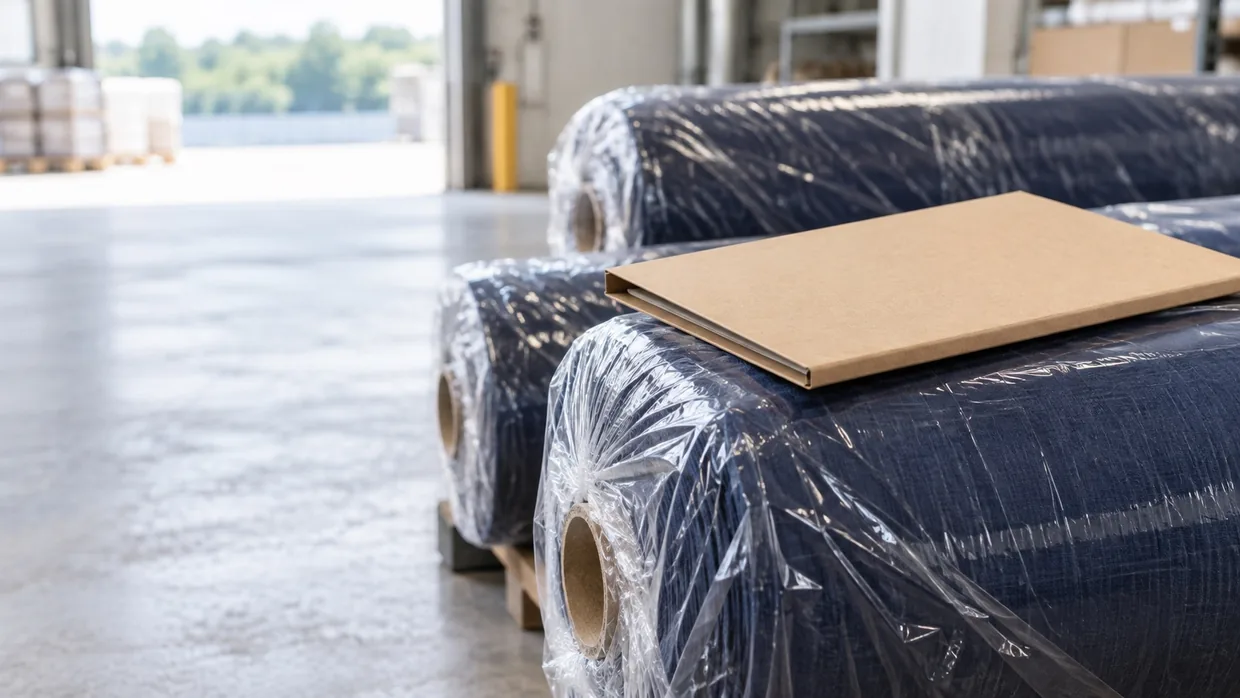
Freight for fabric is priced on space, not weight, so settle early how much room your order takes. Fabric ships as wrapped rolls, either loose-loaded or on pallets. The number that matters is cubic metres, usually written as CBM. Your mill can give you the roll dimensions and the roll count for a given quantity. That is enough to work out the volume before anything is booked. Origin rules are changing too: read how India is rewriting what makes fabric Indian.
Nominal internal capacity is roughly 33 CBM for a 20 foot container, about 67 CBM for a 40 foot, and about 76 CBM for a 40 foot high cube. Treat those as upper limits, not what you will actually achieve. Round rolls do not stack into a rectangular box without wasted space. Palletising costs you more volume in exchange for easier handling at the far end. A load also has to be secured, not just fitted. Planning on eighty to eighty five percent of the nominal figure is realistic.
Below roughly half a container, consolidated part load shipping (LCL) is normally the sensible route: you pay for the volume you use and share the box. Above that, the numbers usually turn. A full container (FCL) is a single fixed price whether it is three quarters full or completely full. It also avoids the extra handling that part loads go through at both ends. The crossover point moves with the shipping route and the season, so ask your freight forwarder to quote both for your actual CBM.
Here is one practical point for a first order. If your quantity is just under a container, ask what extra volume would fill it. The extra cloth may cost less to bring in now than the same cloth shipped separately later, and it can come from the same dye lot. That is a conversation to have while the order is being confirmed, not after the rolls are wrapped.
FAQ
Frequently asked questions
- What should my first enquiry to an Indian fabric mill include?
- Destination country, target quantity, the application or garment type, any known specification (GSM, composition, width), and your timeline. A specific enquiry gets a faster, more useful response than a general request for a catalogue.
- Are export MOQ, payment terms and incoterms standard across Indian mills?
- No. They vary by mill, by destination and by order size, so it's best to ask directly for your specific enquiry and get terms confirmed in writing rather than assuming a standard applies.
- Can I get a sample before placing an export order?
- Most mills can send swatches or a sample cutting so you can verify the fabric before committing to volume. Ask for this as part of your initial enquiry.
- Does a small courier sample from India need the same exporter registration as a bulk order?
- Not since 15 September 2026. DGFT Notification 36/2026-27 of that date added a new sub-paragraph to paragraph 2.57 of the Foreign Trade Policy 2023, with immediate effect. A Registration-cum-Membership Certificate or Certificate of Registration is no longer required for an export consignment whose free on board value stays under the de minimis threshold (a small-value limit) set in that notification. The stated aim is small-value exports, especially by post and courier. Above that threshold the certificate is still required wherever the policy otherwise asks for it, so nothing changes for a bulk fabric order. For you, it means a smaller Indian supplier who has not taken registration can still send you a sample cutting by courier.
- Does Benny Cotts export uniform fabric?
- We welcome export enquiries and are open to serving overseas buyers, with MOQ and terms agreed per order to fit your destination and quantity. Share your destination, quantity and specification and we'll confirm feasibility and terms for your order.
- Will I get an inspection report before my order ships?
- Ask for one. Many mills can provide an inspection report or photos before the shipment leaves. It is worth requesting this on a first order with a new supplier, before you have built trust through repeat business.
- Does lead time differ between a ready-stock shade and a custom order?
- Yes. A running shade taken from ready stock ships faster because it goes straight to packing. A custom shade or construction takes much longer, since it needs its own dye lot and loom setup before weaving can even begin.
- How much fabric fits in a container?
- Work it in cubic metres, not metres of cloth. Nominal internal capacity is roughly 33 CBM for a 20 foot container, about 67 CBM for a 40 foot and about 76 CBM for a 40 foot high cube, and a realistic load is around eighty to eighty five percent of that once rolls, pallets and securing are accounted for. Ask the mill for roll dimensions and roll count for your quantity, then have a forwarder quote both part load and full container against that volume.
- What are demurrage and detention on a fabric import, and who charges them?
- Both are time-based charges for keeping a container longer than the free days allowed, and neither is part of your fabric price or your incoterm. Internationally they split by where the box is. Demurrage applies while the full container sits inside the terminal. Detention applies once it is out and with you, until the empty is returned. Indian port and container freight station tariffs use the words differently. They call the custodian's cargo storage charge demurrage and bill separate ground rent on the laden container, with the shipping line's detention on top. Read each charge by what it measures, not by its name.
- Why can a container start costing money before I have the documents?
- Because the free days run from arrival, not from the day your paperwork lands. The line releases a container against a delivery order. It issues that only once the bill of lading has been surrendered, as the original set or as a telex release. Under a letter of credit the originals travel through two banks. A document discrepancy or a courier delay then stops the delivery order while the clock is already running. Agree the release method at order stage, ask for scans as soon as documents are issued, and appoint your customs broker before the estimated arrival.
- Should I ship LCL or FCL?
- Below roughly half a container, consolidated part load shipping usually wins because you pay only for the space you use. Above that, a full container often costs less in total and avoids extra handling at both ends. The crossover moves with the shipping route and the season, so get both quoted for your actual CBM. If your quantity lands just under a container, ask what extra volume would fill it, since that cloth can come from the same dye lot.
- What is the FR001 or FR009 code on an Indian fabric shipping bill?
- From 1 November 2026, under CBIC Circular 42/2026-Customs, Indian exporters must declare listed woven and knitted fabric lines in Chapters 52, 55 and 60, including poly-viscose under heading 5515, as either flame retardant fabric (FR001) or other than flame retardant fabric (FR009). It is an identifier for India's textiles incentive scheme, not a duty, and it changes nothing at your own customs. Check that it matches what you ordered: certified flame retardant cloth should be declared FR001.
- Who issues the certificate of origin for fabric shipped from India?
- Not the mill. In India it is issued by a designated issuing agency, usually a chamber of commerce or an export promotion council authorised for the purpose. The exporter applies to that agency through the Directorate General of Foreign Trade's electronic certificate of origin system. The mill's own part is a manufacturer declaration supporting the application. Ask which agency your supplier applies to before the order, because the agency and the trade agreement together decide what the certificate can state.
- What is the difference between a preferential and a non-preferential certificate of origin?
- A preferential certificate is issued under a trade agreement. Your customs needs it before it will apply a concessional duty rate. A non-preferential certificate simply certifies the country of manufacture for clearance and compliance, and carries no duty benefit. They are separate documents, so tell the mill which one your entry is being made on. Some agreements, including the India-UK agreement, accept an origin declaration completed by the exporter instead of an agency certificate. That is a third route.
- Can I ask for a certificate of origin after my shipment has arrived?
- Assume not. The exporter applies for the certificate before despatch, against that consignment's documents. So a preference you decide to claim after the container has landed usually cannot be rescued with a certificate produced later. Settle at order stage which document your entry needs. Check that the tariff heading, description and quantity read the same on the invoice, the packing list and the certificate, because a set that does not agree with itself is refused on its face.
Cite this guide
Quoting this page? Paste the line below so the credit links back.
<a href="https://www.bennycotts.com/guides/how-to-import-uniform-fabric-from-india">How to Import Uniform Fabric from India: A Buyer's Guide</a>, Benny Cotts, 2026Next in The trade
Certificates of Conformity: The Destination-Market Paperwork That Can Stop Fabric at Your Border
More in The trade
- The Textile Value Chain: Who Does What, From Fiber to Uniform
- Uniform Fabric Pricing Explained
- Who Pays When Duty, Freight or Fiber Costs Move During a Fabric Contract
- Understanding Fabric Quotations
- Uniform Fabric MOQ in India, Explained
- Uniform Fabric Sampling Guide
- Custom Production vs Ready Stock Fabric
- Payment Terms for Bulk Fabric Orders: Advance, LC, Collections and Open Account
- Uniform Fabric Lead Times in India
- How Woven Fabric Is Packed and Shipped: Rolls, Bales, Labels and Paperwork
- When Bulk Fabric Arrives Wrong: Claims, Remedies and Tolerances
- HSN Codes and GST Basics for Uniform Fabric Buyers
- Incoterms Explained for Uniform Fabric Buyers Sourcing from India
- How to Import Uniform Fabric from India: A Buyer's Guide
- Certificates of Conformity: The Destination-Market Paperwork That Can Stop Fabric at Your Border
- EU Textile EPR, Explained for Indian Fabric and Garment Exporters
- The Digital Product Passport for Textiles: The Data Your Fabric Supplier Will Need to Give You
- Uniform Fabric for Government Tenders: A Supplier's Guide
- Tender Documentation for Uniform Fabric: What a Mill Must Actually Produce
- Selling Fabric: How a New Trader Finds Buyers for Uniform, Suiting and Shirting Cloth
Updated 1 October 2026 · Benny Cotts, Bhilwara
Fabrics
Fabrics mentioned in this guide
Spec, price and MOQ on every fabric page.

Officer Choice
Poly-Viscose (PV) blend · 210-230 GSM
Crisp, structured suiting engineered for officer uniforms.

Power Gold
Premium Poly-Viscose blend · 230-250 GSM
Our premium-line suiting with a refined hand and superior drape.

Grado 1st
Poly-Viscose blend · 220-240 GSM
Tailoring-grade fabric built for everyday durability.
Industries this applies to
Uniform programs these fabrics are used for
- Fabric for Business Attire
- Fabric for Corporate Uniforms
- Fabric for Corporate Trousers
- Fabric for Blazers & Waistcoats
- Fabric for School Uniforms
- Fabric for College & University Uniforms
- Fabric for Doctor Coats
- Fabric for Lab Coats
- Fabric for Hospital Staff Uniforms
- Fabric for Cabin Crew Uniforms
- Fabric for Ground Staff Uniforms
- Fabric for Army Uniforms
- Fabric for Police Uniforms
- Fabric for Security Guard Uniforms
- Fabric for Industrial Uniforms
- Fabric for Construction Workwear
- Fabric for Business Suits
- Fabric for Black-Tie Attire
- Fabric for Formal Event Wear
Fabric types covered here
Keep reading
Related guides





Ready to place an enquiry?