Textile Decoded
The Four-Point Inspection System: How Fabric Rolls Are Scored
A beginner's lesson on the four-point system used to grade woven fabric: how points are given by defect length, the four-point cap per yard, the points per 100 square yards formula, and how a roll passes or fails.
Jump to section
Quick answer
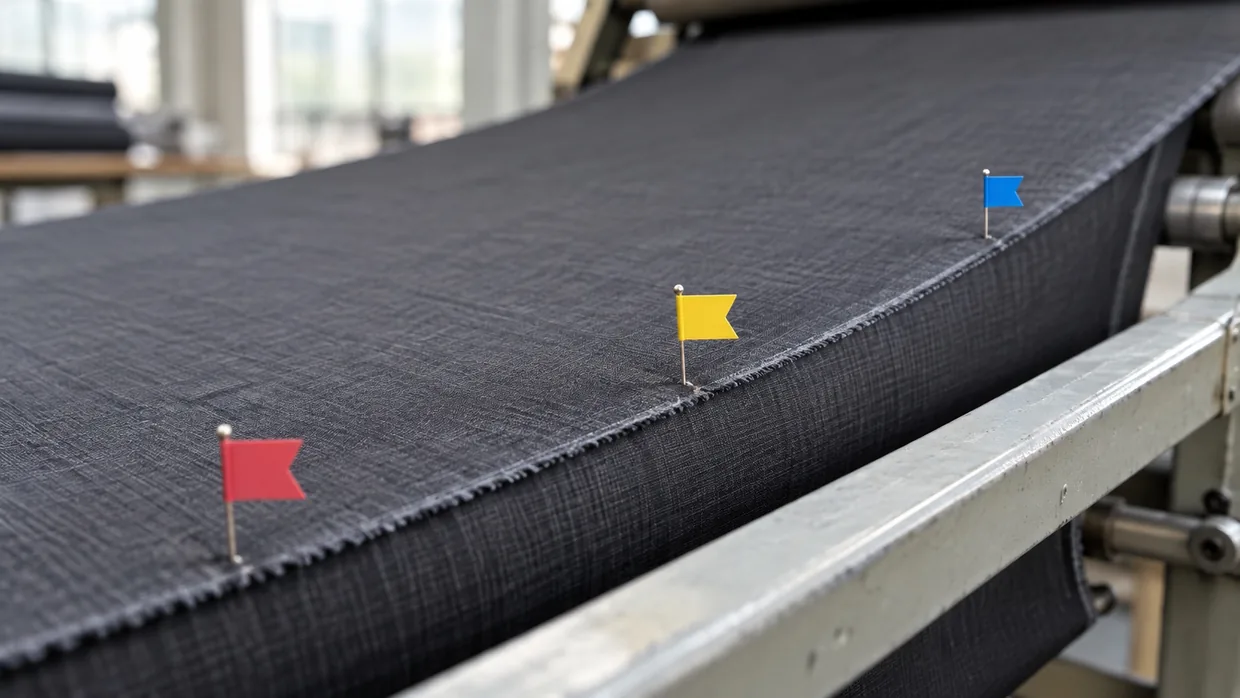
The four-point system is the common way to grade woven fabric. An inspector runs the roll over a lit frame and gives each visible fault points by its length: up to 3 inches is 1 point, over 3 up to 6 inches is 2, over 6 up to 9 inches is 3, and over 9 inches is 4. Holes and openings score by size, with anything over 1 inch counting 4. No single running yard can collect more than 4 points. The points are then turned into a score per 100 square yards, so wide and narrow cloth can be compared fairly. The roll passes if that score is at or below the limit the buyer and supplier agreed. Many buyers use 40 points per 100 square yards, but the number is a contract term, not a law.
Why fabric needs a scoring system
No woven cloth is perfect. Looms run fast, yarn has natural thick and thin places, and dyeing and finishing add their own small marks. So a few faults in a long roll are normal. The real question is whether a roll has too many faults, or faults that are too big, for the order.
A scoring system turns that judgement into a number that both sides can check. Instead of one person saying the cloth looks fine and another saying it does not, the inspector counts and measures each fault the same way every time. The four-point system is the most widely used method for woven fabric, and it is described in the ASTM D5430 standard for visual inspection of fabric.
This lesson explains how the scoring works. For the wider receiving checklist, from paperwork to width and shade, see how to inspect uniform fabric on delivery.
What counts as a defect
A defect is any fault an inspector can see from the normal viewing distance on the inspection frame, usually about a metre away, that would show in the finished garment. Inspectors do not hunt with a magnifier. If it cannot be seen at that distance under good light, it is not scored.
Typical scored faults include broken or missing threads, thick places and slubs in the yarn, stop marks where the loom restarted, oil stains, holes, uneven dyeing and spots. Where each of these starts, at the yarn, the loom or the process house, is covered in woven fabric defects and where each one comes from.
Some problems are not scored by points at all because they affect the whole roll rather than one spot: wrong width, wrong weight, a shade that does not match the approved standard, or bowed and skewed weft on checks. Those are measured separately and can fail a roll on their own, whatever its point score.
How points are given
Each fault is measured in its longest direction, whether it runs along the length of the cloth (the warp) or across it (the weft), and given points by size.
| Size of the fault | Points |
|---|---|
| Up to 3 inches | 1 |
| Over 3 inches, up to 6 inches | 2 |
| Over 6 inches, up to 9 inches | 3 |
| Over 9 inches | 4 |
| Hole or opening, 1 inch or less | 2 |
| Hole or opening, over 1 inch | 4 |
Holes are scored more strictly than other faults of the same size because a garment cannot hide them. Many buyers also treat any hole, however small, as a serious fault.
The four-point cap per yard
The system gets its name from one rule: no single linear yard (one yard of the roll's length, across its full width) can score more than 4 points. If a yard holds a 4-point fault and a 1-point fault, it still scores 4.
The cap stops one badly damaged stretch from spoiling the whole result. A long fault that runs down the cloth for several yards is scored yard by yard, up to 4 points in each yard it touches. Buyers who want to limit those stretches often add a separate rule, such as a maximum number of 4-point yards per roll.
From points to a score per 100 square yards
A roll's raw point total is not enough on its own, because a long wide roll will naturally collect more points than a short narrow one. So the total is converted to points per 100 square yards of cloth, which puts every roll on the same footing.
The usual formula is: points per 100 square yards = total points x 3,600 / (yards inspected x cuttable width in inches). The 3,600 comes from 100 square yards being 3,600 inches across times one yard long (100 x 36). Cuttable width means the usable width inside the selvedges, the firm woven edges.
A worked example: a roll of 100 yards at 58 inches cuttable width scores 50 points in total. That is 50 x 3,600 / (100 x 58) = 31.0 points per 100 square yards. If the agreed limit is 40, the roll passes. The same 50 points on a roll only 60 yards long would score 51.7 and fail. Converting metres and yards correctly matters here, because the formula is written in yards and inches.
How a roll passes or fails
A roll passes when its score per 100 square yards is at or below the agreed limit. A common limit for woven apparel cloth is 40 points per 100 square yards for each roll, sometimes with a lower average across the whole lot, but there is no single fixed number. Fine suiting may be held tighter than workwear, and the figure should be written into the order before production, not argued about on delivery.
- Score each roll on its own. One poor roll does not fail a whole lot, and one clean roll does not rescue a poor one.
- Check the non-point items too: width, weight, shade and squareness can fail a roll that scored well.
- Agree how many rolls will be inspected, often a share of the lot, and what happens if the sample fails.
- Agree in advance how failed rolls are handled, such as replacement, re-processing or an allowance; fabric delivery claims and remedies explains the usual routes.
Where the four-point system fits in quality checks
Point scoring covers what the eye can see on the surface. It does not tell you how the cloth will shrink, fade or pill. Those are lab tests, covered in how we test our fabric, and both kinds of check belong in a sensible specification.
At Benny Cotts we weave in-house at Village Atoon in Bhilwara, and dyeing, finishing and testing happen at partnered Bhilwara process houses. Knowing which stage a fault came from is what makes a point score useful: it tells both sides not just how many faults there are, but who can stop them happening again.
FAQ
Frequently asked questions
- Why is it called the four-point system?
- Because the largest fault scores 4 points, and no single linear yard of fabric can score more than 4 points in total, however many faults it holds.
- Is 40 points per 100 square yards a fixed standard?
- No. It is a widely used acceptance limit, but the pass mark is agreed between buyer and supplier and should be written into the order. Some buyers set it tighter for fine cloth.
- Can a roll with a low point score still be rejected?
- Yes. Width, weight, shade against the approved standard and bowed or skewed weft are checked separately, and any one of them can fail a roll that scored well on points.
- Why does the formula use cuttable width?
- Because the selvedges are not used in the garment. Scoring only the usable width gives a fair figure for the cloth a cutting room will actually get. To see our fabrics, Request Catalog at /quote.
Cite this guide
Quoting this page? Paste the line below so the credit links back.
<a href="https://www.bennycotts.com/guides/four-point-inspection-system">The Four-Point Inspection System: How Fabric Rolls Are Scored</a>, Benny Cotts, 2026Next in Testing and quality
How to Inspect Uniform Fabric on Delivery
More in Testing and quality
- How We Test Our Fabric
- Key Fabric Tests Explained: GSM, Strength, Colour Fastness, Shrinkage, Pilling and More
- The Four-Point Inspection System: How Fabric Rolls Are Scored
- How to Inspect Uniform Fabric on Delivery
- OEKO-TEX in 2026: What the Updated Rules Mean When You Buy Certified Fabric
- ISI Marks, QCOs and Indian Standards for Uniform Fabric
- Sustainability Certifications for Uniform Fabric, Explained
Updated 18 October 2026 · Benny Cotts, Bhilwara
Fabrics
Fabrics mentioned in this guide
Spec, price and MOQ on every fabric page.

Officer Choice
Poly-Viscose (PV) blend · 210-230 GSM
Crisp, structured suiting engineered for officer uniforms.

Power Gold
Premium Poly-Viscose blend · 230-250 GSM
Our premium-line suiting with a refined hand and superior drape.

Spun Shirting
Micro 1/40s spun polyester · 67 GSM
Lightweight micro shirting, spun 1/40s count, in 74 shades.
Industries this applies to
Uniform programs these fabrics are used for
- Fabric for Business Attire
- Fabric for Corporate Shirts
- Fabric for Corporate Trousers
- Fabric for Blazers & Waistcoats
- Fabric for Cabin Crew Uniforms
- Fabric for Ground Staff Uniforms
- Fabric for Army Uniforms
- Fabric for Police Uniforms
- Fabric for Security Guard Uniforms
- Fabric for Industrial Uniforms
- Fabric for Construction Workwear
- Fabric for Business Suits
- Fabric for Black-Tie Attire
- Fabric for Formal Event Wear
Fabric types covered here
Keep reading
Related guides




Ready to place an enquiry?