
Corporate buyer
A Consignment Held at Incoming Inspection, and How the Three Causes Were Separated
A corporate buyer held a suiting consignment at incoming inspection on a mixed list of faults. Sorting weaving from shade from handling decided what was actually owed, and to whom.
Scale
one held consignment, multi-roll program
The challenge
A buyer's incoming inspection held a suiting consignment and raised a single rejection covering everything the inspector had seen: streaks in some rolls, a shade the stitching unit called off against the approved swatch, and soiled, crushed patches on the outer wraps of a few rolls. Raised as one rejection, it read as a failed lot and the buyer's first ask was to replace all of it. That framing was the real problem. The three complaints have three different causes, three different remedies and three different people responsible, and arguing about the lot as a whole meant none of them could be settled. A rejection that is not separated tends to end in either a full replacement nobody can justify or a discount nobody is happy with.
Our approach
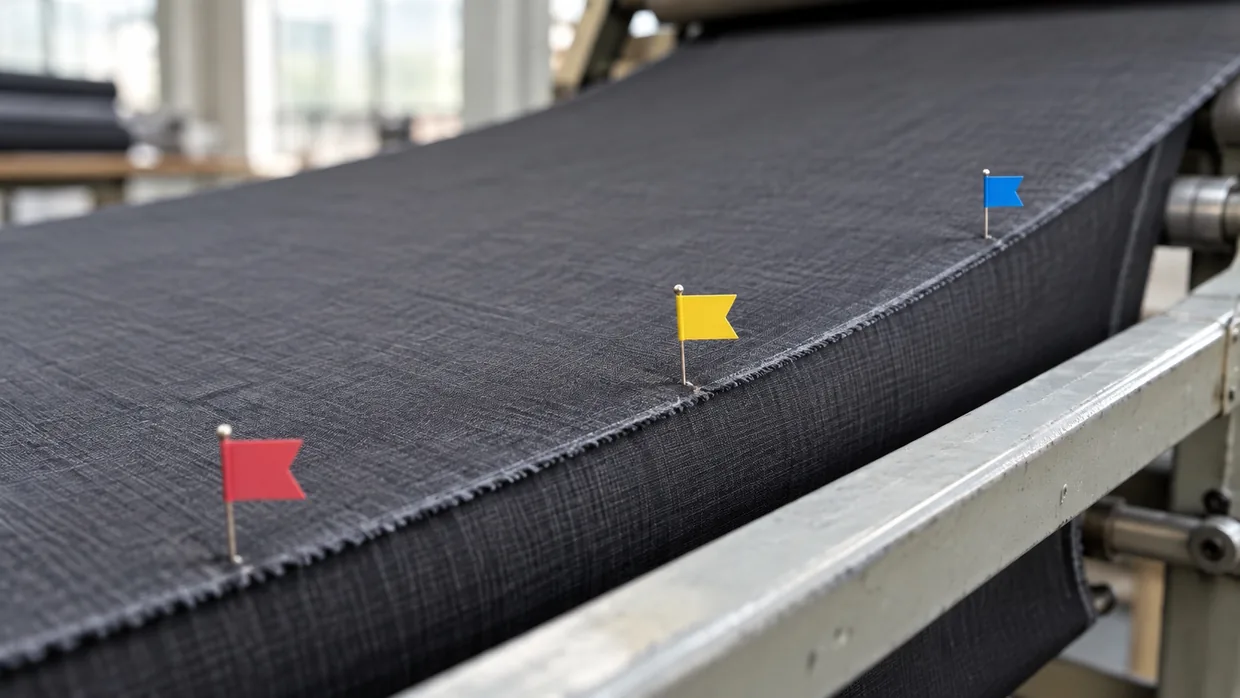
- The first step was to stop treating it as one issue and get the faults located. We asked for the rejection to be restated roll by roll, with the fault marked at its position on the roll and photographed under a single consistent light. That alone split the list: the streaks appeared in two rolls out of the consignment and repeated down the length, which is a loom or a beam signature, while the soiling was on outer wraps only and never continued into the body of the roll, which is handling in transit or in the store rather than anything that happened at the mill.
- The shade complaint was settled against the reference, not against opinion. The physical reference swatch held on file for the program was compared with a cutting from each roll under a controlled light source, because a grey or a khaki that agrees under one light can split under another, and a stitching unit comparing a cutting to a garment made from last year's lot is not comparing to the approved standard at all. Two rolls were genuinely off the reference and the rest were within it, which converted a whole-lot shade rejection into a two-roll one.
- For the disputed rolls we agreed a retest rather than a second opinion. Composition, GSM and width were retested at an independent laboratory both sides accepted before the samples were drawn, with sampling witnessed and the cuttings sealed and signed. Our fabric is tested through our partnered processing houses in Bhilwara rather than in a laboratory we own, so an independent retest is the normal route here, not a concession, and having the laboratory named before the result exists is what stops the result being argued about afterwards.
- Then the remedies were separated to match. The two rolls with a weaving fault were replaced. The two off-shade rolls were re-dyed against the locked recipe rather than replaced, because the greige was sound. The handling damage was quantified as an unusable outer allowance on the affected rolls and settled without a claim on construction at all, since nothing about the cloth had failed. The rolls that passed went to the cutting room the same week, which mattered more than any of the rest of it: the programme had a delivery date that a blanket hold would have taken out.
- The last step was writing the procedure down so the next one is shorter. The buyer's inspection now records faults per roll with position and light source, keeps a reference cutting from every delivery, and raises separate lines for construction, shade and handling. We hold the same reference at our end. Neither side has to reconstruct what was approved when a question comes up eight months later.
Outcome
The consignment moved from a whole-lot rejection to four affected rolls with three different remedies, the cutting room started on schedule with the rolls that passed, and the buyer and the mill now raise construction, shade and handling as separate lines rather than as one dispute.
Cite this case study
Quoting this page? Paste the line below so the credit links back.
<a href="https://www.bennycotts.com/case-studies/fabric-rejected-at-inspection-who-fixes-what">A Consignment Held at Incoming Inspection, and How the Three Causes Were Separated</a>, Benny Cotts, 2026Updated 5 September 2026 · Benny Cotts, Bhilwara
Fabrics
Fabrics used in this case
Spec, price and MOQ on every fabric page.

Officer Choice
Poly-Viscose (PV) blend · 210-230 GSM
Crisp, structured suiting engineered for officer uniforms.

Panto
Poly-Viscose blend · 215-235 GSM
Workhorse trouser fabric with consistent dye lots.

Sonata
Poly-Viscose blend · 190-210 GSM
Cost-efficient uniform fabric without compromising weave quality.
Industries this applies to
Uniform programs these fabrics are used for
- Fabric for Corporate Shirts
- Fabric for Corporate Trousers
- Fabric for School Uniforms
- Fabric for Sports & PT Uniforms
- Fabric for Pre-School & Kindergarten Uniforms
- Fabric for Doctor Coats
- Fabric for Nurse Scrubs
- Fabric for Lab Coats
- Fabric for OT & Surgical Wear
- Fabric for Patient Gowns
- Fabric for Chef Coats
- Fabric for Salon & Spa Uniforms
- Fabric for Ground Staff Uniforms
- Fabric for Army Uniforms
- Fabric for Police Uniforms
- Fabric for Security Guard Uniforms
- Fabric for Industrial Uniforms
- Fabric for Construction Workwear
- Fabric for Housekeeping Uniforms
Ready to place an enquiry?