
Buying guide
Wedding-Season Suiting: How Garmenters and Retailers Should Plan Stock
India's winter wedding season concentrates months of formal-wear demand into a few weeks from November onward. How a garmenter or fabric retailer should work backwards from the season: what to stock, when to order custom shades, and how to keep a reorder possible when the rush arrives.
Jump to section
Quick answer
Work backwards from the first week of November. Custom shades and constructions need to be ordered by early September to clear weaving, dyeing and finishing comfortably; ready-stock top-ups can run into October. Stock the safe core first, blacks, deep blues and charcoals in reliable formal constructions, take depth in few shades rather than breadth in many, and lock the dye lot on anything you expect to reorder mid-season.
The shape of the season
India's winter wedding season is short and steep. Trade-body counts put the late-2025 window, roughly 1 November to mid-December, at around 46 lakh weddings nationally, with clothing and apparel consistently estimated among the largest single heads of wedding spending. The same trade reporting noted a strong tilt toward Indian-made goods in wedding purchases.
For a garmenter or fabric retailer the exact totals matter less than the shape: demand that builds through October, peaks across November and early December, pauses, then returns for the spring dates. Fabric that is not on the shelf when the tailoring rush starts is fabric that misses the season entirely, because a wedding date does not move to accommodate a weaving schedule.
Work backwards from the first fitting
A groom's suit is typically cut four to eight weeks before the wedding, and the retailer sold that fabric before the cutting date. So a November wedding is an October fabric sale, and an October fabric sale is stock that arrived in September. That is the whole calendar in one sentence.
Custom work needs the most runway. A custom shade or construction woven to order has to clear weaving, dyeing, processing and transit, so orders placed by early September are comfortable and orders placed in October are a gamble. Ready-stock purchases are more forgiving, running shades can ship on much shorter cycles, but even ready stock runs out precisely when everyone wants it, which is the one time the mill can least prioritise a rush.
- By early September: place custom-shade and custom-construction orders for the season.
- September: receive and shelf-check core stock, verify shades against retained swatches.
- Early October: top up ready-stock shades based on early movement.
- November to mid-December: sell; place any mid-season reorder against the locked dye lot, not by eye.
- January: review what sold and what sat, and let that set next season's depth.
What to stock: depth beats breadth
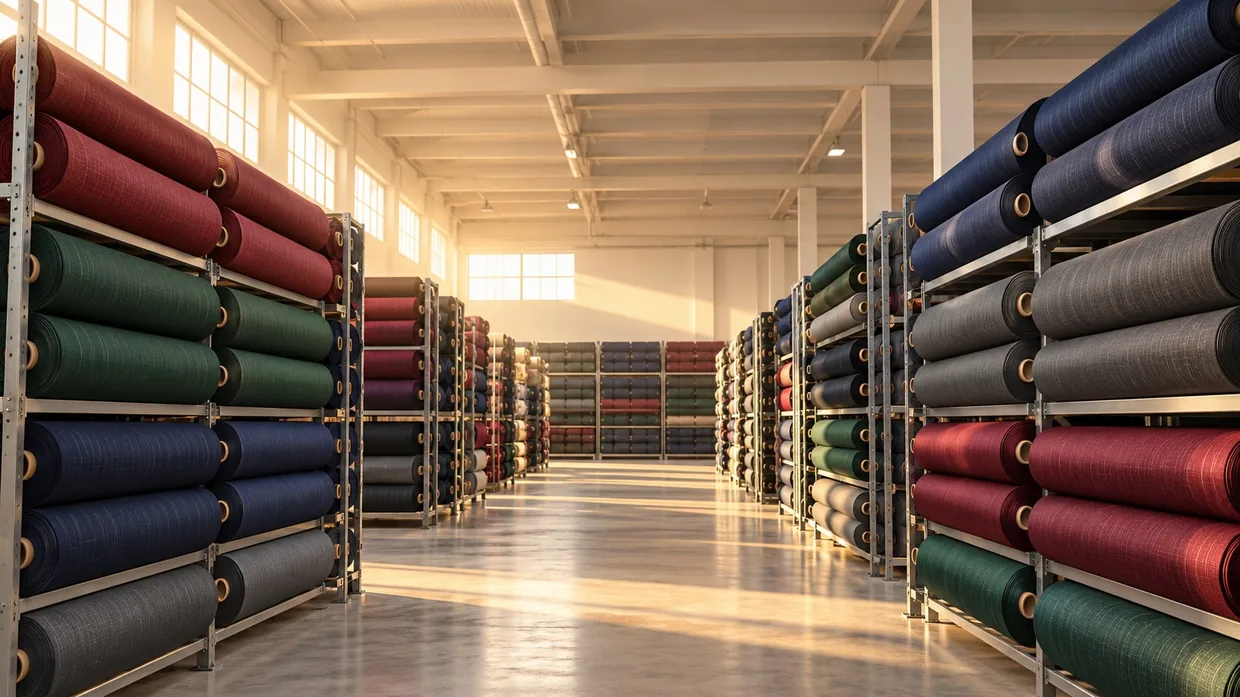
Wedding formal wear is conservative at its core. Blacks that stay black, deep navy and midnight blues, and charcoal carry the bulk of groom-side and guest-side suiting, with texture and sheen doing the differentiation that colour used to do. A retailer serving that demand is better off deep in six shades than shallow in twenty, because the cost of a stock-out in black in late November is a lost suit sale, while the cost of an unsold fancy shade is a year of shelf space.
Fancy and occasion-specific shades still earn a place, but as a managed edge, bought shallow, accepted as seasonal, and not reordered on hope. The core, meanwhile, should be in constructions that tailor well and press crisply, and on which a mid-season reorder is actually possible because the shade is a running one.
The mid-season reorder is won in September
The difference between a retailer who can restock black suiting in the last week of November and one who cannot is rarely the mill's speed in November. It is whether the first order was placed against a locked dye lot with a reference swatch held on file, in a running shade the mill keeps greige for, with the reorder possibility discussed at the time of the first order.
A reorder matched by eye against a half-sold roll will sit visibly next to the original on the same shelf, and wedding buyers comparing suit lengths notice. A reorder against a retained reference swatch and a locked recipe is a phone call. This is the same discipline uniform programs use for mid-session top-ups, applied to a season instead of a school year, and our guide to dye lot consistency covers the mechanics.
How we fit into a season
Our formal and premium suiting ranges are woven in-house at Village Atoon, with dyeing and finishing through partnered Bhilwara processing houses. Ready-stock shades start at 50 meters per shade, custom shades at 500 meters, which lets a retailer take depth in the core and still trial an edge shade without committing a season to it. Shade cards and swatches are available on request ahead of the season, and reorders run against retained reference swatches so a November top-up matches a September delivery.
As always there are no prices in this guide. Fabric is quoted per order against construction, shade, quantity and finish.
FAQ
Frequently asked questions
- When should a retailer order suiting fabric for the winter wedding season?
- Custom shades and constructions by early September, so weaving, dyeing and finishing clear comfortably before the November rush. Ready-stock top-ups can run into October. Fabric that has not arrived by mid-October is at real risk of missing the peak, since suits for November weddings are cut and sold weeks in advance.
- Which shades should be stocked deepest?
- The conservative core: black, deep navy and midnight blue, and charcoal, in constructions that tailor and press well. These carry the bulk of wedding suiting demand every season. Fancy shades deserve shelf presence but shallow depth, treated as seasonal rather than reorderable.
- How does a retailer make a mid-season reorder match the original stock?
- Set it up at the first order: buy a running shade, have the mill lock the dye lot and retain a reference swatch on file, and reorder against that reference rather than matching by eye. A reorder matched visually against a part-sold roll will usually sit a shade apart from the original on the same shelf.
- Is it better to buy wedding-season suiting from ready stock or custom?
- The core should lean on running shades and ready stock, because those are the only ones that can be topped up mid-season at short notice. Custom shades make sense for a differentiated edge or a house-exclusive shade, ordered early against the higher minimum, with no expectation of a quick November repeat.
- How much buffer stock should a garmenter carry for the season?
- Enough that the peak weeks cannot be broken by one delayed delivery, commonly an extra ten to twenty percent on the core shades bought with the main order so it stays in the same dye lot. Buffer bought later is a different lot by definition, which is exactly what the buffer was meant to avoid.
Cite this guide
Quoting this page? Paste the line below so the credit links back.
<a href="https://www.bennycotts.com/guides/wedding-season-suiting-stock-planning">Wedding-Season Suiting: How Garmenters and Retailers Should Plan Stock</a>, Benny Cotts, 2026Updated 27 August 2026 · Benny Cotts, Bhilwara
Fabrics
Fabrics mentioned in this guide
Spec, price and MOQ on every fabric page.

Serze Italian Premium
Poly-Viscose blend, fiber dyed · 405 g/m
Heavy fiber-dyed serge suiting, 405 g per metre at 58 inch.

Power Gold
Premium Poly-Viscose blend · 230-250 GSM
Our premium-line suiting with a refined hand and superior drape.

Officer Choice
Poly-Viscose (PV) blend · 210-230 GSM
Crisp, structured suiting engineered for officer uniforms.

Grado 1st
Poly-Viscose blend · 220-240 GSM
Tailoring-grade fabric built for everyday durability.

Benzer Special
Poly-Viscose blend · 200-220 GSM
Versatile PV blend optimized for uniform programs at scale.
Industries this applies to
Uniform programs these fabrics are used for
- Fabric for Business Attire
- Fabric for Corporate Uniforms
- Fabric for Corporate Trousers
- Fabric for Blazers & Waistcoats
- Fabric for School Uniforms
- Fabric for College & University Uniforms
- Fabric for Sports & PT Uniforms
- Fabric for Pre-School & Kindergarten Uniforms
- Fabric for Doctor Coats
- Fabric for Lab Coats
- Fabric for Hospital Staff Uniforms
- Fabric for Hotel Uniforms
- Fabric for Waiter Uniforms
- Fabric for Cabin Crew Uniforms
- Fabric for Ground Staff Uniforms
- Fabric for Army Uniforms
- Fabric for Police Uniforms
- Fabric for Security Guard Uniforms
- Fabric for Industrial Uniforms
- Fabric for Construction Workwear
- Fabric for Business Suits
- Fabric for Black-Tie Attire
- Fabric for Formal Event Wear
Fabric types covered here
Keep reading
Related guides




Ready to place an enquiry?