
Police force
One Khaki, Two Constructions: Matching Shirt and Trouser Across a Force Rollout
A force procurement office was buying khaki shirting and khaki trouser cloth separately, and the two shades did not read as one uniform in daylight.
Scale
District-wide rollout, shirting and trouser ordered on separate cycles
The challenge
Shirting and trouser cloth were sourced on separate tenders and separate cycles, so each was approved on its own against a written shade name rather than against the other. On parade in daylight the shirt read greener than the trouser, and every reorder cycle reset the problem because neither supplier had the other's cloth to match against.
Our approach
- We treated the two garments as one shade problem rather than two orders. The shirting was fixed first on a stocked khaki from the Commander PV Ultima shade card, so the shirt shade became a physical reference held at the mill instead of a word on a specification.
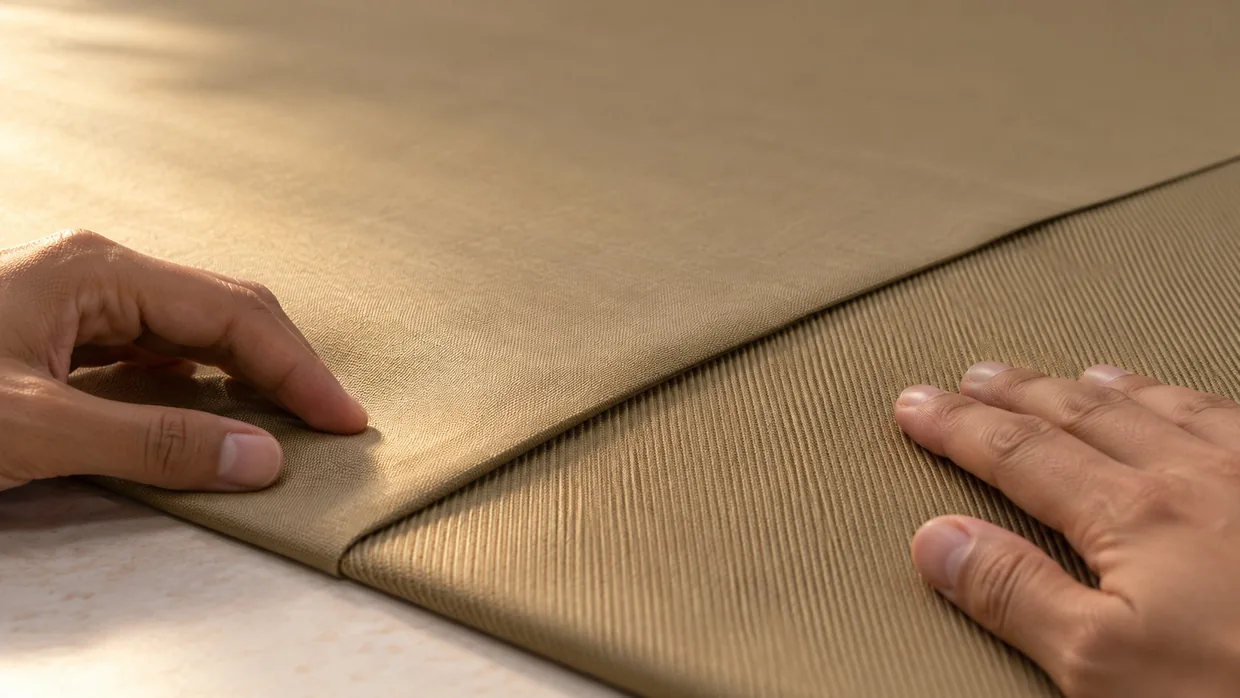
- The trouser cloth was then matched to that shirting swatch as its own custom lot, with lab dips approved side by side under the same light before the bulk lot was run. Because a shirting and a suiting are different constructions, the same recipe does not read the same on both, so the approval was made on the pair and not on either cloth alone.
- Both references were kept on file at the mill, and each subsequent cycle was dyed against them rather than against the last delivery. Where the programme needed a fitted cut for office and traffic roles, the stocked khaki on our stretch quality was matched into the same reference set so a third construction did not restart the exercise.
- The order of approval was deliberate. Shirting goes first because it is the stocked, piece-dyed shade with a fixed card reference, and stocked shades cannot be adjusted to meet a trouser; the trouser lot, dyed to order, can be steered towards the shirting. Reversing that order would have meant chasing a stocked cloth that does not move.
- The daylight check was also built into the routine rather than left to parade day. Khaki is a colour that can split between light sources, reading greener in one light and redder in another, so every side-by-side lab dip was viewed under the same light and confirmed in daylight before the bulk trouser lot was committed. A pair that matches only under the store's tube lights is not yet approved.
- The takeaway for a force procurement office is that a uniform is approved as a set, not garment by garment. When shirting and trouser are bought on separate tenders, name one physical reference in both, approve the second cloth against the first, and hold both references at the mill so the next cycle starts from the same pair rather than from a written shade name.
Outcome
Shirt and trouser now read as one uniform in daylight, and each reorder cycle is approved against the held references instead of against the previous shipment, so the two garments no longer drift apart between tenders.
Cite this case study
Quoting this page? Paste the line below so the credit links back.
<a href="https://www.bennycotts.com/case-studies/police-force-one-khaki-across-shirt-and-trouser">One Khaki, Two Constructions: Matching Shirt and Trouser Across a Force Rollout</a>, Benny Cotts, 2026Updated 5 September 2026 · Benny Cotts, Bhilwara
Fabrics
Fabrics used in this case
Spec, price and MOQ on every fabric page.

Commander PV Ultima Shirting
Poly-Viscose (PV Ultima), 2/40 x 2/40 premium, 2/40 x 1/20 standard
PV Ultima spun shirting in 135 shades, 36" and 58", grey ready year-round.

Officer Choice
Poly-Viscose (PV) blend · 210-230 GSM
Crisp, structured suiting engineered for officer uniforms.

Panto
Poly-Viscose blend · 215-235 GSM
Workhorse trouser fabric with consistent dye lots.

Glacier Soft Lycra
Polyester-Lycra blend · 177 GSM
Piece-dyed stretch suiting with a soft, fluid handle.
Industries this applies to
Uniform programs these fabrics are used for
Ready to place an enquiry?